
 Full Text (PDF)
Abstract
This study describes cross-sectional grade-level patterns in electricity questionnaire performance among 304 students in grades 7-11, recruited through convenience sampling in the Ioannina region of Greece. A 16-item multiple-choice questionnaire was administered before new electricity instruction in the current school year. Items addressed current consumption, voltage-current distinction, safety and short circuits, charge origin, and energy in circuits. Overall performance differed across grade groups, F(4, 299) = 4.32, p = .002, η² = .055. Grade 10 had the highest mean score and scored significantly higher than grades 7 and 8 after Bonferroni adjustment; its difference from grade 11 was not significant. Individual-item accuracy varied substantially, including within the proposed conceptual categories. Category composites showed low internal consistency (Cronbach’s alpha = .054-.425), so their comparisons were treated as secondary and exploratory. No within-grade gender comparison remained significant after correction for multiple testing. Response accuracy alone does not establish the prevalence of specific misconceptions, and cross-sectional differences cannot demonstrate conceptual persistence, retention, or instructional effects. Regional nonrandom sampling and unaccounted school and class clustering further limit interpretation. The findings identify questions for further diagnostic investigation and support subsequent research using stronger measurement, students’ explanations, and longitudinal or intervention designs.
License
This is an open access article distributed under the Creative Commons Attribution License which permits unrestricted use, distribution, and reproduction in any medium, provided the original work is properly cited.
Article Type: Research Article
INTERDISCIP J ENV SCI ED, Volume 23, Issue 1, 2027, Article No: e2701
https://doi.org/10.29333/ijese/19999
Publication date: 23 Nov 2026
Article Views: 5
Article Downloads: 3
Open Access HTML Content Download XML References How to cite this articleHTML Content
INTRODUCTION
Scientific literacy includes the capacity to apply scientific knowledge when interpreting phenomena and making informed decisions (Millar & Osborne, 1998; OECD, 2018). In physics, however, successful procedural problem solving does not necessarily demonstrate conceptual understanding (Halloun & Hestenes, 1985; Mazur, 1997). Electricity presents particular challenges because explaining observable circuit behavior requires distinguishing quantities such as current and potential difference and connecting macroscopic observations with models of charge movement and energy transfer (Carlton, 1999; McDermott & Shaffer, 1992).
Students interpret these ideas through prior knowledge and everyday experience, which may support alternative explanations of circuit behavior (Driver & Easley, 1978; Kotsis, 2023a; Vosniadou et al., 2001). Conceptual-change research consequently emphasizes examining learners’ reasoning rather than assuming that instruction replaces their initial ideas uniformly (Duit & Treagust, 2003; Vosniadou, 2019). Research on early electricity learning also provides examples of structured exploratory activities that engage children with these concepts (Gavrilas et al., 2025). This background motivates assessment of students’ responses at different educational stages, while recognizing that cross-sectional comparisons describe group differences rather than individual conceptual change.
Electricity is one of the most extensively researched domains for alternative conceptions within the physics education literature. A substantial body of work spanning several decades has documented a range of persistent misconceptions that students hold about electric circuits. Among the most prevalent are the belief that electric current is consumed as it passes through circuit components, the conflation of voltage and current as a single undifferentiated concept, the assumption that current flows from both terminals of a battery and collides in the load, and various forms of sequential reasoning in which changes to one part of a circuit are assumed not to affect other parts (Bilal & Erol, 2009; Osborne, 1983; Shipstone, 1984; Turgut et al., 2011). Recent systematic review evidence confirms that these misconceptions remain central in the international literature on electricity and electric circuits, especially misconceptions concerning current flow, voltage, resistance, circuit topology, and the role of batteries in circuits (Olaogun et al., 2023). Difficulties with electric circuits have been documented across educational contexts, and research has also examined alternative conceptions among science teachers, indicating that these difficulties are not confined to school students (Aligo et al., 2021; Shipstone et al., 1988). Furthermore, recent studies continue to confirm the prevalence of these difficulties, with investigations in diverse national settings reporting that the majority of secondary school students confuse current with voltage and hold consumption-based models of current flow even after formal instruction (Adeduyigbe et al., 2025; Saputro et al., 2018). In the Greek context, related evidence from 11th-grade high school students’ understanding of key electromagnetism concepts also indicates that conceptual difficulties remain present at the upper secondary level, reinforcing the need to examine how such ideas persist across grades (Kaliampos et al., 2021).
Previous cross-grade research has examined students’ mental models of electric circuits, providing an important precedent for comparing conceptual performance across educational stages (Lin, 2017; Panagou et al., 2022). The contribution of the present study therefore lies in extending cross-grade diagnostic evidence within a specific educational context rather than introducing cross-grade comparison as a new approach. It examines responses to a common 16-item questionnaire across five consecutive grades of Greek secondary education, encompassing the transition from Gymnasium to Lyceum. The items address current consumption, voltage-current distinction, safety and short circuits, charge origin, and energy in circuits; these categories provide an organizational framework for examining item-level findings rather than established measures of separate constructs. Administration before new electricity instruction permits comparison of groups at different curricular stages, although differences in instructional history remain inseparable from cohort and contextual differences. The study consequently offers a regional description of overall and item-specific grade-level patterns that can inform diagnostic assessment and generate hypotheses for subsequent longitudinal and intervention research.
The present study addresses this gap by examining cross-sectional grade-level patterns in students’ alternative conceptions about electricity across five consecutive grade levels in Greek secondary education: the three years of Gymnasium (grades 7, 8, and 9, roughly corresponding to ages 12-15) and the first two years of Lyceum (grade 10 and grade 11, corresponding to ages 15-17). The Greek educational context offers a particularly informative setting for this investigation, because the electricity curriculum follows a spiral structure in which the topic is first introduced in primary school (grade 5 and grade 6), then formally revisited in the third year of Gymnasium (grade 9) and subsequently taught at a higher level of mathematical formalism in the second year of Lyceum (grade 11). The importance of early engagement with electricity concepts is also supported by Greek primary education research showing that technology-supported activities, such as Makey-Makey, can be used to introduce electricity to younger learners through active and exploratory learning experiences (Fokides & Papoutsi, 2020). This curricular arrangement creates natural contrasts between students who have recently received systematic instruction in electricity and those whose last formal exposure to the topic occurred several years earlier. These contrasts make it possible to explore how grade-level patterns may be associated with the recency of formal instruction, while recognizing that instructional effects cannot be fully separated from maturation, everyday experience, cohort differences, and other contextual influences in a cross-sectional design.
A common 16-item multiple-choice questionnaire was administered to 304 students in October, before new electricity instruction in their current grade. Its questions addressed current consumption, voltage-current distinction, safety and short circuits, charge origin, and energy in circuits. These categories provisionally organize the item content rather than constitute validated scales. The analysis compares overall and individual-item response accuracy across grades, with category averages and gender comparisons treated as secondary and exploratory. Differences between groups may reflect instructional history, cohort composition, prior achievement, and school or classroom context. The study does not establish instructional effects, individual conceptual change, or a grade × gender interaction.
The study is guided by two research questions. First, how does overall performance on a 16-item electricity questionnaire differ across five consecutive grade levels of Greek secondary education? Second, what cross-sectional grade-level patterns are observed in responses to individual items designed to target documented alternative conceptions about electricity? Item-level findings provide the primary diagnostic evidence, while the five proposed conceptual categories serve as provisional organizational groupings rather than validated scales. Comparisons of composite category scores are therefore treated as secondary and exploratory, particularly given their low internal consistency. The observed patterns describe differences between grade groups in the present sample; they do not establish individual conceptual change, persistence, retention, or responsiveness to instruction. Likewise, the absence of a statistically significant grade difference does not demonstrate equivalent performance or conceptual stability. By addressing these questions, the study aims to identify areas of difficulty that may inform diagnostic assessment and the design of subsequent instructional investigations.
THEORETICAL FRAMEWORK
Constructivist perspectives emphasize that learners interpret scientific explanations through existing knowledge and experience (Driver & Easley, 1978; Driver et al., 1985). Alternative conceptions can therefore influence how students understand electricity instruction and respond to assessment questions. These perspectives motivate investigating students’ reasoning, but do not imply that every incorrect response reflects a coherent or enduring conceptual framework.
The classical conceptual-change model identifies dissatisfaction with an existing conception and the intelligibility, plausibility, and fruitfulness of an alternative explanation as conditions supporting conceptual change (Posner et al., 1982; Strike & Posner, 1992). Subsequent perspectives emphasize the complexity and context dependence of learning, including the possibility that scientific explanations coexist with earlier ideas (Duit & Treagust, 2003; Vosniadou, 1994, 2019). Research also examines how learners respond to conflicting evidence and whether changes in reasoning are maintained across contexts and time (Chinn & Brewer, 1993; Hewson & Hennessey, 1992; Li et al., 2023).
In electricity education, these approaches provide a rationale for examining questions about current, potential difference, charge, and energy rather than relying exclusively on a total achievement score. However, the present study records multiple-choice response accuracy across different grade groups; it does not directly assess the proposed mechanisms of conceptual change. The theoretical framework therefore informs item selection and questions for further investigation, while interpretations of persistence, restructuring, and retention require additional evidence.
Within this broader theoretical context, electricity represents one of the most extensively studied domains for alternative conceptions in physics education. The pioneering work of Osborne (1983) and Shipstone (1984) identified five distinct models that students commonly hold regarding the flow of electric current, ranging from the unipolar model, in which the circuit is not understood as a closed loop, through the clashing currents model and the attenuation model, to the scientifically correct model of a constant current determined by the resistance and the electromotive force in a closed circuit. These findings were later reinforced by comparative European research showing that students’ difficulties with electricity were not restricted to one national context but appeared across several educational systems, confirming the broad persistence of alternative conceptions in this domain (Shipstone et al., 1988). Subsequent research by numerous investigators confirmed and extended these findings, documenting a wide range of misconceptions related to current, voltage, resistance, circuit topology, and energy that appear with remarkable consistency across different educational levels, national contexts, and cultural backgrounds (Duit & Treagust, 2003; Fredette & Lochhead, 1980; McDermott & Shaffer, 1992). Although not focused specifically on electricity, cross-level research on heat and temperature has similarly shown that students’ conceptual understanding of physics concepts can be examined meaningfully across primary, secondary, and university levels, supporting the value of cross-sectional comparisons in identifying persistent conceptual difficulties (Kotsis et al., 2023).
Among the most persistent and well-documented of these misconceptions is the current consumption model, according to which the electric current that exits a circuit component is less than the current that enters it, because the component is believed to use up or consume some portion of the current (Bilal & Erol, 2009; Turgut et al., 2011). Closely related is the confusion between voltage and current, in which students treat the two quantities as interchangeable or fail to recognize that they refer to fundamentally different aspects of the circuit, the former to the energy per unit charge and the latter to the rate of charge flow (Duit & Treagust, 2003; Pardhan & Bano, 2001). Additional misconceptions concern the origin and nature of electric charges, the behavior of short circuits, and the role of energy in the circuit, each of which has been found to present distinct challenges for students at different developmental stages (Chambers & Andre, 1997; Saputro et al., 2018; Setyani et al., 2017).
Research on electricity has examined alternative conceptions among both students and science teachers, indicating the relevance of teachers’ conceptual understanding to this area of science education (Aligo et al., 2021). Related studies of force and energy provide a broader context for investigating alternative ideas across educational stages (Kotsis & Panagou, 2022, 2023), but they do not constitute electricity-specific evidence about practicing teachers. The present study examines student responses only and cannot determine whether their difficulties are associated with teachers’ conceptions or instructional practices. Those relationships require direct investigation of teachers’ knowledge and classroom teaching.
These theoretical perspectives inform the selection of electricity questions and possible interpretations of students’ responses, but the present study does not test mechanisms of conceptual change. Building on previous cross-grade research (Lin, 2017), it compares overall and individual-item performance across five consecutive grades in a regional Greek sample. The five conceptual categories organize the item content provisionally, while their composite scores provide secondary, exploratory summaries. The analysis describes differences between grade groups and identifies questions for further investigation; it does not trace individual development or establish differences in conceptual persistence.
METHODOLOGY
The study employed a cross-sectional survey design to compare electricity questionnaire performance across five consecutive grades of Greek secondary education. A common instrument was administered to different grade groups in October, before new electricity instruction in their current grade. This timing provided a basis for examining performance before the relevant instructional unit but did not constitute a pre-post assessment or isolate the effects of previous instruction. Grade comparisons may reflect differences in instructional history, cohort composition, prior achievement, maturation, and school or classroom context. Because the same students were not followed over time, the study cannot establish individual conceptual development, retention, regression, or instructional effects. Its findings are interpreted as cross-sectional differences in overall and item-level response accuracy.
The sample consisted of 304 students enrolled in public secondary schools in the Ioannina basin, a mid-sized urban area in northwestern Greece. Students were drawn from three grades of Gymnasium, the lower secondary school in the Greek educational system (grades α, β, and γ, corresponding roughly to ages 12-13, 13-14, and 14-15, respectively), and two grades of Lyceum, the upper secondary school (grade Α and grade Β, corresponding roughly to ages 15-16 and 16-17). The participating schools and classes were selected through convenience sampling, based on school accessibility and willingness to participate. Consequently, the sample should be understood as a regional and non-random sample rather than as a nationally representative sample of Greek secondary students. The distribution across grades was as follows: 65 students in α Gymnasium (21.4%), 59 in β Gymnasium (19.4%), 67 in γ Gymnasium (22.0%), 61 in Α Lyceum (20.1%), and 52 in Β Lyceum (17.1%). As regards gender, the sample included 163 boys (53.6%) and 141 girls (46.4%). The third year of Lyceum (γ Lyceum) was deliberately excluded from the study, as it constitutes the final pre-university year during which students are intensively preparing for the Panhellenic university entrance examinations. Students in this grade either have an advanced and highly specialized engagement with electricity (if they belong to the science or health science track) or have no substantive engagement with the topic at all (if they belong to the Humanities or Economics track), creating a bifurcated population that would be difficult to interpret meaningfully within the framework of the present study.
A critical feature of the Greek physics curriculum that bears directly on the interpretation of the results is the spiral structure of electricity instruction across educational levels. Basic concepts of electricity and simple circuits are first introduced in primary school, specifically in the fifth and sixth grades (ages 10-12), within a largely qualitative and experiential pedagogical framework. The topic is not formally revisited during the first two years of Gymnasium (α and β) but is taught again in a more systematic and mathematically formalized manner in the third year of Gymnasium (γ), where students encounter the concepts of current, voltage, resistance, and Ohm’s law through a combination of theoretical exposition and practical exercises. The topic is subsequently taught at a yet higher level of abstraction and mathematical rigor in the second year of Lyceum (Β). This curricular arrangement has important consequences for the interpretation of the data: at the time of assessment, students in the three Gymnasium grades (α, β, γ) had as their most recent formal instruction on electricity the content taught in primary school, since the Gymnasium electricity unit in γ Gymnasium had not yet been delivered. By contrast, students in A Lyceum encountered the Gymnasium electricity unit during the preceding school year, whereas students in B Lyceum had encountered it two school years earlier. These descriptions refer to curricular placement rather than verified elapsed time since instruction; individual instructional dates were not recorded in the reported analysis. Differences in questionnaire performance may therefore be considered alongside the groups’ expected instructional histories, without attributing them to instructional recency. However, because the study is cross-sectional, the effects of formal instruction cannot be fully separated from cognitive maturation, everyday experience, cohort differences, teacher-related factors, or other contextual influences.
The research instrument was a purpose-designed 16-item multiple-choice questionnaire used to examine students’ responses to electricity questions across five provisional conceptual categories. Item wording was intended to be accessible across the five grade levels, including to students whose formal electricity instruction was limited to primary school; however, comparable interpretation of the items across grades was not empirically established. The questionnaire was administered in Greek. Appendix A provides an English translation of all 16 items and their response options, together with the circuit diagrams. This translation is included for reporting purposes and was not administered or independently validated. The original Greek questionnaire is provided in Appendix B. Table 1 identifies the item sources and provisional conceptual categories. Together, these materials support inspection of the instrument and its conceptual coverage. The questionnaire combined verbal descriptions of everyday electrical situations with diagram-based questions about simple circuits. Some items also included numerical voltage values. The questions focused on qualitative judgements and explanations rather than extended mathematical calculations. Nevertheless, performance may have been influenced by students’ familiarity with circuit diagrams and electrical terminology, reading comprehension, interpretation of wording, contextual familiarity, and guessing. Consequently, administering the same questionnaire across grades provided a common assessment format but did not ensure that all observed differences reflected conceptual understanding alone. A further limitation concerns Item 2, which asks respondents to attribute lamp brightness to either voltage or current. Because electrical power depends on both quantities, these response alternatives do not provide an unambiguous distinction between scientifically correct and incorrect reasoning. Responses to this item should therefore be interpreted as agreement with the scoring key rather than definitive evidence of a voltage-current misconception. Its inclusion also limits the interpretation of the total score and the provisional voltage-current category score.
Table 1. Item-specific sources and provisional conceptual-category assignments
| ||||||||||||||||||||||||||||||||||||||||||||||||||||||
The majority of the items were drawn from established instruments and published studies in the international physics education research literature. Item 1 and item 2 were adapted from Engelhardt and Beichner (2004), item 3 and item 4 from Wainwright (2007), and item 5 from Osborne (1983). Items 6 and 7 were adapted from the DIRECT instrument developed by Engelhardt and Beichner (2004). Items 8, 9, 10, and 13 were adapted from the two-tier instrument of Ivanjek et al. (2021), while item 11 was adapted from Setyani et al. (2017). Item 15 was adapted from Önder et al. (2017). Three additional items, items 12, 14, and 16, were developed specifically for the present study. Item 12 and item 16 were based on the treatment of fuses and short circuits presented in the Greek γ Gymnasium and Β Lyceum physics textbooks (Alexakis et al., 2013; Antoniou et al., 2013), while item 14 was adapted from a thermodynamics question in the Β Lyceum advanced physics textbook (Vlachos et al., 2013), modified to address energy concepts in the context of electrical circuits. Before administration, the questionnaire was independently reviewed by two experts in physics education. The review focused on the accessibility of item wording across the five grade levels, the correspondence of distractors to alternative conceptions documented in the literature, and the alignment of each item with its intended conceptual category. These categories concerned current consumption, voltage-current distinction, safety and short circuits, charge origin, and energy in circuits. The expert review provided a qualitative appraisal of content relevance and wording; it did not, by itself, establish psychometric validity or confirm age appropriateness across all five grades. The five conceptual categories are therefore treated as provisional groupings informed by the literature rather than validated constructs. Accordingly, individual-item results receive interpretive priority, while composite category scores are treated as secondary, exploratory summaries.
The 16 items were assigned to five provisional conceptual categories to organize the descriptive and exploratory analyses. Table 1 reports the source or development basis of each item and its category assignment. These assignments represent the organizational scheme used in the analysis rather than evidence of validated conceptual constructs.
The proposed categories were current consumption (c1, c5, c6, c13), voltage-current distinction (c2, c8, c9, c10, c11), safety and short circuits (c12, c16), charge origin (c3, c7, c15), and energy in circuits (c4, c14). Their organization was informed by the literature rather than established through factor analysis. Some questions may involve overlapping reasoning demands, and their placement within a category should not be interpreted as an exclusive or validated classification. In particular, c15 concerns circuit completion, making its assignment to charge origin uncertain. The reported grouping is retained transparently as the basis of the existing exploratory analysis, while individual-item findings receive priority. Reclassification would require a documented content review and corresponding recalculation of affected composite results.
The questionnaires were administered in printed form during regular school hours, with 30 minutes allowed for completion. The study was authorized by the participating institution and the heads of the participating secondary schools, and parental or guardian consent was obtained. One author worked as a physics teacher at these schools and taught participating students. Students were informed about the study’s purpose, the voluntary nature of participation, and the anonymous treatment of responses. They could decline participation without academic consequences, and no names or personal identifiers were collected. Teachers distributed, supervised, and collected the questionnaires, and responses were subsequently entered into an electronic database.
Statistical analysis was performed using STATA. Each response matching the scoring key received one point, and other responses received zero points. The total questionnaire score was the sum across the 16 items, with a possible range of 0-16. Given the ambiguity identified in Item 2, agreement with the scoring key should not uniformly be equated with scientifically correct reasoning. Cronbach’s alpha was calculated for the complete questionnaire and separately for each provisional conceptual category. Descriptive statistics summarized total and category scores by grade and gender.
Overall score differences across the five grade groups were examined using one-way analysis of variance, with η² reported as an effect-size measure. Bonferroni adjustment covered the ten pairwise grade comparisons. Gender comparisons were secondary and exploratory; the aggregate comparison and the five within-grade comparisons were reported separately, with Bonferroni correction applied across the five within-grade tests. Individual-item findings were summarized as percentages selecting the keyed answer, overall and by grade. As an additional exploratory analysis, each conceptual-category average was modelled using fractional logit regression, an approach for outcomes bounded between 0 and 1 (Papke & Wooldridge, 1996). Predicted mean proportions and their pairwise differences were reported, with Bonferroni adjustment across the ten grade comparisons within each category. These adjustments did not provide a single correction across all category analyses. The category models were interpreted cautiously because their outcomes comprised small, discrete item sets with low internal consistency. Statistical significance was assessed at .05 using adjusted p-values where applicable.
Homogeneity of total-score variances across the five grade groups was examined using Bartlett’s test, χ²(4) = 3.83, p = .430. The test did not detect statistically significant differences in variances, although this result does not establish normality or independence of observations. For the exploratory conceptual-category analyses, fractional logistic regression was performed with robust standard errors (SEs). Predicted mean proportions of correct responses were obtained using STATA’s margins procedure, and pairwise grade comparisons were conducted using pwcompare with Bonferroni adjustment. The available analysis documentation reports predicted means, SEs, confidence intervals (CIs), omnibus Wald tests, and pairwise comparisons, but does not provide complete fractional-logit coefficient tables, executable analysis commands, or residual diagnostic results. The adjusted p-values were reconstructed from rounded contrasts and SEs and are therefore approximate. The original item-scoring key has not been independently verified against the analysis records. These gaps limit independent reproduction of the reported analyses and should be considered alongside the low internal consistency of category scores and the unaccounted school and class clustering.
Students were sampled within schools and classes, but the reported analyses treated individual observations as independent. Shared instructional experiences and classroom or school characteristics may produce correlated responses within these groups. The analyses did not account for this dependence, and the robust SEs used in the fractional logit models were not adjusted for school or class clustering. Consequently, SEs may be underestimated, CIs may be too narrow, and statistical significance may be overstated. Bonferroni correction addresses multiple comparisons but does not resolve dependence between observations. This constitutes a material limitation of the present inferential findings. Interpretation thus prioritizes descriptive overall and individual-item response patterns, while statistical comparisons are treated as exploratory.
RESULTS
Overall Performance Across Grade Levels
The total questionnaire score was the number of responses matching the scoring key across the 16 items. Across the 304 students, the mean score was 7.86 (standard deviation [SD] = 2.32), with observed scores ranging from 2 to 14. These statistics summarize questionnaire performance within the sample; they do not establish the instrument’s discriminative capacity or validity. Given the heterogeneous item content, limited internal consistency, and ambiguity identified in Item 2, the total score is interpreted alongside individual-item findings rather than as a validated measure of electricity understanding.
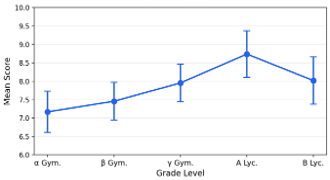
Table 2 presents descriptive statistics for total questionnaire scores across the five grade groups. Mean total scores were 7.17 in α Gymnasium, 7.46 in β Gymnasium, 7.96 in γ Gymnasium, 8.74 in A Lyceum, and 8.02 in B Lyceum. A Lyceum had the highest observed mean, approximately 1.57 points above that of α Gymnasium. Although the B Lyceum mean was lower than the A Lyceum mean, this difference was not statistically significant. The descriptive pattern therefore does not establish an inverted-U trajectory or a decline in individual students’ understanding. These cross-sectional comparisons concern different student groups and cannot demonstrate improvement, knowledge loss, or erosion of instructional gains. Differences in prior instruction, cohort composition, teaching experiences, and other unmeasured contextual characteristics remain possible explanations for the observed means.
Table 2. Descriptive statistics for the total score by grade level
|
A one-way analysis of variance indicated differences in mean total scores across the five grade groups, F(4, 299) = 4.32, p = .002, η² = .055. Grade-group membership accounted for approximately 5.5% of the observed variance in questionnaire performance. With Bonferroni adjustment across all ten pairwise comparisons, only the A Lyceum-α Gymnasium and A Lyceum-β Gymnasium comparisons remained statistically significant (Table 3). No other pairwise comparison reached the adjusted significance threshold, including A Lyceum versus γ Gymnasium, A Lyceum versus B Lyceum, B Lyceum versus α Gymnasium, and γ Gymnasium versus α Gymnasium. These results identify differences between particular sampled groups; they do not show improvement across successive grades or the effect of instruction. The inferential results also remain subject to the limitation that the analysis did not account for students’ clustering within schools and classes.
Table 3. Bonferroni-adjusted pairwise comparisons of total scores
| ||||||||||||||||||||||||||||||||||||||||||||||||||||||||||||
Figure 1 displays mean total scores and their 95% CIs for the sampled grade groups.
Gender Differences in Overall Performance
Girls had a higher mean total questionnaire score (mean [M] = 8.31, SD = 2.46) than boys (M = 7.47, SD = 2.13), with a statistically significant difference in the unadjusted aggregate comparison. However, none of the five within-grade comparisons remained statistically significant after Bonferroni correction. The aggregate result and the corrected within-grade tests address different comparisons and should not be interpreted as demonstrating either a gender advantage specific to A Lyceum or equivalent performance within grades. These exploratory findings also remain subject to unaccounted school and class clustering and differences in unmeasured participant characteristics.
Gender comparisons were retained as secondary, exploratory analyses of total questionnaire scores. Table 4 presents the boys-minus-girls mean difference within each grade, together with its SE, CI, and unadjusted p-value. Bonferroni correction across the five comparisons was used when assessing statistical significance. These comparisons describe within-grade differences but do not establish whether the gender difference varies significantly across grades. No conclusion about a grade × gender interaction is therefore drawn.
Table 4. Within-grade gender comparisons (boys vs girls) for the total score
| ||||||||||||||||||||||||||||||||||||||||||
In A Lyceum, girls had a higher observed mean total score than boys, with a boys-minus-girls contrast of -1.57 points and an unadjusted p-value of .014. However, this comparison did not remain statistically significant after Bonferroni adjustment across the five within-grade gender tests (adjusted p ≈ .070). None of the within-grade comparisons therefore met the corrected significance threshold. Moreover, a significant result in one subgroup and nonsignificant results in others would not, by itself, establish that gender differences vary by grade; that conclusion requires an omnibus grade × gender interaction test. The observed gender differences are consequently treated as exploratory, without concluding that the aggregate difference is attributable primarily to A Lyceum.
Instrument Reliability
Cronbach’s alpha for the 16-item questionnaire ranged from .459 in β Gymnasium to .593 in A Lyceum across the five grade groups, indicating limited internal consistency. Although the items cover heterogeneous content, this does not establish multidimensionality or remove concerns about the reliability of the total score. The score is therefore treated as a descriptive summary of responses matching the scoring key, with limited support for interpreting differences as differences in a coherent underlying construct of electricity understanding. Individual-item findings receive interpretive priority.
Internal consistency was low across all five proposed conceptual categories. Cronbach’s alpha was .425 for current consumption (four items), .212 for voltage-current distinction (five items), .363 for safety and short circuits (two items), .117 for charge origin (three items), and .054 for energy in circuits (two items). The small number of items and their heterogeneous content may contribute to these coefficients, but do not justify treating the composites as reliable measures of distinct conceptual constructs. In particular, the coefficient of .054 indicates very weak internal consistency between the two energy-related items. Statistically significant grade differences in a composite score cannot compensate for this measurement limitation. Individual-item findings therefore receive interpretive priority, while category averages are treated as secondary, exploratory summaries of responses to the included questions. These summaries do not establish conceptual persistence, retention, or responsiveness to instruction. Further development should examine students’ interpretation of the items, strengthen coverage of each conceptual category, and evaluate the reliability and validity of any proposed scales.
Item-Level Performance
Item-level performance was examined to identify questions on which students experienced difficulty and to describe differences in response accuracy across grades. Table 5 reports the percentage selecting the keyed answer for each item, both overall and separately by grade. These percentages indicate performance on questions designed to target documented alternative conceptions; they do not directly measure the prevalence of those conceptions. An incorrect response may reflect alternative reasoning, misunderstanding of the wording or diagram, limited contextual familiarity, or guessing. Similarly, a correct response does not necessarily demonstrate scientifically appropriate reasoning. Because the reported analysis summarizes answer accuracy without examining distractor distributions or students’ explanations, its diagnostic interpretation remains limited. Individual-item results nevertheless reveal variation that may be obscured by total scores or composite category averages.
Table 5. Percentage of responses matching the scoring key by item, provisional conceptual category, and grade
| ||||||||||||||||||||||||||||||||||||||||||||||||||||||||||||||||||||||||||||||||||||||||||||||||||||||||||||||||||||||||||||||||||||||||||||||||||||||||||||||||||
Response accuracy varies substantially between individual items, including those assigned to the same conceptual category. Overall, 81.6% of students answered the question about inserting a metal object into an electrical socket correctly (c12), compared with 59.5% for the question about the function of fuses (c16). Accuracy on voltage-current items ranged from 23.7% for c11 to 65.8% for c8, while charge-origin items ranged from 30.6% for c3 to 57.9% for c7. These differences demonstrate the importance of examining individual questions rather than assuming uniform performance within a proposed category. The grade-specific percentages in Table 5 describe differences between the sampled groups; they do not establish conceptual persistence, instructional effects, or change within individual students.
To improve transparency, Table 5 presents the percentage of correct responses for each item in the total sample and across grade levels. Table 5 also allows readers to evaluate whether the observed domain-level patterns are driven by all items within a domain or mainly by particular items.
Exploratory Comparisons Across Proposed Conceptual Categories
As a secondary, exploratory analysis, responses were summarized within five provisional conceptual categories. Each category score was the proportion of responses matching the scoring key for its constituent items, ranging from 0 to 1. Fractional logit models with robust SEs examined associations between grade and these scores. Each category contained only two to five items, and all showed low internal consistency. The voltage-current category also included the ambiguous item 2. Category averages therefore summarize agreement with the key on particular item sets and should not be interpreted as validated measures of conceptual understanding. Table 6 presents model-estimated means by grade, and Figure 2 displays these cross-sectional profiles.
Table 6. Model-estimated mean proportions of responses matching the scoring key by provisional conceptual category and grade
| ||||||||||||||||||||||||||||||||||||||||||
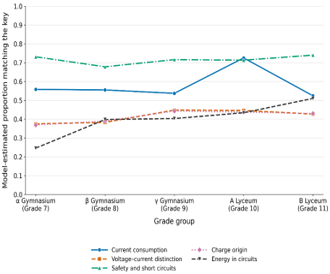
Individual-item findings receive interpretive priority; category comparisons cannot establish persistence, retention, or instructional effects.
The following exploratory analyses describe grade-group comparisons for each proposed conceptual category. Differences in statistical significance between categories do not, by themselves, establish that their grade-level associations differ.
Energy in circuits
The exploratory fractional logit model for the two-item average indicated an association with grade, Wald χ²(4) = 20.42, p < .001. Model-estimated mean proportions were higher in B Lyceum (.510) than in α Gymnasium (.246), and the reported Bonferroni-adjusted comparisons identified differences between α Gymnasium and both Lyceum groups (Table 7). However, the two items had extremely low internal consistency (α = .054), limiting interpretation of their average as a measure of energy understanding. Their individual profiles also differed: accuracy on c4 was 47.5% in A Lyceum and 44.2% in B Lyceum, whereas accuracy on c14 was 39.3% and 57.7%, respectively. The findings therefore describe performance on two particular questions and do not establish uniform improvement, greater conceptual stability, or cumulative learning across grades.
Table 7. Selected Bonferroni-adjusted pairwise comparisons of mean proportions matching the scoring key for the energy-related item set
| |||||||||||||||||||||||||||||||||||
Current consumption
The exploratory fractional logit model for the four-item average indicated an association with grade, Wald χ²(4) = 16.50, p = .002. Model-estimated mean proportions ranged from .537 to .558 across the Gymnasium groups, compared with .725 in A Lyceum and .524 in B Lyceum. The reported Bonferroni-adjusted comparisons identified higher average performance in A Lyceum than in α Gymnasium (p = .009), β Gymnasium (p = .006), γ Gymnasium (p = .002), and B Lyceum (p = .003) (Table 8). However, internal consistency was low (α = .425), so these comparisons concern performance on the four included questions rather than a validated measure of a single conception. The differences between independently sampled grade groups do not demonstrate that students first abandoned and subsequently reacquired a current-consumption conception, or that instructional gains were lost.
Table 8. Selected Bonferroni-adjusted pairwise comparisons of mean proportions matching the scoring key for the current-consumption item set
| |||||||||||||||||||||||||||||||||||
Voltage-current distinction
The exploratory fractional logit model for the five-item average did not identify a statistically significant association with grade, Wald χ²(4) = 7.13, p = .129. Model-estimated mean proportions ranged from .375 in α Gymnasium to .448 in γ Gymnasium, and no pairwise comparison was statistically significant after Bonferroni adjustment. These results indicate that grade-level differences were not detected for this item-set average; they do not demonstrate equivalent performance, conceptual stability, or resistance to instruction. Internal consistency was low (α = .212), further limiting interpretation of the composite. Individual-item accuracy varied substantially (Table 5), supporting examination of the specific questions rather than treating their average as a validated measure of voltage-current confusion.
Safety and short circuits
The exploratory fractional logit model for the two-item average did not identify a statistically significant association with grade, Wald χ²(4) = 1.13, p = .889. Model-estimated mean proportions ranged from .678 in β Gymnasium to .740 in B Lyceum, and no pairwise comparison was statistically significant after Bonferroni adjustment. These findings describe relatively high average accuracy on the two questions included, but do not establish equivalent performance across grades or comprehensive understanding of electrical safety. Internal consistency was low (α = .363), and overall accuracy differed between the socket-safety item (c12: 81.6%) and the fuse-function item (c16: 59.5%). Everyday experience and informal learning may be relevant explanations, but neither was measured. The study therefore cannot determine when this knowledge was acquired or which experiences contributed to it.
Charge origin
The exploratory fractional logit model for the three-item average did not identify a statistically significant association with grade, Wald χ²(4) = 3.20, p = .525. Model-estimated mean proportions were .369 in α Gymnasium, .443 in γ Gymnasium, .437 in A Lyceum, and .430 in B Lyceum. No pairwise comparison was statistically significant after Bonferroni adjustment. These results indicate that grade-level differences were not detected for the composite; they do not establish conceptual stability or explain the observed performance. Internal consistency was very low (α = .117), and overall accuracy varied between c3 (30.6%), c7 (57.9%), and c15 (38.2%). Interpretation should therefore focus on the individual questions and their specific reasoning demands. Difficulties with microscopic explanations remain a possible interpretation, but the present response-accuracy analysis does not directly establish students’ reasoning processes.
Summary of Results
The results describe differences in questionnaire performance across five independently sampled grade groups. A Lyceum had the highest observed mean total score, with Bonferroni-adjusted differences identified relative to α and β Gymnasium. Individual-item accuracy varied substantially, including between questions assigned to the same conceptual category. Secondary analyses of category averages identified grade associations for the current-consumption and energy-related item sets, while associations were not statistically significant for the other three sets. All category composites had low internal consistency, limiting their interpretation as measures of distinct constructs. None of the within-grade gender comparisons remained significant after correction for multiple testing. Overall, the findings identify item-specific difficulties and exploratory cross-sectional profiles; they do not establish conceptual persistence, individual improvement or decline, or instructional effectiveness. The inferential findings also require caution because school and class clustering was not accounted for.
DISCUSSION
The present study compared electricity questionnaire performance across five consecutive grades in a regional sample of Greek secondary students. Individual-item findings formed the principal basis for interpretation, while averages for five provisional conceptual categories provided exploratory summaries. The observed differences concern independently sampled groups and cannot establish how conceptual understanding develops with age or instruction. The following discussion considers these response patterns in relation to previous research, identifies questions for further diagnostic and instructional investigation, and examines the study’s limitations.
The highest mean total score was observed in A Lyceum (8.74), and the lowest in α Gymnasium (7.17). Although B Lyceum had a lower mean than A Lyceum, their difference was not statistically significant after correction for multiple comparisons. These findings describe differences between grade groups rather than a developmental trajectory. Previous work on learning patterns in physics education provides a context for considering uneven conceptual performance (Kotsis, 2023b), but the present design cannot determine whether the observed differences resulted from instructional recency, maturation, everyday experience, or cohort characteristics. These explanations remain hypotheses because the relevant influences were not directly measured or isolated. Interpretation therefore centers on the observed performance profiles, with longitudinal and intervention studies needed to investigate the processes underlying them.
The higher mean score in A Lyceum may be considered in relation to the curricular placement of electricity instruction in the preceding γ Gymnasium year. At the October assessment, A Lyceum students had completed that instructional unit, whereas the Gymnasium groups had not yet received it. This curricular contrast provides a plausible context for the observed difference but does not establish an instructional effect: grade, instructional exposure, and cohort characteristics were not independently controlled. Furthermore, the study did not assess cognitive maturity, abstract reasoning, instructional quality, or retention. It therefore cannot identify an optimal instructional stage or determine whether the higher score represents lasting conceptual change. As previous research also cautions, academic performance should not automatically be equated with conceptual understanding (Kotsis, 2026a). The present finding is best interpreted as higher questionnaire accuracy in the sampled A Lyceum group, requiring further investigation of its possible explanations.
The mean total score was lower in B Lyceum than in A Lyceum, but the difference was not statistically significant after adjustment for multiple comparisons. It should therefore be reported as a descriptive difference between the sampled groups, without inferring knowledge decay, conceptual regression, or loss of instructional gains. Instructional recency is one possible explanation, alongside differences in prior achievement, teaching experiences, motivation, and cohort composition; the present study cannot distinguish among these possibilities. Although conceptual-change research discusses the re-emergence of alternative conceptions and the importance of sustained engagement (Hewson & Hennessey, 1992; Kotsis, 2026b; Li et al., 2023), those processes were not observed here. The B Lyceum finding instead motivates a testable question for future longitudinal research: whether performance on specific electricity items changes within students as the interval since instruction increases, and whether planned revisiting activities influence that change.
Grade-group membership accounted for approximately 5.5% of the observed variance in total questionnaire scores. This modest association indicates that grade alone provides a limited account of performance differences in the present sample; it does not identify the sources of the remaining variation. Previous research points to the relevance of instructional experiences, prior knowledge, and motivational characteristics in physics learning (Angell et al., 2004; Redish, 2003), including students’ interest in electric circuits (Burde et al., 2020). These variables were not directly measured in the present study and therefore remain possible explanations rather than demonstrated influences on its findings. Future research should assess such variables alongside item-level performance and account for the organization of students within classes and schools.
The item-level findings show that students’ response accuracy differed across questions addressing several aspects of electricity. These differences are educationally relevant because a total score may obscure difficulty with particular situations or representations. The five proposed conceptual categories provide a provisional framework for organising these findings, but their low internal consistency limits interpretation of category averages as distinct measures of understanding. Moreover, a significant grade association for one category and a nonsignificant association for another does not, by itself, establish that their grade patterns differ statistically. The present results therefore support a descriptive account of item-specific performance and exploratory category profiles, rather than a theoretical claim of differential persistence. Whether particular alternative conceptions differ in retention or responsiveness to instruction requires stronger measurement evidence and longitudinal or intervention research.
The two energy-related questions illustrate why individual-item findings require priority over category averages. The questions addressed different contexts: payment for household electricity (c4) and recognition of an example of electrical energy consumption (c14). Although their combined average showed an association with grade, their individual response profiles differed, and their internal consistency was extremely low (α = .054). The composite therefore provides insufficient support for conclusions about a coherent energy construct or its development across grades. Previous research on alternative ideas about energy offers a broader conceptual context (Kotsis & Panagou, 2023) but should not be treated as direct evidence about electricity-specific understanding in this sample. Further investigation should examine students’ explanations for each item and determine whether performance transfers across energy contexts before drawing conclusions about conceptual integration or retention.
The four questions assigned to current consumption had higher average accuracy in A Lyceum than in the other sampled grades. This finding is compatible with several explanations, including differences in prior instruction, cohort composition, and familiarity with the specific questions, but the study cannot determine their relative contributions. The low internal consistency of the item set (α = .425) also limits its interpretation as a unified measure of a current-consumption conception. In particular, lower average accuracy in B Lyceum does not demonstrate that students reacquired an earlier misconception or lost previously established understanding. The conceptual-change literature provides reasons to investigate retention and context-dependent reasoning (Hewson & Hennessey, 1992; Vosniadou et al., 2001), but these processes require direct evidence. The present findings can inform the selection of questions for further diagnostic assessment; interviews, distractor analyses, and repeated assessments would be needed to establish the reasoning underlying responses and its relationship to instruction.
Several questions assigned to voltage-current distinction had low response accuracy, identifying specific tasks that warrant further diagnostic attention. However, the absence of a statistically significant grade association for their composite does not establish equivalent performance, conceptual persistence, or resistance to instruction. The category’s low internal consistency (α = .212) further limits such interpretations. Previous research documents difficulties in distinguishing voltage and current (Pardhan & Bano, 2001), while conceptual-change perspectives provide possible explanations involving learners’ existing interpretive frameworks (Duit & Treagust, 2003; Vosniadou, 2019). These perspectives inform hypotheses rather than establish the reasoning underlying responses in the present sample. Because instructional practices and students’ explanations were not examined, the findings cannot demonstrate that standard Greek teaching fails to produce conceptual restructuring. Further research should investigate reasoning on individual items and evaluate targeted instruction through designs that directly measure its effects.
The two safety-related questions produced different levels of response accuracy: 81.6% of students selected the keyed answer for the socket-safety question, compared with 59.5% for the fuse-function question. This distinction cautions against interpreting their average as comprehensive electrical-safety understanding, particularly given the low internal consistency of the pair (α = .363). No statistically significant grade association was detected for the composite, but this does not establish equivalent knowledge across grades or indicate when that knowledge was acquired. Formal instruction, family guidance, and public safety messages are possible sources of familiarity with these situations; their contributions were not assessed. Constructivist perspectives recognize the relevance of experiences beyond school (Driver et al., 1985; Kotsis, 2023a), but the present findings cannot distinguish formal from informal learning. Follow-up questions requiring explanations would help determine whether students recognize a familiar warning or understand the electrical principles involved.
The questions assigned to charge origin showed substantial variation in overall accuracy, from 30.6% for c3 to 57.9% for c7, with 38.2% for c15. Their very low internal consistency (α = .117) provides limited support for interpreting the three-item average as a coherent conceptual measure. The questions also involve different reasoning demands: c3 concerns the origin of moving charges, c7 concerns the immediate operation of household lights, and c15 concerns circuit completion and switch position. In particular, c15 does not directly assess charge origin, making the category label an imperfect description of the included content. Interpretation should therefore focus on the individual questions rather than treating their average as a measure of microscopic reasoning. Although no statistically significant grade association was detected for the composite, this does not demonstrate failure to improve, conceptual resistance, or a common explanation for incorrect responses. Conceptual-change theory offers a framework for investigating difficulties with abstract explanations (Posner et al., 1982), but students’ underlying models were not directly examined here. Interviews and explanation-based tasks should first clarify which reasoning difficulties the individual questions reveal. Simulations or analogies could subsequently be evaluated as instructional responses, rather than presented as interventions whose necessity or effectiveness follows from the present results.
Girls had a higher mean total questionnaire score than boys in the aggregate sample, but the exploratory gender findings require cautious interpretation. None of the five within-grade comparisons remained statistically significant after Bonferroni correction, including the A Lyceum comparison. These results do not establish that the aggregate difference was concentrated in a particular grade, nor does the absence of significant within-grade differences establish equivalent performance between boys and girls. Without a reported omnibus interaction test, the study cannot determine whether gender differences vary significantly across grades. Prior achievement, motivation, classroom experiences, and cohort composition were not controlled and may be relevant to the observed differences. The findings therefore do not support a generalized gender difference in electricity understanding or a grade-specific explanation of that difference.
Several limitations define the scope of these findings. The cross-sectional design compares different student groups and cannot establish within-student learning, retention, or regression. Convenience sampling within the Ioannina region limits generalizability beyond the participating students. School and class clustering was not accounted for, potentially understating uncertainty in the inferential comparisons. The multiple-choice format and analysis of response accuracy alone do not establish students’ reasoning or the prevalence of particular alternative conceptions. Furthermore, the proposed conceptual categories contained few items and had low internal consistency, limiting interpretation of their composite scores. The reported expert review provides preliminary content appraisal rather than comprehensive validation across grades. Prior achievement, instructional practices, motivational characteristics, and socioeconomic circumstances were not directly measured, leaving their contributions to group differences unresolved. These limitations support prioritizing descriptive individual-item findings and treating statistical comparisons as exploratory.
CONCLUSIONS AND IMPLICATIONS
The study compared overall and individual-item electricity questionnaire performance across five consecutive grades in a regional sample of Greek secondary students. It also examined averages for five provisional conceptual categories as secondary, exploratory summaries. The conclusions concern observed response patterns and their implications for further diagnostic investigation, subject to the instrument’s measurement limitations and the cross-sectional sampling design.
The first conclusion concerns overall questionnaire performance in the sampled grade groups. A Lyceum had the highest observed mean total score and scored significantly higher than α and β Gymnasium after adjustment for multiple comparisons. The lower mean in B Lyceum relative to A Lyceum was not statistically significant. Grade-group membership accounted for a modest proportion of total-score variance, and the comparisons did not establish a developmental trajectory or an instructional effect. Accordingly, the findings describe regional cross-sectional differences rather than individual improvement, decline, or retention. Longitudinal assessments and direct evaluation of instructional experiences are needed to investigate the processes underlying these differences.
The second conclusion concerns the importance of examining individual questions. Response accuracy varied substantially both across and within the five proposed conceptual categories, indicating that category averages can obscure differences between tasks. Although exploratory composite analyses identified grade associations for the current-consumption and energy-related item sets, all five composites had low internal consistency. Their results therefore do not establish distinct, reliably measured conceptual constructs or differences in persistence and instructional responsiveness. Likewise, nonsignificant grade associations for the other categories do not demonstrate equivalent performance or stable conceptions. The categories remain useful as provisional labels for organising item content, while the principal diagnostic contribution lies in identifying particular questions that warrant closer investigation of students’ reasoning.
Conceptual-change theories provide a context for formulating questions about students’ reasoning, but the present study does not discriminate among their proposed mechanisms. Response accuracy from different grade groups cannot establish conceptual restructuring, reactivation of earlier conceptions, or the contribution of informal learning. Investigating these processes would require direct evidence of students’ explanations, repeated observations within individuals, and documentation of their instructional experiences. The theoretical contribution of the present study is therefore limited to generating hypotheses for further investigation rather than supporting a particular model of conceptual change or demonstrating the need for multiple models.
The findings can inform the selection of electricity questions for diagnostic assessment at different curricular stages. In the curricular sequence described for this study, electricity is introduced in primary school and revisited in γ Gymnasium and B Lyceum. This arrangement provides a context for investigating whether the timing and frequency of subsequent learning opportunities influence performance on particular tasks. However, the present comparisons do not establish that instructional intervals caused the observed differences or that more frequent revisiting would improve retention. A more closely spaced sequence of learning activities is therefore a proposal for future evaluation. Longitudinal and intervention studies should compare alternative schedules and assess students’ explanations and transfer of understanding, alongside response accuracy.
Second, the variation in individual-item accuracy provides a starting point for selecting tasks for further diagnostic assessment and instructional investigation. Questions about current conservation, voltage-current distinction, charge behavior, electrical safety, and energy can be accompanied by requests for explanations to clarify students’ reasoning. Potential instructional approaches include comparing current measurements at different points in a steady-state series circuit, distinguishing potential difference from current through coordinated measurements and representations, and examining the relationship between charge flow and energy transfer. Simulations and carefully evaluated analogies may also be investigated where students experience difficulty connecting microscopic and macroscopic descriptions. These are candidate approaches for subsequent testing; the present study did not compare teaching methods or establish which approaches are necessary or effective. Higher response accuracy on some questions does not demonstrate successful instruction, just as nonsignificant grade differences on others do not demonstrate instructional failure.
Third, the exploratory gender comparisons illustrate the need to distinguish aggregate differences from within-grade findings. Girls had a higher observed mean score in the aggregate sample, but none of the within-grade comparisons remained statistically significant after correction for multiple testing. The study therefore does not establish a gender advantage specific to A Lyceum or a grade-dependent gender pattern. It also provides no direct evidence about the role of self-regulation, study habits, or adjustment to educational transitions, because these characteristics were not measured. Further investigation should use adequately powered analyses, report interaction tests where relevant, and assess potential explanatory variables directly.
Fourth, the findings illustrate the value of examining individual responses alongside total questionnaire scores. Questions answered incorrectly by many students can identify tasks requiring further investigation, but response accuracy alone cannot establish the underlying conception or determine an appropriate intervention. Diagnostic follow-up should examine distractor choices and ask students to explain their reasoning, including their interpretation of circuit diagrams and everyday contexts. Such evidence would help distinguish conceptual difficulties from wording problems, representational unfamiliarity, or guessing. The questionnaire should therefore be used as an initial screening resource whose diagnostic interpretations require additional evidence, rather than as a validated means of identifying persistent misconception domains.
Fifth, the questions used in this study may provide material for teacher-education activities that examine electricity reasoning and the interpretation of assessment responses. Previous research has investigated alternative conceptions of electricity among students and science teachers (Aligo et al., 2021), but the present study did not assess teachers’ knowledge or instructional practices. Its findings therefore cannot attribute students’ responses to teachers’ conceptions or establish a need arising from deficiencies in teacher preparation. Teacher-education activities could nevertheless examine item wording, circuit representations, distractor interpretations, and the distinction between selecting a correct answer and providing a scientific explanation. Dynamic electron models offer an additional instructional resource for consideration (Beil et al., 2023), although their effectiveness in addressing the difficulties identified here would require direct evaluation.
Future research should first strengthen the instrument through documented expert review, cognitive interviews, and pilot testing across the intended grade levels. Item wording, diagrams, distractors, and keyed answers should be examined alongside students’ explanations. Additional items may improve conceptual coverage, but any proposed scales should undergo appropriate reliability and structural evaluation rather than assuming the present five-category organization constitutes a validated factor structure. Longitudinal studies could then investigate within-student changes and retention, while intervention studies could evaluate teaching approaches directed at specific reasoning difficulties. Such studies should record instructional experiences, relevant learner characteristics, and school and class identifiers to support analyses that account for nested observations. Replication across regions and educational systems would help assess the generalizability of individual-item findings and the suitability of the revised instrument.
The study provides a regional cross-sectional description of electricity questionnaire performance among 304 students across five consecutive secondary-school grades. Its principal contribution lies in documenting overall and individual-item response patterns that can guide further investigation of students’ reasoning. The low internal consistency of the proposed category scores, the absence of explanation-based evidence, and the unaccounted school and class clustering limit stronger diagnostic and inferential conclusions. The results do not establish conceptual persistence, instructional responsiveness, or developmental change. Future research should strengthen the instrument, examine distractor choices and students’ explanations, account for the nested sampling structure, and use longitudinal or intervention designs to investigate learning and retention directly.
Author contributions: KTK & MT: conceptualization, data curation, formal analysis, investigation, methodology, writing – original draft, writing – review & editing. Both authors agreed with the results and conclusions.
Funding: No funding source is reported for this study.
Ethical statement: This study followed the ethical principles of educational research. Participation was voluntary, and all participants and their parents were informed about the purpose of the study, the procedures followed, and their right to withdraw at any stage without any consequence. Informed consent was obtained prior to data collection. Anonymity and confidentiality were ensured, and no personal or identifiable information was recorded or reported. Since the study involved the collection of anonymous educational data and no intervention that could cause physical, psychological, social, or academic harm, formal ethics committee approval was not required under school practice.
AI statement: AI-based tools were used solely to improve the English language, grammar, and readability of the manuscript. The authors reviewed and verified the final manuscript and take full responsibility for its content.
Declaration of interest: No conflict of interest is declared by the authors.
Data sharing statement: Data supporting the findings and conclusions are available upon request from the corresponding author.
APPENDIX A: ENGLISH TRANSLATION OF THE QUESTIONNAIRE
The questionnaire was administered in Greek. This English translation is provided for reporting purposes; it was not administered or independently validated. The wording and response alternatives preserve the content of the Greek questionnaire. Original circuit diagrams are retained, except that the diagram for Question 6 has been redrawn to make the existing point labels visible.
Gender: Boy ☐ Girl ☐
Grade: ____________________
-
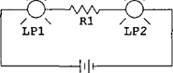
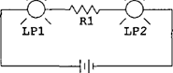
The bulbs in the circuit are identical. Which bulb shines more brightly?
-
Bulb LP1 shines more brightly than LP2.
-
Bulb LP1 shines less brightly than LP2.
-
Bulb LP1 shines as brightly as LP2.
-
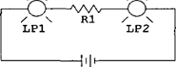
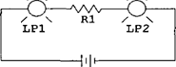
The bulbs in the circuit are identical. The brightness of a bulb is due to:
-
Voltage.
-
Current.
-
When electric current flows through a circuit, it consists of a very large number of moving charges. What is the origin of the moving charges in the circuit?
-
The wires.
-
The battery.
-
The bulbs.
-
A and B only.
-
All of the above.
-
When you pay your household electricity bill (to PPC or another electricity company), what are you actually paying for?
-
Voltage.
-
Energy.
-
Current.
-
Charges.
-
Which of the following diagrams is correct?

-
Diagram A, in which there is no current in the return wire.
-
Diagram B, in which there is an opposing current in the return wire.
-
Diagram C, in which there is less current in the return wire.
-
Diagram D, in which there is an equal current in the return wire.
Diagram labels: Μπαταρία: Battery; Λαμπτήρας: Bulb
-
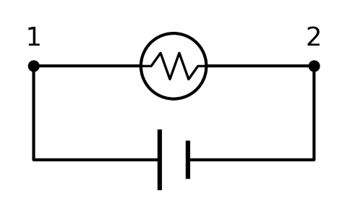
Compare the current at point 1 with the current at point 2. Which point has the greater current?
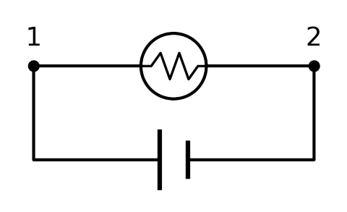
-
Point 1.
-
Point 2.
-
The current is the same.
-
Why do the lights in your home turn on immediately?
-
The charges in the wire travel very quickly.
-
The charges store energy. When the circuit is closed, the energy is released.
-
The charges are already present in the wires. When you operate the switch, the electrical signal immediately sets them in motion and the light turns on.
-
What happens to the brightness of the bulb when the battery is replaced with one of lower voltage?

-
The bulb shines more brightly than before.
-
The bulb does not light up.
-
The bulb shines less brightly than before.
-
The bulb shines with the same brightness as before.
-
The circuit shown below consists of a 6 V battery and two bulbs. How does the brightness of bulb L1 change when bulb L2 breaks?
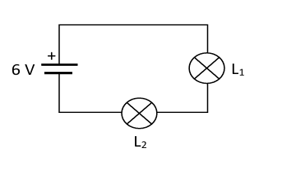
-
L1 shines more brightly than before.
-
L1 no longer lights up.
-
L1 shines less brightly than before.
-
L1 shines as brightly as before.
-
Examine the following circuit. What is the voltage between points 1 and 2?
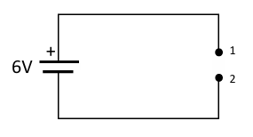
-
There is no voltage between points 1 and 2.
-
The voltage between points 1 and 2 is 6 V.
-
The voltage between points 1 and 2 is less than 6 V.
-
A bird lands on an uninsulated wire, and both of its feet touch that wire. What will happen to the bird?
-
The bird will receive an electric shock because the wire is at a high voltage.
-
The bird will receive an electric shock because there is a voltage across its feet.
-
The bird will receive an electric shock because there is current in the wire.
-
The bird will not receive an electric shock because there is no voltage across its feet.
-
The bird will not receive an electric shock because the current in the circuit is small.
-
-
Why is it dangerous to insert tweezers or another metal object into an electrical socket?
-
Because the socket may be damaged.
-
Because it may cause a short circuit and an electric shock.
-
Because the current in the house will become weaker.
-
Because the lights in the house will go out.
-
-
The circuit shown below consists of a battery and a bulb. The bulb is lit. What can you say about the current at points A and B?
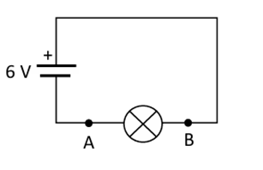
-
The current at point A is greater than at point B.
-
The current at point B is greater than at point A.
-
The current is the same at points A and B.
-
Which of the following is an example of electrical energy consumption?
-
A car running on petrol.
-
Water boiling in a kettle.
-
Wind blowing strongly at a wind turbine.
-
Sunlight falling on photovoltaic panels.
-
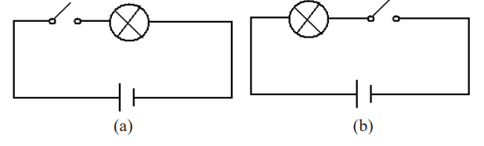
When the switch is closed, in which of the two circuits will the bulb light up?
-
In circuit (a).
-
In circuit (b).
-
In both circuits.
-
In neither circuit.
-
Why are fuses important in a home?
-
Because they interrupt the current if a short circuit occurs.
-
Because they help the bulbs shine more brightly.
-
Because they keep the current constant in all sockets.
-
Because they prevent the current from ever reaching appliances.
APPENDIX B:
Φύλλο: Αγόρι Κορίτσι
Τάξη: ……………………………………………………
-
Στο κύκλωμα οι λαμπτήρες είναι πανομοιότυποι: Ποιος λαμπτήρας λάμπει περισσότερο;
-
Ο λαμπτήρας LP1 λάμπει περισσότερο από τον LP2
-
Ο λαμπτήρας LP1 λάμπει λιγότερο από τον LP2
-
Ο λαμπτήρας LP1 λάμπει το ίδιο με τον LP2
-
Στο κύκλωμα οι λαμπτήρες είναι πανομοιότυποι: η φωτοβολία του λαμπτήρα οφείλεται
-
Στην τάση
-
Στην ένταση του ρεύματος
-
Όταν το ηλεκτρικό ρεύμα ρέει μέσα σε ένα κύκλωμα, αποτελείται από έναν πολύ μεγάλο αριθμό κινούμενων φορτίων. Ποια είναι η προέλευση των κινούμενων φορτίων μέσα στο κύκλωμα;
-
Τα καλώδια
-
Η μπαταρία
-
Οι λαμπτήρες
-
Α και Β μόνο.
-
Όλα τα παραπάνω
-
Όταν πληρώνει κανείς τον οικιακό λογαριασμό της ηλεκτρικής εταιρείας (ΔΕΗ και άλλες), τι πληρώνει στην πραγματικότητα;
-
Τάση
-
Ενέργεια
-
Ρεύμα
-
Φορτία
-
Ποιο από τα παρακάτω σχήματα είναι το σωστό;

-
Το σχήμα Α, όπου δεν υπάρχει ρεύμα στο καλώδιο επιστροφής
-
Το σχήμα Β, όπου στο καλώδιο επιστροφής υπάρχει συγκρουόμενο ρεύμα
-
Το σχήμα C , όπου το καλώδιο επιστροφής έχει λιγότερο ρεύμα
-
Το σχήμα D, όπου το καλώδιο επιστροφής έχει ίσο ρεύμα
-
Συγκρίνετε το ρεύμα στο σημείο 1 με το ρεύμα στο σημείο 2. Ποιο σημείο έχει το μεγαλύτερο ρεύμα;
-
Σημείο 1
-
Σημείο 2
-
Είναι το ίδιο
-
Γιατί τα φώτα στο σπίτι σας ανάβουν αμέσως;
-
Τα φορτία στο σύρμα ταξιδεύουν πολύ γρήγορα.
-
Τα φορτία αποθηκεύουν ενέργεια. Όταν το κύκλωμα κλείνει, η ενέργεια απελευθερώνεται.
-
Τα φορτία υπάρχουν ήδη στα καλώδια. Όταν πατάς τον διακόπτη, το ηλεκτρικό σήμα τα κινεί αμέσως και το φως ανάβει.
-
Τι συμβαίνει με τη φωτεινότητα του λαμπτήρα όταν αντικαθίσταται η μπαταρία με μικρότερης τάσης;

-
Η λάμπα λάμπει πιο έντονα από πριν.
-
Ο λαμπτήρας δεν ανάβει.
-
Ο λαμπτήρας λάμπει λιγότερο έντονα από πριν.
-
Ο λαμπτήρας λάμπει με την ίδια φωτεινότητα όπως πριν.
-
Το κύκλωμα που φαίνεται παρακάτω αποτελείται από μια μπαταρία 6 V και δύο λαμπτήρες. Πώς αλλάζει η φωτεινότητα του λαμπτήρα L1 όταν σπάει ο λαμπτήρας L2;
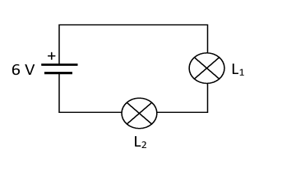
-
Ο L1 λάμπει πιο έντονα από πριν.
-
Ο L1 δεν λάμπει πια.
-
Ο L1 λάμπει λιγότερο έντονα από πριν.
-
Ο L1 λάμπει τόσο έντονα όσο πριν.
-
Εξετάστε το ακόλουθο κύκλωμα. Ποια είναι η τάση μεταξύ των σημείων 1 και 2;
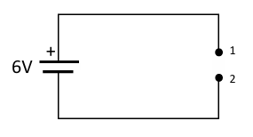
-
Δεν υπάρχει τάση μεταξύ των σημείων 1 και 2.
-
Η τάση μεταξύ των σημείων 1 και 2 είναι 6 V.
-
Η τάση μεταξύ των σημείων 1 και 2 είναι μικρότερη από 6 V.
-
Ένα πουλί που πέταξε ξαφνικά πήδηξε πάνω σε ένα ξεφλουδισμένο σύρμα και τα δύο πόδια του άγγιξαν αυτό το σύρμα. Τι θα γίνει με το πουλί;
-
Το πουλί θα πάθει ηλεκτροσόκ επειδή το καλώδιο είναι υψηλής τάσης
-
Το πουλί θα πάθει ηλεκτροσόκ γιατί υπάρχει τάση στα πόδια του πουλιού
-
Το πουλί θα πάθει ηλεκτροσόκ επειδή υπάρχει ρεύμα στο σύρμα
-
Το πουλί δεν θα πάθει ηλεκτροσόκ γιατί δεν υπάρχει τάση στα πόδια του πουλιού
-
Το πουλί δεν θα πάθει ηλεκτροσόκ επειδή το ηλεκτρικό ρεύμα στο κύκλωμα είναι μικρό
-
Γιατί είναι επικίνδυνο να βάλουμε τσιμπιδάκι ή άλλο μεταλλικό αντικείμενο σε πρίζα;
-
Γιατί η πρίζα μπορεί να χαλάσει.
-
Γιατί μπορεί να προκληθεί βραχυκύκλωμα και ηλεκτροπληξία.
-
Γιατί το ρεύμα θα γίνει πιο αδύναμο στο σπίτι.
-
Γιατί θα σβήσουν τα φώτα στο σπίτι.
-
-
Το κύκλωμα που φαίνεται παρακάτω αποτελείται από μια μπαταρία και μια λάμπα. Η λάμπα λάμπει. Τι μπορείτε να πείτε για το ρεύμα στα σημεία Α και Β;
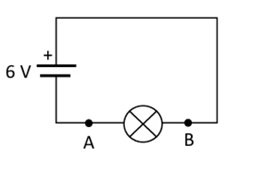
-
Το ρεύμα στο σημείο Α είναι μεγαλύτερο από ό,τι στο σημείο Β.
-
Το ρεύμα είναι μεγαλύτερο στο σημείο Β από ό,τι στο σημείο Α.
-
Το ρεύμα είναι το ίδιο στα σημεία Α και Β.
-
Ποιο από τα παρακάτω είναι παράδειγμα κατανάλωσης ηλεκτρικής ενέργειας;
-
Ένα αυτοκίνητο που κινείται με βενζίνη
-
Το νερό που βράζει σε έναν βραστήρα
-
Ο άνεμος που φυσάει δυνατά σε μια ανεμογεννήτρια
-
Ο ήλιος που πέφτει στα φωτοβολταϊκά πάνελ
-
Όταν κλείσει ο διακόπτης σε ποιο από τα δύο κυκλώματα θα ανάψει ο λαμπτήρας;
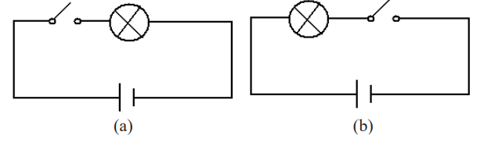
-
Στο α
-
Στο b
-
Και στα δύο
-
Σε κανένα
-
Γιατί οι ασφάλειες είναι σημαντικές σε ένα σπίτι;
-
Γιατί διακόπτουν το ρεύμα αν υπάρξει βραχυκύκλωμα.
-
Γιατί βοηθούν τις λάμπες να ανάβουν πιο δυνατά.
-
Γιατί κρατούν το ρεύμα σταθερό σε όλες τις πρίζες.
-
Γιατί δεν αφήνουν το ρεύμα να φτάσει ποτέ στις συσκευές.
References
- Adeduyigbe, A. M., Ukoh, E. E., & Okeke, U. K. (2025). Influence of gender on secondary school physics students’ learning difficulties in electricity. Physics Education, 60(2), Article 025017. https://doi.org/10.1088/1361-6552/adab5d
- Alexakis, N., Ampatzis, S., Gkougkousis, G., Kountouris, V., Moschovitis, N., Ovadias, S., Petrocheilos, K., Samprakos, M., Psalidas, A., Georgakakos, P., Skalomenos, A., Sfarnas, N., & Christakopoulos, I. (2013). Fysikí v´ genikoú lykeíou: Genikís paideías [Physics for grade Β of general lyceum: General education]. ΙΤΥΕ Διόφαντος.
- Aligo, B. L., Branzuela, R. L., Faraon, C. A. G., Gardon, J. D., & Orleans, A. V. (2021). Teaching and learning electricity—A study on students’ and science teachers’ common misconceptions. Manila Journal of Science, 14, 22-34.
- Angell, C., Guttersrud, Ø., Henriksen, E. K., & Isnes, A. (2004). Physics: Frightful, but fun. Pupils’ and teachers’ views of physics and physics teaching. Science Education, 88(5), 683-706. https://doi.org/10.1002/sce.10141
- Antoniou, N., Dimitriadis, P., Kampouris, K., Papamichalis, K., & Papatsimpa, L. (2013). Fysikí g´ gymnasíou [Physics for grade 3 of gymnasium]. ΙΤΥΕ Διόφαντος.
- Beil, F., Thees, M., Kapp, S., & Kuhn, J. (2023). A dynamic electron model for teaching electric circuits. The Physics Teacher, 61(1), 10-14. https://doi.org/10.1119/5.0041364
- Bilal, E., & Erol, M. (2009). Investigating students’ conceptions of some electricity concepts. Latin-American Journal of Physics Education, 3(2), 193-201.
- Burde, J.-P., Wilhelm, T., Hopf, M., Ivanjek, L., Schubatzky, T., Haagen-Schützenhöfer, C., Dopatka, L., & Spatz, V. (2020). Evaluating secondary school students’ interest and conceptual understanding of circuits. In Proceedings of the Physics Education Research Conference 2020 (pp. 69-74). American Association of Physics Teachers. https://doi.org/10.1119/perc.2020.pr.Burde
- Carlton, K. (1999). Teaching electric current and electrical potential. Physics Education, 34(6), 341-345. https://doi.org/10.1088/0031-9120/34/6/401
- Chambers, S. K., & Andre, T. (1997). Gender, prior knowledge, interest, and experience in electricity and conceptual change text manipulations in learning about direct current. Journal of Research in Science Teaching, 34(2), 107-123. https://doi.org/10.1002/(SICI)1098-2736(199702)34:2<107::AID-TEA2>3.0.CO;2-X
- Chinn, C. A., & Brewer, W. F. (1993). The role of anomalous data in knowledge acquisition: A theoretical framework and implications for science instruction. Review of Educational Research, 63(1), 1-49. https://doi.org/10.3102/00346543063001001
- Driver, R., & Easley, J. (1978). Pupils and paradigms: A review of literature related to concept development in adolescent science students. Studies in Science Education, 5(1), 61-84. https://doi.org/10.1080/03057267808559857
- Driver, R., Guesne, E., & Tiberghien, A. (Eds.). (1985). Children’s ideas in science. Open University Press.
- Duit, R., & Treagust, D. F. (2003). Conceptual change: A powerful framework for improving science teaching and learning. International Journal of Science Education, 25(6), 671-688. https://doi.org/10.1080/09500690305016
- Engelhardt, P. V., & Beichner, R. J. (2004). Students’ understanding of direct current resistive electrical circuits. American Journal of Physics, 72(1), 98-115. https://doi.org/10.1119/1.1614813
- Fokides, E., & Papoutsi, A. (2020). Using Makey-Makey for teaching electricity to primary school students: A pilot study. Education and Information Technologies, 25, 1193-1215. https://doi.org/10.1007/s10639-019-10013-5
- Fredette, N., & Lochhead, J. (1980). Student conceptions of simple circuits. The Physics Teacher, 18(3), 194-198. https://doi.org/10.1119/1.2340470
- Gavrilas, L., Papanikolaou, M.-S., & Kotsis, K. T. (2025). Exploring electricity in early childhood education: A 5E-based learning approach. Science Activities, 62(1), 53-94. https://doi.org/10.1080/00368121.2024.2406208
- Halloun, I. A., & Hestenes, D. (1985). The initial knowledge state of college physics students. American Journal of Physics, 53(11), 1043-1055. https://doi.org/10.1119/1.14030
- Hewson, P. W., & Hennessey, M. G. (1992). Making status explicit: A case study of conceptual change. In R. Duit, F. Goldberg, & H. Niedderer (Eds.), Research in physics learning: Theoretical issues and empirical studies (pp. 176-187). IPN.
- Ivanjek, L., Morris, L., Schubatzky, T., Hopf, M., Burde, J.-P., Haagen-Schützenhöfer, C., Dopatka, L., Spatz, V., & Wilhelm, T. (2021). Development of a two-tier instrument on simple electric circuits. Physical Review Physics Education Research, 17(2), Article 020123. https://doi.org/10.1103/PhysRevPhysEducRes.17.020123
- Kaliampos, G., Pantidos, P., Kalogiannakis, M., & Ravanis, K. (2021). A study of the understanding of key concepts of electromagnetism of 11th grade Greek high school students. Jurnal Pendidikan IPA Indonesia, 10(4), 474-485. https://doi.org/10.15294/jpii.v10i4.31863
- Kotsis, K. T. (2023a). Alternative ideas about concepts of physics, a timelessly valuable tool for physics education. Eurasian Journal of Science and Environmental Education, 3(2), 83-97. https://doi.org/10.30935/ejsee/13776
- Kotsis, K. T. (2023b). The outcomes of the learning curve for a concept in physics education. European Journal of Contemporary Education and E-Learning, 1(3), 49-61. https://doi.org/10.59324/ejceel.2023.1(3).05
- Kotsis, K. T. (2026a). High achievement without conceptual understanding: Evidence from honors high school graduates in Greek science education. European Journal of Contemporary Education and E-Learning, 4(2), 26-38. https://doi.org/10.59324/ejceel.2026.4(2).03
- Kotsis, K. T. (2026b). Persistent misconceptions in physics education across educational levels: Patterns, instructional responses, and future directions. European Journal of Contemporary Education and E-Learning, 4(1), 185-197. https://doi.org/10.59324/ejceel.2026.4(1).14
- Kotsis, K. T., & Panagou, D. (2022). Using alternative ideas for determining the learning curve on the concept of force. European Journal of Science and Mathematics Education, 10(4), 495-506. https://doi.org/10.30935/scimath/12251
- Kotsis, K. T., & Panagou, D. (2023). The determination of the learning curve on the concept of energy using the alternative ideas. Contemporary Mathematics and Science Education, 4(1), Article ep23011. https://doi.org/10.30935/conmaths/13022
- Kotsis, K. T., Stylos, G., Houssou, P., & Kamaratos, M. (2023). Students’ perceptions of the heat and temperature concepts: A comparative study between primary, secondary, and university levels. European Journal of Education and Pedagogy, 4(1), 136-144. https://doi.org/10.24018/ejedu.2023.4.1.577
- Li, X., Li, Y., & Wang, W. (2023). Long-lasting conceptual change in science education: The role of U-shaped pattern of argumentative dialogue in collaborative argumentation. Science & Education, 32(1), 123-168. https://doi.org/10.1007/s11191-021-00288-x
- Lin, J.-W. (2017). A cross-grade study validating the evolutionary pathway of student mental models in electric circuits. Eurasia Journal of Mathematics, Science and Technology Education, 13(7), 3099-3137. https://doi.org/10.12973/eurasia.2017.00707a
- Mazur, E. (1997). Peer instruction: A user’s manual. Prentice Hall. https://doi.org/10.1063/1.881735
- McDermott, L. C., & Shaffer, P. S. (1992). Research as a guide for curriculum development: An example from introductory electricity. Part I: Investigation of student understanding. American Journal of Physics, 60(11), 994-1003. https://doi.org/10.1119/1.17003
- Millar, R., & Osborne, J. F. (Eds.). (1998). Beyond 2000: Science education for the future: The report of a seminar series funded by the Nuffield Foundation. Nuffield Foundation. https://www.nuffieldfoundation.org/wp-content/uploads/2015/11/Beyond-2000.pdf
- OECD. (2018). The future of education and skills: Education 2030. OECD Publishing.
- Olaogun, O. P., Skelton, A., Zafar, M., Hunsu, N. J., & Idowu, I. A. (2023). A systematic review of student misconceptions about electricity and electric circuit concepts. In Proceedings of the 2023 IEEE Frontiers in Education Conference (pp. 1-5). IEEE. https://doi.org/10.1109/FIE58773.2023.10343239
- Önder, F., Şenyiğit, Ç., & Sılay, İ. (2017). The effects of misconceptions on pre-service teachers’ ability to constructing simple electric circuits. European Journal of Physics Education, 8(1), 1-10.
- Osborne, R. (1983). Towards modifying children’s ideas about electric current. Research in Science & Technological Education, 1(1), 73-82. https://doi.org/10.1080/0263514830010108
- Panagou, D., Kotsis, K. T., & Stylos, G. (2022). An empirical study on the evolution of students’ perceptions in basic concepts of physics of primary and secondary education in Cyprus. The Electronic Journal for Research in Science & Mathematics Education, 26(2), 91-109.
- Papke, L. E., & Wooldridge, J. M. (1996). Econometric methods for fractional response variables with an application to 401(k) plan participation rates. Journal of Applied Econometrics, 11(6), 619-632. https://doi.org/10.1002/(SICI)1099-1255(199611)11:6<619::AID-JAE418>3.0.CO;2-1
- Pardhan, H., & Bano, Y. (2001). Science teachers’ alternate conceptions about direct-currents. International Journal of Science Education, 23(3), 301-318. https://doi.org/10.1080/095006901750066538
- Posner, G. J., Strike, K. A., Hewson, P. W., & Gertzog, W. A. (1982). Accommodation of a scientific conception: Toward a theory of conceptual change. Science Education, 66(2), 211-227. https://doi.org/10.1002/sce.3730660207
- Redish, E. F. (2003). Teaching physics with the physics suite. John Wiley & Sons.
- Saputro, D. E., Sarwanto, Sukarmin, & Ratnasari, D. (2018). Students’ conceptions analysis on several electricity concepts. Journal of Physics: Conference Series, 1013, Article 012043. https://doi.org/10.1088/1742-6596/1013/1/012043
- Setyani, N. D., Suparmi, Sarwanto, & Handhika, J. (2017). Students conception and perception of simple electrical circuit. Journal of Physics: Conference Series, 909, Article 012051. https://doi.org/10.1088/1742-6596/909/1/012051
- Shipstone, D. M. (1984). A study of children’s understanding of electricity in simple DC circuits. European Journal of Science Education, 6(2), 185-198. https://doi.org/10.1080/0140528840060208
- Shipstone, D. M., von Rhöneck, C., Jung, W., Kärrqvist, C., Dupin, J. J., Johsua, S., & Licht, P. (1988). A study of students’ understanding of electricity in five European countries. International Journal of Science Education, 10(3), 303-316. https://doi.org/10.1080/0950069880100306
- Strike, K. A., & Posner, G. J. (1992). A revisionist theory of conceptual change. In R. A. Duschl, & R. J. Hamilton (Eds.), Philosophy of science, cognitive psychology, and educational theory and practice (pp. 147-176). State University of New York Press.
- Turgut, Ü., Gürbüz, F., & Turgut, G. (2011). An investigation of 10th grade students’ misconceptions about electric current. Procedia - Social and Behavioral Sciences, 15, 1965-1971. https://doi.org/10.1016/j.sbspro.2011.04.036
- Vlachos, I. A., Grammatikakis, I. G., Karapanagiotis, V. A., Peristeropoulos, P. E., & Timotheou, G. V. (2013). Fysikí omádas prosanatolismoú thetikón spoudón v´ genikoú lykeíou [Physics for grade Β of general lyceum, science studies orientation]. ΙΤΥΕ Διόφαντος.
- Vosniadou, S. (1994). Capturing and modeling the process of conceptual change. Learning and Instruction, 4(1), 45-69. https://doi.org/10.1016/0959-4752(94)90018-3
- Vosniadou, S. (2019). The development of students’ understanding of science. Frontiers in Education, 4. https://doi.org/10.3389/feduc.2019.00032
- Vosniadou, S., Ioannides, C., Dimitrakopoulou, A., & Papademetriou, E. (2001). Designing learning environments to promote conceptual change in science. Learning and Instruction, 11(4-5), 381-419. https://doi.org/10.1016/S0959-4752(00)00038-4
- Wainwright, C. L. (2007). Toward learning and understanding electricity: Challenging persistent misconceptions [Paper presentation]. The Annual Meeting of the Association for Science Teacher Education.
How to cite this article
APA
Kotsis, K. T., & Theochari, M. (2027). Cross-sectional grade-level patterns of alternative conceptions in electricity across Greek secondary education. Interdisciplinary Journal of Environmental and Science Education, 23(1), e2701. https://doi.org/10.29333/ijese/19999
Vancouver
Kotsis KT, Theochari M. Cross-sectional grade-level patterns of alternative conceptions in electricity across Greek secondary education. INTERDISCIP J ENV SCI ED. 2027;23(1):e2701. https://doi.org/10.29333/ijese/19999
AMA
Kotsis KT, Theochari M. Cross-sectional grade-level patterns of alternative conceptions in electricity across Greek secondary education. INTERDISCIP J ENV SCI ED. 2027;23(1), e2701. https://doi.org/10.29333/ijese/19999
Chicago
Kotsis, Konstantinos T., and Maria Theochari. "Cross-sectional grade-level patterns of alternative conceptions in electricity across Greek secondary education". Interdisciplinary Journal of Environmental and Science Education 2027 23 no. 1 (2027): e2701. https://doi.org/10.29333/ijese/19999
Harvard
Kotsis, K. T., and Theochari, M. (2027). Cross-sectional grade-level patterns of alternative conceptions in electricity across Greek secondary education. Interdisciplinary Journal of Environmental and Science Education, 23(1), e2701. https://doi.org/10.29333/ijese/19999
MLA
Kotsis, Konstantinos T. et al. "Cross-sectional grade-level patterns of alternative conceptions in electricity across Greek secondary education". Interdisciplinary Journal of Environmental and Science Education, vol. 23, no. 1, 2027, e2701. https://doi.org/10.29333/ijese/19999