 Full Text (PDF)
Abstract
Understanding how students conceptualize science, scientists, and the epistemological foundations and processes of scientific knowledge is central to scientific literacy. This exploratory, cross-sectional study compared sixth- and tenth-grade students’ perceptions of science and scientists and their understandings of five selected nature of science (NOS) and two scientific inquiry (SI) aspects in the Greek educational context. The sample comprised 196 students from public schools in Ioannina, Greece: 104 sixth-grade students and 92 tenth-grade students. Data were collected using a written Greek adaptation of the young children’s views about science instrument. Responses were coded as inadequate, mixed, or adequate and analyzed using descriptive statistics, Fisher’s exact test, Cramér’s V, and Holm’s correction for multiple comparisons. After Holm adjustment, response distributions were significantly associated with educational level for perceptions of science (p_adj < .001, V = .52), perceptions of scientists (p_adj < .001, V = .34), understanding that scientific investigations begin with questions (p_adj = .002, V = .27), and creativity and imagination (p_adj = .006, V = .26). In the supplementary dichotomous analysis, only perceptions of science and scientists remained significant. Inadequate responses predominated across most constructs, while the empirical character of scientific knowledge was the best-understood NOS aspect in both groups. The findings identify educational-level differences within the participating sample but do not demonstrate developmental change or causal effects of schooling. They support the need for explicit and reflective treatment of NOS, SI, and representations of scientific work in science education.
License
This is an open access article distributed under the Creative Commons Attribution License which permits unrestricted use, distribution, and reproduction in any medium, provided the original work is properly cited.
Article Type: Research Article
INTERDISCIP J ENV SCI ED, Volume 22, Issue 4, 2026, Article No: e2623
https://doi.org/10.29333/ijese/19555
Publication date: 09 Oct 2026
Article Views: 13
Article Downloads: 5
Open Access HTML Content Download XML References How to cite this articleHTML Content
INTRODUCTION
Scientific literacy constitutes the overarching goal of modern science education and lies at the core of educational reforms worldwide. The concept extends beyond the mere possession of scientific knowledge; it encompasses individuals’ ability to understand and critically evaluate scientific information, to engage with evidence-based reasoning, and to make informed decisions on issues related to science and technology (Kampourakis, 2016; Stylos et al., 2023b). At a time when major societal challenges, such as climate change, pandemics, and rapid technological progress, are deeply intertwined with science, the development of scientifically literate citizens is widely considered essential for the functioning of democratic societies and for responsible individual decision-making (Nguyen & Catalan-Matamoros, 2020; Tsoumanis et al., 2023). Consequently, science education is increasingly expected to move beyond the straightforward delivery of scientific concepts toward helping students understand how scientific knowledge is created, how it develops and changes over time, and how it is interpreted within broader social, cultural, and historical contexts (Lederman & Bartels, 2018; Roberts, 2007). Achieving this broader vision of science education requires attention not only to the products of science, the facts, laws, and theories that students learn, but also to the processes and epistemological foundations that underpin the scientific enterprise.
In this context, two constructs have received particular attention in both research and curriculum development: the nature of science (NOS) and scientific inquiry (SI). The NOS concerns the epistemological foundations of scientific knowledge, its empirical basis, its tentativeness, the role of creativity and subjectivity, and the distinction between observation and inference, while SI refers to the diverse processes through which scientists investigate natural phenomena and construct knowledge (J. S. Lederman et al., 2014; Lederman et al., 2002). Understanding these constructs is considered a prerequisite for achieving scientific literacy, as it enables students to appreciate not only what science knows but also how and why science knows it (N. G. Lederman et al., 2014). Closely related to these epistemological understandings are students’ perceptions of scientists themselves, who they are, what they do, and how they work, which have been shown to influence attitudes toward science and career aspirations (Stylos et al., 2025; Tsoumanis et al., 2024). Despite the recognized importance of these constructs, research consistently shows that students at various educational levels retain simplistic or inadequate understandings of NOS, SI, and the nature of scientific work (Cofré et al., 2019; Lederman et al., 2023). The theoretical foundations of these constructs, the evidence base regarding students’ perceptions, and the rationale and specific research questions (RQs) guiding the present study are presented in the following section.
THEORETICAL BACKGROUND
The NOS refers broadly to the characteristics of scientific knowledge and to the epistemic, cognitive, social, and methodological features of scientific practice (Lederman, 2019). Because science is multifaceted, historically situated, and practiced differently across disciplines, no single definition or framework captures all of its characteristics (Abd-El-Khalick, 2006). Several conceptual approaches have consequently been proposed in science education. In addition to the consensus-list or general-aspects approach, which identifies a set of characteristics considered accessible and educationally relevant for school students, scholars have advanced broader perspectives such as the whole-science approach and the family-resemblance approach. These alternatives place greater emphasis on the reliability and evaluation of scientific knowledge, disciplinary variation, scientific aims and practices, methodological diversity, social institutions, values, and the wider cultural and political contexts in which science operates (Allchin, 2011; Irzik & Nola, 2011). These approaches demonstrate that the NOS aspects selected for any particular study should not be treated as a complete or exhaustive definition of science.
The present study adopts the consensus-list framework as a bounded analytical framework rather than as an exhaustive account of NOS. This framework was selected because its aspects are developmentally accessible to school-age students, have been widely used in K-12 science education, and correspond directly to the constructs assessed by the young children’s views about science (YCVS) instrument and its accompanying coding framework (Lederman & Bartels, 2018; Lederman et al., 2002). Its use also facilitates comparison with previous research employing related NOS instruments. Accordingly, the present analysis focuses on five selected aspects: the empirical and tentative character of scientific knowledge, the roles of creativity and subjectivity in its production, and the distinction between observation and inference. Other important dimensions of science, including its disciplinary, institutional, social, cultural, ethical, and political characteristics, fall outside the scope of the instrument and are not assessed in this study.
Within this delimited framework, scientific knowledge is described as empirical because it is grounded in observations and evidence obtained through investigation of the natural world. It is tentative because scientific explanations may be revised in response to new evidence or reinterpretations of existing evidence. Scientific knowledge also involves creativity and imagination, particularly in formulating questions and hypotheses, designing investigations, interpreting evidence, and constructing explanations. It is partially subjective because scientists’ theoretical commitments, prior experiences, and disciplinary backgrounds may influence their interpretations. Finally, observations refer to descriptions of phenomena that are accessible through the senses or instruments, whereas inferences are interpretations or explanations that extend beyond what is directly observed (Lederman et al., 2002).
SI constitutes a fundamental component of science education and encompasses the diverse processes through which scientists investigate natural phenomena and construct scientific knowledge. These processes may include formulating questions, designing and conducting investigations, analyzing evidence, developing explanations, and communicating conclusions (J. S. Lederman et al., 2014). Contemporary accounts reject the traditional representation of inquiry as a fixed, universally applicable sequence of steps. Scientific investigations may instead follow different methodological pathways depending on the question being investigated, the scientific discipline, the available evidence and resources, and the purposes of the investigation (J. S. Lederman et al., 2014).
An important distinction must be made between students’ ability to perform inquiry activities and their understanding about SI. Inquiry skills concern what students can do when planning investigations, collecting or analyzing data, and constructing evidence-based explanations. Understanding about SI concerns students’ epistemic knowledge of how scientific investigations are initiated, structured, and justified. Participation in an inquiry activity does not necessarily ensure an informed understanding of why a particular method was selected or whether alternative methods could also address the same question. The present study assesses students’ understanding about SI rather than their practical ability to conduct scientific investigations.
The SI assessment in this study is intentionally limited to two aspects: whether scientific investigations begin with questions and whether different methods may be used to investigate a scientific question. These aspects were selected because they are directly represented in the written YCVS items employed in the study and can be examined consistently across both age groups. They also address two common misconceptions: that scientific investigation begins with undirected observation and that all scientists follow a single, fixed “scientific method.” Nevertheless, these two aspects do not provide a comprehensive assessment of students’ understanding about SI. Other important dimensions—including the relationship between questions and methods, the role of evidence in supporting explanations, the distinction between data and evidence, the influence of prior knowledge, and the justification and communication of conclusions—were not assessed. Therefore, the findings should be interpreted as evidence concerning two selected SI aspects rather than as a general measure of students’ overall understanding or practical competence in SI.
Students’ perceptions of science and scientists and their understandings of NOS and SI are conceptually distinct but theoretically connected. Perceptions of science provide a broad representation of what science is, what it seeks to accomplish, and which activities students associate with it. Perceptions of scientists concern the human agents who participate in scientific work and the roles, characteristics, and practices attributed to them. NOS understandings concern the characteristics and epistemological status of the knowledge these agents produce, whereas understandings about SI concern the processes through which scientific questions are investigated and evidence-based knowledge is constructed. Together, these constructs address complementary components of the scientific enterprise: science as a field of knowledge and activity, scientists as participants in that enterprise, scientific knowledge as its epistemic product, and inquiry as a set of diverse knowledge-producing processes (N. G. Lederman et al., 2014; Roberts, 2007).
These constructs may also shape one another in students’ reasoning. For example, a student who represents science primarily as laboratory experimentation may also depict scientists mainly as isolated laboratory workers and assume that all scientific investigations follow a single experimental method. Conversely, understanding that scientific knowledge involves interpretation, creativity, and revision may support a broader representation of both scientific activity and scientists’ work. Examining the four constructs together can therefore reveal whether students’ representations of the scientific enterprise are consistently informed across its different components or whether their understandings remain uneven and fragmented. The constructs are nevertheless analyzed separately in the present study, and no assumption is made that they constitute a single underlying psychological dimension.
Within this interconnected framework, students’ perceptions of scientists are particularly important because they connect epistemological representations of science with beliefs about the people who produce scientific knowledge. Students’ images of scientists are frequently shaped by deeply ingrained stereotypes. Common portrayals represent scientists as predominantly older men with unkempt hair who work alone in laboratories and are primarily engaged in conducting experiments (Emvalotis & Koutsianou, 2018; Miller et al., 2018; Stylos et al., 2025). Such representations may reinforce narrow perceptions of science itself by implying that scientific work is confined to laboratory experimentation and performed by a restricted category of people. Research has shown that stereotypical representations can negatively influence students’ attitudes toward science and may discourage interest in science-related educational pathways and careers (Besley, 2015; Lamminpää et al., 2023; Stylos et al., 2025; Thomson et al., 2019; Tsoumanis et al., 2024). Their persistence across age groups and educational systems highlights the need for science education to present more diverse and realistic accounts of scientists and scientific practice. Challenging these stereotypes may help broaden participation in science, support more informed perceptions of scientific work, and reduce gender-related differences in attitudes toward science and STEM fields (Grassi & De Cajen, 2024).
In the present study, the term “perceptions of science” refers specifically to students’ conceptual representations of what science is, the purposes it serves, the domains and activities it encompasses, and the ways in which scientific knowledge is produced. It does not refer to affective constructs such as attitudes toward science, interest, motivation, engagement, or career aspirations, although these constructs may influence students’ broader relationship with science. Similarly, “perceptions of scientists” refers to students’ conceptual representations of who scientists are, what kinds of work they perform, and how they contribute to the production of scientific knowledge. These two constructs are examined separately from students’ understandings of the NOS and SI. NOS concerns the characteristics and epistemological status of scientific knowledge, whereas SI concerns students’ understanding of how scientific investigations are initiated and conducted.
This conceptual distinction is reflected in the written YCVS instrument and the subsequent analyses. Students’ responses concerning science and scientists were coded as general conceptual representations, while their responses concerning the empirical, tentative, subjective, creative, and inferential characteristics of scientific knowledge were analyzed as NOS understandings. Responses concerning whether investigations begin with questions and whether scientists may use multiple methods were analyzed as SI understandings. Across all four domains, responses were categorized according to the extent to which they demonstrated an informed understanding of the construct under examination.
The investigation of students’ perceptions of science and scientists and their understandings of NOS and SI represents a well-established area of science education research. A substantial body of literature indicates that students frequently retain inadequate or overly simplistic understandings of these constructs, even after prolonged periods of formal science instruction (Kotsis & Stylos, 2023; Kotsis et al., 2023; Stylos et al., 2021; Panagou et al., 2021). Such findings indicate that exposure to scientific content and participation in science activities alone are often insufficient to foster deeper and more epistemologically informed understandings of how science operates.
Although attitudes, interests, motivation, engagement, and career aspirations may shape students’ broader relationships with science, they are conceptually distinct from the perceptions and epistemological understandings examined in this study. Previous research indicates that students’ engagement and science-related aspirations may be influenced by their interests, educational experiences, and stereotypical representations of scientists and scientific work (Höft & Bernholt, 2021; Scholes & Stahl, 2022; Sheldrake & Mujtaba, 2025). These affective and motivational constructs provide relevant context but were not measured and are therefore excluded from the present study’s operational definition of “perceptions of science.”
The two educational levels examined represent distinct points in the structure of Greek science education. Sixth grade is the final year of primary education, during which science is taught as an integrated subject encompassing content from physics, chemistry, biology, environmental science, and geography. The official curriculum promotes students’ engagement in observation, comparison, measurement, prediction, investigation, problem-solving, and experimentation as part of learning about the natural world (Pedagogical Institute, 2003). Tenth grade is the first year of Greek upper secondary education, where students encounter science through discipline-specific courses, particularly physics, chemistry, and biology, with more differentiated and conceptually specialized content (Institute of Educational Policy, 2025). These curricular differences make the two grade levels meaningful points for examining whether the distributions of students’ perceptions and understandings differ across educational stages. Nevertheless, curriculum prescriptions do not establish how science is actually taught in individual classrooms. The present study did not examine classroom instruction, curriculum implementation, or students’ prior participation in inquiry activities and therefore does not assume that the older students necessarily receive more frequent or more effective inquiry-oriented instruction.
Although students’ perceptions of science and scientists and their understandings of NOS and SI have each received considerable research attention, fewer studies have examined these four related but conceptually distinct domains together within the same investigation. Evidence is particularly limited regarding how these domains are represented among Greek students at two important points in their schooling: the completion of primary education and the beginning of upper secondary education. Previous Greek research has documented educational-level differences in students’ understanding of particular science-related concepts (Vakarou et al., 2024), but it has not established whether primary and secondary students differ across a broader set of representations concerning science as an enterprise, scientists and their work, the epistemological characteristics of scientific knowledge, and the conduct of SI.
The present study addresses this gap by applying a common analytical framework to compare sixth- and tenth-grade students’ responses across all four domains. It also examines the feasibility of using a Greek-language written adaptation of the YCVS for classroom-based data collection with these two age groups. The study’s contribution lies, therefore, in the simultaneous examination of the four domains, the comparison of two educational stages within the Greek context, and the classroom administration of a written form of an instrument originally designed as an oral interview protocol. Because the study employs a cross-sectional design involving two independent groups, it does not trace individual development or determine the effects of schooling. Instead, it identifies response patterns and educational-level differences within the participating sample.
Accordingly, the study addresses the following RQs:
RQ1. What response patterns characterize sixth- and tenth-grade students’ perceptions of
-
science and
-
scientists?
RQ2. What response patterns characterize sixth- and tenth-grade students’ understandings of
-
the five selected NOS aspects—empirical, tentative, subjective, creativity and imagination, and observation and inference—and
-
the two selected SI aspects—beginning with a question and multiple methods?
RQ3. For each perception, NOS aspect, and SI aspect examined, are the distributions of inadequate, mixed, and adequate responses associated with educational level?
METHOD
This study employed an exploratory, cross-sectional comparative design to examine students’ perceptions of science and scientists and their understandings of selected NOS and SI aspects. Two independent groups—sixth-grade primary students and tenth-grade secondary students—were assessed at a single point in time. The design permits the description and comparison of response distributions across the two educational-level groups but does not allow conclusions about individual developmental change, the causal effects of schooling, or changes occurring as students progress through the educational system. Accordingly, educational level is treated as a grouping variable, and the findings are interpreted exclusively as differences or similarities between the participating sixth- and tenth-grade groups.
A convenience sample of 196 students was recruited from public schools in the urban area of Ioannina, Northwestern Greece. The sample comprised 104 sixth-grade primary students aged 11-12 years and 92 tenth-grade upper secondary students aged 15-16 years. The available study records did not include the exact number of participating schools and classrooms or the distribution of participants across individual schools and classes.
Participation was voluntary, and students were informed that choosing not to participate would have no academic consequences. Because all participants were minors, written informed consent was obtained from their parents or legal guardians, and assent was obtained from the students before data collection. Permission to conduct the study was also obtained from the administrations of the participating schools. Under the institutional regulations applicable at the time of data collection, this anonymous, non-interventional educational study did not require formal review by an institutional ethics committee because it involved no collection of personally identifiable or sensitive information. The available records did not include the number of eligible students initially invited to participate; consequently, a participation rate could not be calculated.
The sample included 116 boys (59.2%) and 80 girls (40.8%), with no missing gender data. The primary group comprised 64 boys (61.5%) and 40 girls (38.5%), while the secondary group comprised 52 boys (56.5%) and 40 girls (43.5%). Information concerning socioeconomic status, parental education, ethnicity, prior science achievement, and other potentially relevant demographic characteristics was not available in the analytical dataset. Consequently, the comparability of the two educational-level groups on these characteristics could not be evaluated.
Because students were recruited within existing classrooms and schools, their responses may not have been statistically independent. The available sample did not support reliable multilevel modelling of classroom- and school-level variation; therefore, the analyses were conducted at the individual-student level. The results should consequently be interpreted as exploratory, as unmeasured differences among participating schools, classrooms, or teachers may partly account for the observed educational-level differences.
Sixth and tenth grade were selected because they represent the completion of primary education and the beginning of upper secondary education, respectively. They therefore provide two clearly defined educational-level groups for a cross-sectional comparison. Previous research in Greece has also documented differences between primary and secondary students in their understanding of particular science-related concepts (Vakarou et al., 2024). The comparison was not intended to demonstrate individual development, the effects of schooling, or differences in the quality of instruction received by the two groups.
The relatively small, geographically concentrated convenience sample limits the generalizability of the findings. The study should therefore be regarded as an exploratory comparison of response patterns within the participating sixth- and tenth-grade groups rather than as evidence of a general developmental sequence across Greek schooling.
The study employed a written Greek adaptation of the YCVS, originally developed by Lederman (2009) as an oral interview protocol. The instrument contains open-ended questions intended to elicit students’ perceptions of science and scientists and their understandings of selected NOS and SI aspects. The original interview format permits the interviewer to ask follow-up questions, request clarification, and encourage participants to elaborate on incomplete or ambiguous answers. For the present study, the questions were administered in written form to enable simultaneous classroom-based data collection from both educational groups.
The authors translated the YCVS questions into Greek, after which a bilingual reviewer examined the translation for linguistic accuracy and correspondence with the meaning of the original items. No formal pilot study, cognitive interviews, or separate age-specific validation of the written version was conducted before the main data collection. The adaptation should therefore be regarded as a pragmatic modification of the original instrument rather than as a validated written equivalent of the interview-based YCVS.
Changing the mode of administration from an oral interview to a written questionnaire constitutes a substantial measurement modification. Without follow-up questioning, brief, ambiguous, or incomplete written responses cannot be clarified, and students’ writing ability, reading comprehension, motivation, and fatigue may affect the amount of evidence available for coding. These effects may be particularly important for the younger participants. Accordingly, the written instrument may underestimate students’ understanding, and direct comparisons with findings obtained through the original interview protocol should be made cautiously. The present study does not claim to establish the validity or reliability of the Greek written adaptation; further research involving pilot testing, cognitive interviews, expert review, and comparison with oral interview responses is required.
Data collection was conducted within the school environment during regular instructional time. Prior to administering the questionnaire, students were briefed on the purpose of the study, assured of the anonymity and confidentiality of their responses, and provided with guidance on how to complete the instrument. During administration, researchers were present in the classroom to address any questions related to item wording or comprehension difficulties, while taking care to ensure that no influence was exerted on students’ responses. The estimated completion time ranged from 50 to 60 minutes.
Students’ written responses were analyzed through qualitative content coding informed by the YCVS coding framework (Lederman & Bartels, 2018). The coding team consisted of two researchers. Before formal coding, both researchers reviewed the instrument, the operational definitions of the examined constructs, and representative responses corresponding to each coding category. Category boundaries and coding criteria were discussed to establish a common interpretation of the coding framework. No changes were made to the substantive meaning of the original YCVS categories during this process.
Each student’s responses were examined for evidence relevant to four domains: perceptions of science, perceptions of scientists, selected NOS aspects, and selected SI aspects. The NOS domain comprised the empirical, tentative, subjective, creativity and imagination, and observation-inference aspects. The SI domain comprised whether investigations begin with questions and whether different investigative methods are possible. Coding was performed separately for every aspect; therefore, a student could demonstrate different levels of understanding across the examined constructs.
For perceptions of science, coding focused on how students characterized the meaning, purposes, scope, and activities of science. Responses that reduced science exclusively to a school subject, laboratory experiments, or the accumulation of facts were coded as inadequate. Responses that recognized some broader purposes or practices of science but remained incomplete or internally inconsistent were coded as mixed. Responses that coherently represented science as a systematic, evidence-informed process for investigating and explaining the natural world were coded as adequate. For perceptions of scientists, coding focused on students’ representations of scientists’ roles, activities, fields of work, and knowledge-producing practices. Narrow or stereotypical accounts restricted to isolated laboratory experimentation were coded as inadequate; partially broadened but incomplete accounts were coded as mixed; and coherent accounts recognizing scientists as individuals who formulate questions, investigate problems, interpret evidence, construct explanations, and work across diverse fields were coded as adequate.
For the NOS and SI aspects, an inadequate response expressed a view inconsistent with the aspect’s operational definition or provided no interpretable conceptual justification. A mixed response included both informed and uninformed elements or demonstrated partial understanding without a coherent justification. An adequate response consistently expressed the targeted understanding and supported it with relevant reasoning or an appropriate example. Responses containing insufficient but potentially relevant information were not automatically treated as conceptually incorrect; blank and unclassifiable responses were recorded separately from the three substantive categories.
All available responses were coded independently by two researchers. Inter-rater reliability was assessed separately for each construct using weighted Cohen’s (1988) kappa because inadequate, mixed, and adequate represent ordered levels of understanding. Percentage agreement ranged from 82.2% to 91.9%, while the weighted κ coefficients ranged from .74 to .89. The mean agreement across the nine constructs was 87.0%, and the mean weighted κ was .81, indicating acceptable to strong inter-rater reliability. For perceptions of scientists, the reliability analysis included 193 valid responses because three responses were missing. Following the independent coding, disagreements were discussed and resolved through consensus with reference to the operational definitions and the YCVS coding framework. The final consensus classifications were used in the subsequent statistical analyses. Detailed reliability results are presented in Table 1.
Table 1. Inter-rater reliability of the response coding
| ||||||||||||||||||||||||||||||||||||||||||||||||||||||||||||||||||||||||
Following the coding process, descriptive and inferential analyses were conducted. For each construct and educational group, raw frequencies were calculated separately for inadequate, mixed, adequate, and missing responses. Missing responses were not treated as evidence of inadequate conceptual understanding. The primary analysis therefore included only responses that could be substantively classified as inadequate, mixed, or adequate, and percentages were calculated using the valid number of responses for each construct as the denominator. No responses were explicitly coded as “no answer” using the corresponding code of 0 in the analytical dataset. Three system-missing responses were identified for perceptions of scientists, all within the secondary group. Consequently, the valid sample size was 196 for eight constructs and 193 for perceptions of scientists, comprising 104 primary and 89 secondary students.
Fisher’s exact test was used to compare the three-category response distributions of the primary and secondary groups. This non-parametric procedure was selected because several cells in the contingency tables had expected frequencies below five (Field, 2018). Cramér’s V was calculated to quantify the strength of the association between educational level and response category, with values interpreted using Cohen’s (1988) conventional benchmarks of approximately .10 for a small association, .30 for a medium association, and .50 for a large association. For perceptions of scientists, the proportions of missing responses were also compared between the educational groups using Fisher’s exact test.
A supplementary dichotomous analysis was conducted using only valid responses. Inadequate responses remained a separate category, while mixed and adequate responses were combined into a broader category representing evidence of at least partial understanding. Missing responses were excluded from this analysis. Fisher’s exact test and Cramér’s V were used to compare the resulting two-category distributions across the educational groups.
Because separate statistical tests were conducted for each of the nine constructs, the familywise Type I error rate was controlled using Holm’s (1979) sequential Bonferroni procedure. The nine primary three-category comparisons were treated as one family of tests, while the nine supplementary dichotomous comparisons were treated as a separate family. Both unadjusted exact p-values and Holm-adjusted p-values were reported, but conclusions regarding statistical significance were based on the adjusted values. The findings were interpreted by considering the adjusted p-values, effect sizes, and observed response distributions together.
To evaluate the sensitivity of the findings to the treatment of missing data, the analyses for perceptions of scientists were repeated after the three missing responses had been conservatively recoded as inadequate. The results were compared with those of the primary valid-response analysis to determine whether the statistical conclusion depended on the treatment of these responses. Because no missing responses occurred for the other eight constructs, their primary and sensitivity analyses were identical. The sensitivity analysis was treated as supplementary and was not used as the principal evidence concerning students’ conceptual understanding. All statistical analyses were performed using IBM SPSS Statistics, version 26.0, and Microsoft Excel.
RESULTS
To examine response patterns across the nine constructs, raw frequencies and valid-response percentages were calculated separately for the inadequate, mixed, and adequate categories within each educational-level group.
Table 2 presents these three-category distributions together with the unadjusted exact p-values from Fisher’s exact test, the Holm-adjusted p-values, and Cramér’s V effect sizes. Statistical conclusions were based on the Holm-adjusted p-values, while the observed distributions and effect sizes were considered when interpreting the magnitude and form of the associations.
Table 2. Primary three-category distribution of valid student responses across educational levels
| ||||||||||||||||||||||||||||||||||||||||||||||||||||||||||||||||||||||||||||||||||||||||||||||||||||||||||||||||||||||||||||
Overall, inadequate responses predominated across most constructs in both educational groups. After Holm correction, statistically significant associations with educational level remained for beginning with a question, exact p < .001, p_adj = .002, Cramér’s V = .27; creativity and imagination, exact p < .001, p_adj = .006, Cramér’s V = .26; perceptions of science, exact p < .001, p_adj < .001, Cramér’s V = .52; and perceptions of scientists, exact p < .001, p_adj < .001, Cramér’s V = .34. The associations for multiple methods, observation-inference, and tentativeness produced unadjusted exact p-values below .05 but did not remain statistically significant after Holm correction. The empirical and subjective aspects were not statistically associated with educational level. The strongest educational-level differences were therefore observed in students’ broader perceptions of science and scientists, while smaller but statistically reliable associations were identified for beginning with a question and creativity and imagination.
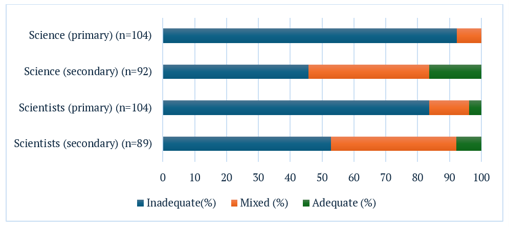
Students’ perceptions of science differed substantially between the two educational-level groups. Among primary students, 96 responses (92.3%) were classified as inadequate and 8 (7.7%) as mixed, while none were classified as adequate. Among secondary students, 42 responses (45.7%) were inadequate, 35 (38.0%) were mixed, and 15 (16.3%) were adequate. Fisher’s exact test indicated a statistically significant association between educational level and response category, exact p < .001, which remained significant after Holm adjustment, p_adj < .001. The association was large, Cramér’s V = .52, and represented the strongest effect observed across the nine constructs. The response distribution therefore indicates that the participating secondary students expressed broader and more differentiated perceptions of science than the participating primary students. Because the study was cross-sectional, this difference should not be interpreted as evidence of individual development or as a causal effect of progression through schooling.
Students’ perceptions of scientists were also associated with educational level. Among the 104 primary students, 87 responses (83.7%) were classified as inadequate, 13 (12.5%) as mixed, and 4 (3.8%) as adequate. Among the 89 secondary students with valid responses, 47 responses (52.8%) were inadequate, 35 (39.3%) were mixed, and 7 (7.9%) were adequate. Three secondary responses were missing and were excluded from the valid-response analysis. Fisher’s exact test indicated a statistically significant association between educational level and response category, exact p < .001, which remained significant after Holm adjustment, p_adj < .001. The effect size was moderate, Cramér’s V = .34. The proportions of missing responses did not differ significantly between the educational groups, exact p = .102.
Although inadequate responses remained the most frequent category in both groups, the participating secondary students provided a substantially greater proportion of mixed and adequate responses than the participating primary students. Typical inadequate responses restricted scientists’ work to conducting experiments in laboratories, whereas more informed responses recognized that scientists formulate questions, examine evidence, construct explanations, and work across different fields. The continued predominance of restricted representations is consistent with previous research documenting narrow and stereotypical perceptions of scientists and scientific work among school students (Bartels & Lederman, 2022; El Takach & Yacoubian, 2020; Ferreira & Valente, 2024; Thomson et al., 2019). Because the study involved independent cross-sectional groups, the observed association should not be interpreted as evidence of individual developmental change.
Figure 1 presents the valid-response distributions for students’ perceptions of science and scientists across the two educational-level groups. Figure 1 illustrates the substantially higher proportion of mixed and adequate responses among secondary students, particularly for perceptions of science.
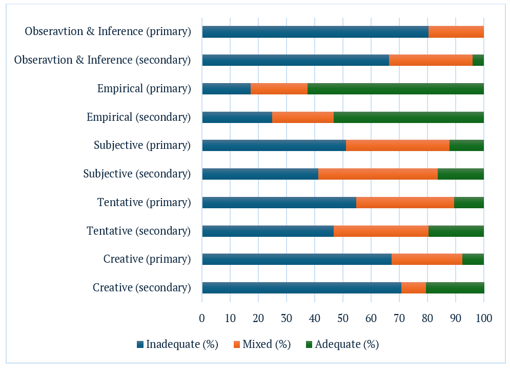
Turning to the five selected NOS aspects, empirical, tentative, subjective, creativity and imagination, and observation-inference, the empirical character of scientific knowledge was the best-understood aspect in both educational groups. Among primary students, 18 responses (17.3%) were classified as inadequate, 21 (20.2%) as mixed, and 65 (62.5%) as adequate. Among secondary students, 23 responses (25.0%) were inadequate, 20 (21.7%) were mixed, and 49 (53.3%) were adequate. Although the primary group showed a somewhat higher proportion of adequate responses, Fisher’s exact test did not indicate a statistically significant association between educational level and response category, exact p = .355, p_adj = .355, Cramér’s V = .10. The empirical aspect therefore exhibited relatively informed response distributions in both groups without evidence of a statistically reliable educational-level difference. Its comparatively strong representation is consistent with previous research identifying the empirical basis of scientific knowledge as one of the more accessible NOS aspects for students (Cofré et al., 2019).
The tentative character of scientific knowledge was less well understood than the empirical aspect. Among primary students, 64 responses (61.5%) were classified as inadequate, 31 (29.8%) as mixed, and 9 (8.7%) as adequate. Among secondary students, 43 responses (46.7%) were inadequate, 31 (33.7%) were mixed, and 18 (19.6%) were adequate. The secondary group therefore showed a descriptively lower proportion of inadequate responses and a higher proportion of adequate responses. Fisher’s exact test produced an unadjusted exact p-value below .05, exact p = .041; however, the association did not remain statistically significant after Holm correction, p_adj = .164, Cramér’s V = .18. Consequently, the observed distribution should be interpreted as a descriptive educational-level difference rather than as a statistically reliable association within the corrected family of comparisons. The high proportion of inadequate responses, particularly in the primary group, is consistent with previous research documenting persistent difficulties in understanding the tentative status of scientific knowledge (Cofré et al., 2019; Lederman, 2019).
For the subjective aspect of scientific knowledge, 57 primary responses (54.8%) were classified as inadequate, 36 (34.6%) as mixed, and 11 (10.6%) as adequate. Among secondary students, 38 responses (41.3%) were inadequate, 39 (42.4%) were mixed, and 15 (16.3%) were adequate. Although the secondary group showed a descriptively lower proportion of inadequate responses and higher proportions of mixed and adequate responses, Fisher’s exact test did not indicate a statistically significant association between educational level and response category, exact p = .146, p_adj = .293, Cramér’s V = .14. The findings therefore provide no statistically reliable evidence of an educational-level difference for this NOS aspect. The relatively high proportions of inadequate and mixed responses in both groups are consistent with previous research showing that students often experience difficulty recognizing how scientists’ theoretical commitments, prior knowledge, and backgrounds may influence the interpretation of evidence (Cofré et al., 2019; Lederman et al., 2002).
For creativity and imagination, 70 primary responses (67.3%) were classified as inadequate, 26 (25.0%) as mixed, and 8 (7.7%) as adequate. Among secondary students, 65 responses (70.7%) were inadequate, 8 (8.7%) were mixed, and 19 (20.7%) were adequate. Fisher’s exact test indicated a statistically significant association between educational level and response category, exact p < .001, which remained significant after Holm correction, p_adj = .006, Cramér’s V = .26.
The form of this association does not represent a uniform improvement among secondary students. Although the proportion of adequate responses was considerably higher in the secondary group, the proportion of mixed responses was substantially lower and the proportion of inadequate responses was slightly higher. The result therefore indicates a more polarized secondary response distribution rather than a simple progression toward informed understanding. Responses describing science as the mechanical execution of prescribed steps reflected limited recognition of creativity, whereas responses referring to the formulation of new ideas, investigative designs, interpretations, or explanations demonstrated more informed understanding. The predominance of inadequate responses in both groups is consistent with research showing that students frequently underrecognize the creative and imaginative dimensions of scientific knowledge production (Cofré et al., 2019; Lederman et al., 2002).
For the distinction between observation and inference, 69 primary responses (66.3%) were classified as inadequate, 31 (29.8%) as mixed, and 4 (3.8%) as adequate. Among secondary students, 74 responses (80.4%) were inadequate, 18 (19.6%) were mixed, and none were adequate. Thus, the secondary group displayed a descriptively higher proportion of inadequate responses and lower proportions of mixed and adequate responses. Fisher’s exact test produced an unadjusted exact p-value below .05, exact p = .025; however, the association did not remain statistically significant after Holm correction, p_adj = .123, Cramér’s V = .19.
The observed difference should therefore be treated as a descriptive pattern requiring further investigation rather than as statistically reliable evidence that the educational groups differed in their understanding of observation and inference. The predominance of inadequate responses in both groups is consistent with previous research demonstrating the conceptual difficulty students experience in distinguishing direct observations from interpretations that extend beyond the available evidence (Cofré et al., 2019; Lederman et al., 2002).
Figure 2 presents the valid-response distributions for the five selected NOS aspects across the two educational-level groups. The empirical aspect displayed the highest proportion of adequate responses in both groups, whereas inadequate responses predominated for tentativeness, subjectivity, creativity and imagination, and observation-inference.
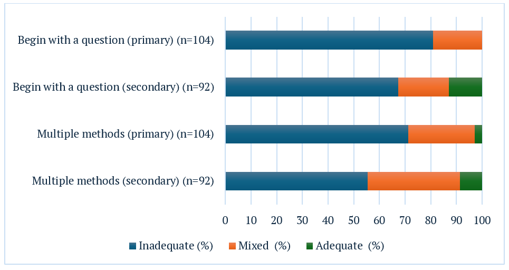
Turning to the two selected SI aspects, the response distributions indicated limited understanding in both educational groups. For the understanding that scientific investigations begin with questions, 84 primary responses (80.8%) were classified as inadequate and 20 (19.2%) as mixed, while none were classified as adequate. Among secondary students, 62 responses (67.4%) were inadequate, 18 (19.6%) were mixed, and 12 (13.0%) were adequate.
Fisher’s exact test indicated a statistically significant association between educational level and response category, exact p < .001, which remained significant after Holm correction, p_adj = .002, Cramér’s V = .27. The secondary group therefore displayed a lower proportion of inadequate responses and a higher proportion of adequate responses than the primary group. Nevertheless, inadequate responses remained predominant in both groups, indicating that many participating students did not clearly recognize the role of RQs in initiating and directing scientific investigations. This difficulty is consistent with previous research showing that students’ participation in inquiry activities does not necessarily produce an informed understanding about how scientific investigations are initiated and structured (Eliyahu et al., 2021; J. S. Lederman et al., 2014; Penn et al., 2023).
For the understanding that scientific questions may be investigated using different methods, 74 primary responses (71.2%) were classified as inadequate, 27 (26.0%) as mixed, and 3 (2.9%) as adequate. Among secondary students, 51 responses (55.4%) were inadequate, 33 (35.9%) were mixed, and 8 (8.7%) were adequate. The secondary group therefore showed a descriptively lower proportion of inadequate responses and higher proportions of mixed and adequate responses. Fisher’s exact test produced an unadjusted exact p-value below .05, exact p = .043; however, the association did not remain statistically significant after Holm correction, p_adj = .164, Cramér’s V = .18. The observed distribution should consequently be interpreted as a descriptive educational-level difference rather than as statistically reliable evidence of an association within the corrected family of tests. The predominance of inadequate responses in both groups is consistent with previous studies showing that many students retain the misconception that scientific investigations follow a single, universal method (Gai et al., 2022; Gyllenpalm et al., 2022; Morrell et al., 2024; Yoo et al., 2021).
Figure 3 presents the valid-response distributions for the two selected SI aspects across the educational-level groups. Inadequate responses predominated for both aspects, although the secondary group showed lower proportions of inadequate responses and higher proportions of adequate responses than the primary group.
Taken together, the primary three-category analysis showed that inadequate responses predominated for most of the examined constructs in both educational groups. The empirical character of scientific knowledge was the principal exception, with adequate responses representing the largest category among both primary and secondary students. After Holm correction, statistically significant associations with educational level remained for perceptions of science, p_adj < .001, Cramér’s V = .52; perceptions of scientists, p_adj < .001, Cramér’s V = .34; beginning with a question, p_adj = .002, Cramér’s V = .27; and creativity and imagination, p_adj = .006, Cramér’s V = .26. The strongest association was therefore observed for perceptions of science, followed by perceptions of scientists.
Tentativeness, multiple methods, and observation-inference produced unadjusted exact p-values below .05 but did not remain statistically significant after correction for multiple comparisons. The empirical and subjective aspects were also not statistically associated with educational level. The observed distributions consequently indicate that educational-level differences were not uniform across the four domains examined. Furthermore, the significant creativity and imagination result reflected a differently shaped response distribution rather than a straightforward improvement among secondary students. Because the two educational groups were assessed cross-sectionally, these associations should not be interpreted as evidence of individual developmental change or causal effects of schooling.
As a supplementary analysis, the three substantive response categories collapsed into two broader groups:
-
inadequate responses and
-
responses demonstrating at least partial understanding, comprising the original mixed and adequate categories.
The second category should not be interpreted as representing fully adequate understanding because it includes responses demonstrating only partial, developing, or internally inconsistent understanding. Missing responses were excluded from this valid-response analysis. Table 3 presents the supplementary dichotomous comparison, while the original three-category analysis remains the primary basis for interpreting students’ understanding.
Table 3. Supplementary dichotomous distribution of valid responses across educational levels
| ||||||||||||||||||||||||||||||||||||||||||||||||||||||||||||||||||||||||||||||||||||||||||||||||||||||||
The supplementary dichotomous analysis examined whether the proportion of valid responses demonstrating at least some evidence of understanding differed between the educational groups. Because this analysis combines conceptually distinct mixed and adequate responses, it provides a less differentiated representation of students’ understanding than the primary three-category analysis. Its findings are therefore interpreted cautiously and are not treated as equivalent to the results obtained for fully adequate understanding.
After Holm correction, only perceptions of science and perceptions of scientists remained statistically associated with educational level in the supplementary dichotomous analysis. Responses demonstrating at least partial understanding of science increased from 7.7% among primary students to 54.3% among secondary students, exact p < .001, p_adj < .001, Cramér’s V = .51. For perceptions of scientists, the corresponding proportions were 16.3% and 47.2%, exact p < .001, p_adj < .001, Cramér’s V = .33.
The unadjusted exact p-values for beginning with a question, multiple methods, observation-inference, and tentativeness were below .05, but none remained statistically significant after Holm correction, with adjusted p-values ranging from .181 to .206. The empirical, subjective, and creativity and imagination comparisons were also not statistically significant. Secondary students showed a lower proportion of responses demonstrating at least partial understanding of observation-inference than primary students, 19.6% compared with 33.7%, but this difference did not survive correction for multiple comparisons. The supplementary analysis therefore provides additional descriptive information but remains secondary to the more differentiated three-category analysis.
DISCUSSION
The present study examined cross-sectional differences between sixth- and tenth-grade students’ perceptions of science and scientists and their understandings of selected NOS and SI aspects. Inadequate responses predominated across most constructs in both educational groups, although the corrected primary analysis revealed statistically significant associations with educational level for perceptions of science, perceptions of scientists, beginning with a question, and creativity and imagination. The largest associations were observed for perceptions of science (Cramér’s V = .52) and scientists (Cramér’s V = .34), while smaller associations were found for beginning with a question (Cramér’s V = .27) and creativity and imagination (Cramér’s V = .26). The creativity result reflected a more polarized distribution among secondary students rather than a uniform shift toward adequate understanding. The empirical character of scientific knowledge was the best-understood NOS aspect in both groups, but it was not statistically associated with educational level. Tentativeness, subjectivity, multiple methods, and observation-inference also showed no statistically reliable associations after correction for multiple comparisons. Taken together, the findings indicate uneven and construct-specific response patterns rather than a consistent progression toward more informed understanding across all dimensions of the scientific enterprise. This fragmented pattern is consistent with previous research showing that students may retain inadequate or partially informed understandings of NOS and SI despite continued participation in formal science education (Cofré et al., 2019; Lederman, 2019; Lederman et al., 2023).
Perceptions of science and scientists displayed the strongest associations with educational level, with a large effect for science (Cramér’s V = .52) and a moderate effect for scientists (Cramér’s V = .34). In both cases, the secondary group produced substantially higher proportions of mixed and adequate responses than the primary group. These findings are consistent with previous research showing that students’ representations of science and scientists may become broader across educational levels while restricted associations with laboratory experiments, natural science disciplines, and stereotypical scientific work remain common (Bartels & Lederman, 2022; El Takach & Yacoubian, 2020; Ferreira & Valente, 2024; Thomson et al., 2019). One possible interpretation is that older students have encountered a wider range of discipline-specific scientific content and representations of scientific work through formal education and informal sources. However, the present study did not measure classroom instruction, curriculum implementation, media exposure, cognitive development, or prior science-learning experiences. These factors therefore remain possible explanations rather than empirically tested mechanisms. Moreover, because the study compared two independent groups at a single point in time, the observed associations cannot establish that schooling or maturation caused the broader representations expressed by the participating secondary students.
The empirical character of scientific knowledge was the best-understood NOS aspect in both educational groups, with adequate responses provided by 62.5% of primary students and 53.3% of secondary students. The response distributions were not significantly associated with educational level, p_adj = .355, Cramér’s V = .10. This finding is consistent with research identifying the empirical basis of scientific knowledge as comparatively accessible to students, particularly when contrasted with more epistemologically complex aspects such as tentativeness, subjectivity, and the distinction between observation and inference (Cofré et al., 2019; Lederman et al., 2002). Observation, evidence, measurement, and investigation are also represented within the official science curricula for the educational levels examined (Institute of Educational Policy, 2025; Pedagogical Institute, 2003). Nevertheless, curriculum prescriptions do not demonstrate how frequently or explicitly these ideas were addressed in the participating classrooms. The present cross-sectional findings therefore indicate that the empirical aspect was comparatively well represented in both groups but do not establish when this understanding developed or whether it resulted from particular curricular or instructional experiences.
Tentativeness and subjectivity remained difficult for substantial proportions of students in both educational groups. For tentativeness, inadequate responses accounted for 61.5% of the primary group and 46.7% of the secondary group; however, the association with educational level did not remain significant after Holm correction, p_adj = .164, Cramér’s V = .18. A similar pattern was found for subjectivity, with inadequate responses accounting for 54.8% and 41.3% of the primary and secondary groups, respectively, and no statistically reliable association after correction, p_adj = .293, Cramér’s V = .14. These findings are consistent with research showing that students often experience difficulty recognizing scientific knowledge as revisable and understanding how prior knowledge, theoretical commitments, and interpretative perspectives may influence scientific reasoning (Cofré et al., 2019; Lederman, 2019; Lederman et al., 2002).
Creativity and imagination presented a different pattern. Although inadequate responses remained frequent in both groups, adequate responses increased from 7.7% among primary students to 20.7% among secondary students. The overall three-category distribution was significantly associated with educational level, p_adj = .006, Cramér’s V = .26. Nevertheless, inadequate responses were also slightly more frequent among secondary students, while mixed responses decreased markedly from 25.0% to 8.7%. This polarized distribution does not support a simple developmental interpretation. Instead, it suggests that a larger subgroup of secondary students recognized creativity as part of scientific knowledge production, while most continued to represent science as the mechanical application of established procedures. Such uneven understandings reinforce the value of explicit and reflective instruction addressing the interpretative and creative dimensions of scientific practice (Cofré et al., 2019; Lederman et al., 2002).
The observation-inference aspect displayed a noteworthy descriptive pattern. Inadequate responses increased from 66.3% among primary students to 80.4% among secondary students, while adequate responses decreased from 3.8% to 0%. Although the unadjusted exact p-value was below .05, the association did not remain statistically significant after Holm correction, p_adj = .123, Cramér’s V = .19. The direction of the difference therefore warrants further investigation but should not be interpreted as evidence that secondary education reduced students’ understanding. Distinguishing direct observations from interpretations and explanations requires students to recognize that scientific claims frequently extend beyond what is immediately accessible through the senses or instruments, a distinction that has been identified as conceptually demanding in NOS research (Cofré et al., 2019; Lederman et al., 2002). The present study did not examine classroom instruction, curriculum implementation, or students’ reasoning through follow-up interviews; consequently, it cannot determine why the participating secondary group produced a higher proportion of inadequate responses.
The findings of the present study are broadly consistent with international research examining students’ views of NOS and SI across different countries and educational levels. Lederman et al. (2023), in a multi-country study establishing international baselines, reported that inadequate understandings of SI were common among primary, middle, and secondary students in diverse educational contexts. Similarly, Bartels and Lederman (2022) found that elementary students often demonstrated limited understandings of science, scientists, and scientific work. This convergence places the response patterns observed in the participating Greek sample within a broader international evidence base showing that informed understandings of NOS and SI cannot be assumed to develop through exposure to science education alone (Cofré et al., 2019; Lederman, 2019). However, the present study did not examine classroom instruction, curriculum implementation, teacher preparation, or the extent to which NOS and SI were taught explicitly. It therefore cannot determine whether the observed patterns resulted from implicit treatment of these constructs or from other curricular, instructional, developmental, or contextual factors. Comparative curriculum studies and classroom-based research are needed to investigate the mechanisms that may contribute to these recurring patterns across educational contexts.
Restricted perceptions of scientists remained common in both educational groups, although their distributions differed significantly. Inadequate responses accounted for 83.7% of the primary group and 52.8% of the secondary group, while responses demonstrating at least partial understanding accounted for 16.3% and 47.2%, respectively. The association remained statistically significant after Holm correction, p_adj < .001, Cramér’s V = .34. Thus, the secondary group expressed broader representations of scientists more frequently, but inadequate responses remained the largest category in both groups. Students commonly restricted scientists’ work to conducting experiments in laboratories or working within the natural sciences, consistent with previous research documenting narrow representations of scientists and scientific practice among school students (Bartels & Lederman, 2022; Bozzato et al., 2021; Chionas & Emvalotis, 2021; El Takach & Yacoubian, 2020; Ferreira & Valente, 2024; Stylos et al., 2025).
Because the written YCVS adaptation elicited verbal descriptions rather than drawings, the present findings concern students’ conceptual representations of scientists’ roles, activities, and fields of work. They do not provide direct evidence regarding visual stereotypes involving gender, age, ethnicity, physical appearance, or laboratory clothing. Nevertheless, restricting scientific work to particular disciplines, settings, or activities may narrow students’ understanding of who participates in science and what scientific careers involve (Scholes & Stahl, 2022; Thomson et al., 2019).
The response patterns identified in this study point to several areas that may warrant attention in future science education research and practice. However, the study did not evaluate particular instructional approaches, teacher professional development, curriculum implementation, textbook content, motivation, gender differences, or science-related career aspirations. The following implications should therefore be understood as being informed by the present findings in conjunction with the broader literature rather than as direct conclusions about the effectiveness of specific educational practices. Previous research suggests that explicit and reflective instruction may support students’ understanding of NOS and SI, and intervention studies could examine its effectiveness within Greek primary and secondary classrooms (Lederman, 2019; Lederman et al., 2002). Research could also investigate teachers’ preparedness to address NOS and SI and determine whether appropriately designed professional development contributes to more informed classroom practice (Lederman & Bartels, 2018; Stylos et al., 2023a). Curriculum and textbook analyses may clarify the extent to which epistemological and inquiry-related objectives and diverse representations of scientists are explicitly incorporated into Greek educational materials (Lamminpää et al., 2023; Stylos et al., 2025). Because motivation, gender-related attitudes, and career aspirations were not measured, their possible relationships with students’ perceptions of science and scientists should be examined separately in future studies rather than inferred from the present data (Grassi & De Cajen, 2024; Sheldrake & Mujtaba, 2025).
Several limitations should be considered when interpreting the findings. First, the convenience sample was drawn from public schools within a single urban area in Ioannina, Greece, limiting its representativeness and the generalizability of the findings to students in other geographical, rural, socioeconomic, or educational contexts. The available records did not retain the exact number of participating schools and classrooms, the distribution of students across these units, or the number of eligible students initially invited. Consequently, a participation rate could not be calculated, and potential differences between participating and nonparticipating students could not be examined. Demographic and educational information beyond gender, grade level, and age group was not available in the analytical dataset; therefore, the comparability of the two groups regarding socioeconomic background, parental education, ethnicity, prior achievement, and previous science-learning experiences could not be evaluated.
Second, students were recruited through existing schools and classrooms, creating the possibility that responses within the same instructional settings were correlated. School and classroom identifiers were unavailable, so clustering associated with shared teachers, curricula, or school environments could not be estimated or incorporated into the statistical analyses. Third, the cross-sectional comparison involved two independent educational groups assessed at one point in time. It therefore cannot demonstrate individual developmental change or establish that schooling, age, curriculum exposure, or cognitive maturation caused the observed differences.
Fourth, converting the YCVS from an oral interview protocol to a written Greek questionnaire constituted a substantial measurement modification. No formal pilot study, cognitive interviews, age-specific validation, or direct comparison with oral interview responses was conducted. The absence of follow-up questioning may have limited students’ opportunities to clarify or elaborate their reasoning, while reading comprehension, writing ability, motivation, and fatigue may have influenced the responses, particularly among younger students. The reported inter-rater agreement concerns the consistency of response classification and does not establish the construct validity or equivalence of the written adaptation.
Finally, although the analysis included 196 students and controlled the familywise error rate using Holm’s procedure, it may still have had limited sensitivity to small educational-level associations. Three responses were missing for perceptions of scientists, although the corresponding sensitivity analysis did not alter the statistical conclusion. The findings should therefore be interpreted as exploratory evidence concerning response patterns within the participating sixth- and tenth-grade groups rather than as a developmental account of Greek students’ understandings across schooling.
The findings should also be considered in relation to the formal curricular contexts of the two educational groups. The Greek primary science curriculum includes observation, measurement, prediction, investigation, problem-solving, and experimentation among its intended learning processes, while upper secondary students encounter more differentiated scientific content through discipline-specific courses such as physics, chemistry, and biology (Institute of Educational Policy, 2025; Pedagogical Institute, 2003). Nevertheless, official curriculum documents describe intended content and practices rather than their implementation in individual classrooms. The present study did not examine teachers’ instructional approaches, the explicit treatment of NOS and SI, students’ participation in inquiry activities, or the correspondence between curriculum prescriptions and classroom practice. Consequently, the observed response patterns cannot be attributed to particular characteristics of Greek science teaching or to differences in curriculum implementation. They instead identify areas, particularly the epistemological dimensions of scientific knowledge and the diversity and structure of SI, that warrant further classroom-based investigation and explicit instructional attention.
CONCLUSION
The present study compared sixth- and tenth-grade students’ perceptions of science and scientists and their understandings of selected NOS and SI aspects using a written Greek adaptation of the YCVS administered to 196 students in Ioannina, Greece. Inadequate responses predominated across most constructs in both educational groups. After Holm correction, the primary three-category analysis identified statistically significant associations with educational level for perceptions of science (p_adj < .001, Cramér’s V = .52), perceptions of scientists (p_adj < .001, Cramér’s V = .34), beginning with a question (p_adj = .002, Cramér’s V = .27), and creativity and imagination (p_adj = .006, Cramér’s V = .26). The creativity result reflected a more polarized secondary response distribution rather than a uniform shift toward adequate understanding. The empirical character of scientific knowledge was the best-understood NOS aspect in both groups but was not significantly associated with educational level. Tentativeness, subjectivity, multiple methods, and observation-inference also showed no statistically reliable associations after correction for multiple comparisons. In the supplementary dichotomous analysis, only perceptions of science and scientists remained significantly associated with educational level.
The central conclusion is that differences between the participating sixth- and tenth-grade groups were uneven and construct-specific. Secondary students expressed broader perceptions of science and scientists and differed in their response distributions for beginning with a question and creativity and imagination; however, informed understanding was not consistently more frequent across all NOS and SI aspects. Substantial proportions of students in both groups continued to demonstrate inadequate or only partially informed understandings of how scientific knowledge is constructed and how scientific investigations are initiated and conducted. Because the study was cross-sectional, these patterns cannot establish whether students’ understandings changed through schooling or whether the observed differences resulted from age, curriculum exposure, classroom instruction, cohort characteristics, or other contextual influences. The findings therefore identify specific constructs that warrant further investigation rather than demonstrating the effectiveness or necessity of particular pedagogical or policy responses. In conjunction with the broader literature, they provide a rationale for future studies evaluating explicit and reflective NOS and SI instruction, teacher professional development, assessable epistemological and inquiry-related curriculum objectives, and more diverse representations of scientists in educational materials (Cofré et al., 2019; Lederman, 2019; Lederman et al., 2002). The educational value of these approaches within the Greek context should be established through intervention studies, classroom-based research, and systematic analyses of curriculum implementation and instructional materials.
Future research should replicate the study with larger and more geographically, socially, and educationally diverse samples, including students from rural areas and different regions of Greece. Recruitment records should document the numbers of participating schools and classrooms, eligible students invited, participation rates, and relevant demographic and educational characteristics. Retaining school and classroom identifiers would also permit multilevel analyses that distinguish individual-level response patterns from variation associated with teachers, classrooms, and schools.
Longitudinal studies following the same students would provide more appropriate evidence regarding changes in NOS and SI understandings over time and would help distinguish educational change from cohort differences. Intervention studies could examine the effects of explicit and reflective NOS and SI instruction within Greek primary and secondary classrooms. Qualitative and mixed-methods research involving cognitive interviews, individual interviews, classroom observations, and analysis of students’ written and oral reasoning would further clarify how students interpret the instrument and justify their responses.
The written Greek YCVS adaptation also requires systematic evaluation before it can be treated as equivalent to the original oral protocol. This process should include expert review, age-specific cognitive interviewing, pilot administration, assessment of inter-rater reliability using independently coded responses, and direct comparison between written and oral administration. Because the instrument assesses several conceptually distinct constructs through open-ended responses, evidence based on coding consistency, response-process validity, content representation, and correspondence with interview data is more relevant than a single internal-consistency coefficient. Comparative studies involving students, pre-service teachers, and practising teachers could subsequently provide a broader account of perceptions of science, scientists, NOS, and SI within Greek science education (Stylos et al., 2023a; Tsoumanis et al., 2024).
The development of scientific literacy requires attention not only to students’ knowledge of the natural world but also to their understanding of scientific knowledge, inquiry processes, and the people who participate in scientific work. The present study contributes exploratory evidence concerning these understandings within the participating sixth- and tenth-grade groups and identifies specific constructs for which inadequate or uneven response patterns were particularly common. Although the findings cannot be generalized to all Greek students or interpreted as evidence of developmental change, they provide a basis for more comprehensive research and for the design of instructional approaches that address NOS, SI, and representations of scientists explicitly and reflectively.
Author contributions: KGT, GS, & KTK: conceptualization, data curation, investigation, methodology, writing – original draft, writing – review & editing. All authors agreed with the results and conclusions.
Funding: No funding source is reported for this study.
Ethical statement: This study was conducted in accordance with the applicable institutional and national ethical standards for educational research involving minors. The participants were sixth- and tenth-grade students; therefore, written informed consent was obtained from their parents or legal guardians, and student assent was obtained before participation. Permission to conduct the study was obtained from the administrations of the participating schools. Under the institutional regulations applicable at the time of data collection, formal ethics committee review was not required because the study was anonymous, voluntary, non-interventional, and involved no collection of personally identifiable or sensitive information. Students were informed that participation was voluntary and that declining to participate would have no academic consequences. All responses were treated confidentially, and the anonymized data were securely stored and accessible only to the research team.
AI statement: Generative AI tools were used solely to support English-language editing and improve the clarity and readability of the manuscript. These tools were not used to generate data, conduct statistical analyses, interpret the findings, or make scientific decisions. The authors reviewed and verified the entire manuscript and took full responsibility for its content.
Declaration of interest: No conflict of interest is declared by the authors.
Data sharing statement: Data supporting the findings and conclusions are available upon request from the corresponding author.
References
- Abd-El-Khalick, F. (2006). Over and over and over again: College students’ views of nature of science. In L. B. Flick, & N. G. Lederman (Eds.), Scientific inquiry and nature of science & technology education library, vol 25 (pp. 389-425). Springer. https://doi.org/10.1007/978-1-4020-5814-1_18
- Allchin, D. (2011). Evaluating knowledge of the nature of (whole) science. Science Education, 95(3), 518-542. https://doi.org/10.1002/sce.20432
- Bartels, S. B. S., & Lederman, J. S. (2022). What do elementary students know about science, scientists and how they do their work? International Journal of Science Education, 44(4), 627-646. https://doi.org/10.1080/09500693.2022.2050487
- Besley, J. C. (2015). Predictors of perceptions of scientists: Comparing 2001 and 2012. Bulletin of Science, Technology & Society, 35(1-2), 3-15. https://doi.org/10.1177/0270467615604267
- Bozzato, P., Fabris, M. A., & Longobardi, C. (2021). Gender, stereotypes and grade level in the draw-a-scientist test in Italian schoolchildren. International Journal of Science Education, 43(16), 2640-2662. https://doi.org/10.1080/09500693.2021.1982062
- Chionas, G., & Emvalotis, A. (2021). How Peruvian secondary students view scientists and their works: Ready, set, and draw! International Journal of Education in Mathematics, Science and Technology, 9(1), 116-137. https://doi.org/10.46328/ijemst.1099
- Cofré, H., Núñez, P., Santibáñez, D., Pavez, J. M., Valencia, M., & Vergara, C. (2019). A critical review of students’ and teachers’ understandings of nature of science. Science & Education, 28, 205-248. https://doi.org/10.1007/s11191-019-00051-3
- Cohen, J. (1988). Statistical power analysis for the behavioral sciences (2nd ed.). Lawrence Erlbaum Associates. https://doi.org/10.4324/9780203771587
- El Takach, S., & Yacoubian, H. A. (2020). Science teachers’ and their students’ perceptions of science and scientists. International Journal of Education in Mathematics, Science and Technology, 8(1), 65-75. https://doi.org/10.46328/ijemst.v8i1.806
- Eliyahu, E. B., Assaraf, O. B. Z., & Lederman, J. S. (2021). Do not just do science inquiry, understand it! The views of scientific inquiry of Israeli middle school students enrolled in a scientific reserve course. Research in Science Education, 51(4), 1073-1091. https://doi.org/10.1007/s11165-020-09925-x
- Emvalotis, A., & Koutsianou, A. (2018). Greek primary school students’ images of scientists and their work: Has anything changed? Research in Science & Technological Education, 36(1), 69-85. https://doi.org/10.1080/02635143.2017.1366899
- Ferreira, C., & Valente, B. (2024). Stereotypes and views of science among elementary students: Gender and grade differences. International Journal of Education in Mathematics, Science and Technology, 12(1), 68-84. https://doi.org/10.46328/ijemst.3058
- Field, A. (2018). Discovering statistics using IBM SPSS Statistics. SAGE.
- Gai, L., Li, Y., Zheng, C., Wei, B., Jiang, Z., & Lederman, J. S. (2022). The progression of students’ views about nature of scientific inquiry. International Journal of Science Education, 44(17), 2508-2540. https://doi.org/10.1080/09500693.2022.2138623
- Grassi, L. G., & De Cajen, S. (2024). Gender gap in attitudes towards science and STEM areas in lower secondary students. In Proceedings of the Sustainable Engineering for a Diverse, Equitable, and Inclusive Future at the Service of Education, Research, and Industry for a Society 5.0. https://doi.org/10.18687/LEIRD2024.1.1.688
- Gyllenpalm, J., Rundgren, C. J., Lederman, J. S., & Lederman, N. G. (2022). Views about scientific inquiry: A study of students’ understanding of scientific inquiry in grade 7 and 12 in Sweden. Scandinavian Journal of Educational Research, 66(2), 336-354. https://doi.org/10.1080/00313831.2020.1869080
- Höft, L., & Bernholt, S. (2021). Domain-specific and activity-related interests of secondary school students. Longitudinal trajectories and their relations to achievement. Learning and Individual Differences, 92, Article 102089. https://doi.org/10.1016/j.lindif.2021.102089
- Holm, S. (1979). A simple sequentially rejective multiple test procedure. Scandinavian Journal of Statistics, 6(2), 65-70.
- Institute of Educational Policy. (2025). Curriculum content and teaching guidelines for general upper secondary school courses for the 2025-2026 school year. Institute of Educational Policy.
- Irzik, G., & Nola, R. (2011). A family resemblance approach to the nature of science for science education. Science & Education, 20, 591-607. https://doi.org/10.1007/s11191-010-9293-4
- Kampourakis, K. (2016). The “general aspects” conceptualization as a pragmatic and effective means to introducing students to nature of science. Journal of Research in Science Teaching, 53(5), 667-682. https://doi.org/10.1002/tea.21305
- Kotsis, K. T. , & Stylos, G. (2023). Correlation of primary school students’ misconceptions about concepts of mechanics from their mental age. European Journal of Education Studies, 10(1), 77-90. https://doi.org/10.46827/ejes.v10i1.4619
- Kotsis, K. T., Stylos, G., Houssou, P., & Kamaratos, M. (2023). Students’ perceptions of the heat and temperature concepts: A comparative study between primary, secondary, and university levels. European Journal of Education and Pedagogy, 4(1), 136-144. https://doi.org/10.24018/ejedu.2023.4.1.577
- Lamminpää, J., Vesterinen, V. M., & Puutio, K. (2023). Draw-a-science-comic: Exploring children’s conceptions by drawing a comic about science. Research in Science & Technological Education, 41(1), 39-60. https://doi.org/10.1080/02635143.2020.1839405
- Lederman, J. S., & Bartels, S. B. S. (2018). Assessing the ultimate goal of science education: Scientific literacy for all! In M. Koomen, S. Kahn, C. L. Atchison, & T. A. Wild (Eds.), Towards inclusion of all learners through science teacher education (pp. 277-285). Brill. https://doi.org/10.1163/9789004368422_030
- Lederman, J. S., Bartels, S. B. S., Jimenez, J., Lederman, N. G., Acosta, K., Adbo, K., Akerson, V. L., de Andrade, M. B. S., Avraamidou, L., Barber, K.-A., Blanquet, E., Boujaoude, S., Cardoso, R., Cesljarev, C. D., Chaipidech, P., Connolly, C. P., Crowther, D. T., Das, P. M., Dogan, Ö. K., ... Zhu, Q. (2023). Completing the progression establishing an international baseline of primary, middle and secondary students’ views of scientific inquiry. International Journal of Science Education, 46(7), 715-731. https://doi.org/10.1080/09500693.2023.2256458
- Lederman, J. S., Lederman, N. G., Bartos, S. A., Bartels, S. B. S., Meyer, A. A., & Schwartz, R. S. (2014). Meaningful assessment of learners’ understandings about scientific inquiry, The views about scientific inquiry (VASI) questionnaire. Journal of Research in Science Teaching, 51(1), 65-83. https://doi.org/10.1002/tea.21125
- Lederman, N. G. (2019). Contextualizing the relationship between nature of scientific knowledge and scientific inquiry: Implications for curriculum and classroom practice. Science & Education, 28, 249-267. https://doi.org/10.1007/s11191-019-00030-8
- Lederman, N. G., Abd-El-Khalick, F., Bell, R. L., & Schwartz, R. S. (2002). Views of nature of science questionnaire: Toward valid and meaningful assessment of learners’ conceptions of nature of science. Journal of Research in Science Teaching, 39(6), 497-521. https://doi.org/10.1002/tea.10034
- Lederman, N. G., Antink, A., & Bartos, S. (2014). Nature of science, scientific inquiry, and socio-scientific issues arising from genetics: A pathway to developing a scientifically literate citizenry. Science & Education, 23, 285-302. https://doi.org/10.1007/s11191-012-9503-3
- Miller, D., K. Nolla, A. Eagly, & D. Uttal. (2018). The development of children’s gender-science stereotypes: A meta-analysis of 5 decades of U.S. draw-a-scientist studies. Child Development, 89(6), 1943-1955. https://doi.org/10.1111/cdev.13039
- Morrell, P. D., Visnovska, J., & Miller, J. (2024). Australian primary school students’ understandings about the nature of scientific inquiry. Research in Science Education, 55, 383-397. https://doi.org/10.1007/s11165-024-10195-0
- Nguyen, A., & Catalan-Matamoros, D. (2020). Digital mis/disinformation and public engagement with health and science controversies: Fresh perspectives from COVID-19. Media and Communication, 8(2), 323-328. https://doi.org/10.17645/mac.v8i2.3352
- Panagou, D., Kotsis, K. T., & Stylos, G. (2021). An empirical study on the evolution of students’ perceptions in basic concepts of physics of primary and secondary education in Cyprus. Electronic Journal for Research in Science & Mathematics Education, 26(2), 91-109.
- Pedagogical Institute. (2003). Cross-thematic curriculum framework and subject curricula for compulsory education: Natural sciences. Pedagogical Institute. http://www.pi-schools.gr/download/programs/depps/english/19th.pdf
- Penn, M., Ramnarain, U., Kazeni, M., Dhurumraj, T., Mavuru, L., & Ramaila, S. (2023). South African primary school learners’ understandings about the nature of scientific inquiry. In G. Bansal, & U. Ramnarain (Eds.), Inquiry-based science in the primary classroom (pp. 5-16). Routledge. https://doi.org/10.4324/9781003380351-2
- Roberts, D. A. (2007). Scientific literacy/science literacy. In N. G. Lederman, D. L. Zeidler, & J. S. Lederman (Eds.), Handbook of research on science education (pp. 729-780). Routledge.
- Scholes, L., & Stahl, G. (2022). ‘I’m good at science but I don’t want to be a scientist’: Australian primary school student stereotypes of science and scientists. International Journal of Inclusive Education, 26(9), 927-942. https://doi.org/10.1080/13603116.2020.1751316
- Sheldrake, R., & Mujtaba, T. (2025). ‘I would like a job that involves using science’: Science-related job aspirations and the relevance of family circumstances, personal motivations, and working scientifically for primary school students. International Journal of Science Education, 48(12), 1800-1823. https://doi.org/10.1080/09500693.2025.2488411
- Stylos, G., Christonasis, A., & Kotsis, K. T. (2023a). Pre-service primary teachers’ views about scientific inquiry. International Journal of Studies in Education and Science, 4(2), 100-112. https://doi.org/10.46328/ijses.66
- Stylos, G., Sargioti, A., Mavridis, D., & Kotsis, K. T. (2021). Validation of the thermal concept evaluation test for Greek university students’ misconceptions of thermal concepts. International Journal of Science Education, 43(2), 247-273. https://doi.org/10.1080/09500693.2020.1865587
- Stylos, G., Siarka, O., & Kotsis, K. T. (2023b). Assessing Greek pre-service primary teachers’ scientific literacy. European Journal of Science and Mathematics Education, 11(2), 271-282. https://doi.org/10.30935/scimath/12637
- Stylos, G., Theocharis, I., Gkaltemi, E., Panagou, D., & Kotsis, K. T. (2025). Exploring stereotypical perceptions of scientists among Greek primary school students: Insights from the draw-a-science comic test. Research in Science & Technological Education, 44(2), 761-788. https://doi.org/10.1080/02635143.2025.2543270
- Thomson, M. M., Z. Zakaria, & R. Radut-Taciu. (2019). Perceptions of scientists and stereotypes through the eyes of young school children. Education Research International. https://doi.org/10.1155/2019/6324704
- Tsoumanis, K. G., Stylos, G., & Kotsis, K. T. (2023). A comparative study between Greek pre-service teachers and primary school students’ scientific literacy levels. Science Education International, 34(2), 121-131. https://doi.org/10.33828/sei.v34.i2.6
- Tsoumanis, K. G., Stylos, G., & Kotsis, K. T. (2024). Pre-service teachers’ and primary students’ motivations and beliefs towards science. Interdisciplinary Journal of Environmental and Science Education, 20(3), Article e2408. https://doi.org/10.29333/ijese/14576
- Vakarou, G., Stylos, G., & Kotsis, K. T. (2024). Probing students’ understanding of Einsteinian physics concepts: A study in primary and secondary Greek schools. Physics Education, 59, Article 025004. https://doi.org/10.1088/1361-6552/ad1768
- Yoo, H. J., Park, J., Lederman, J. S., Lederman, N. G., Bartels, S. B. S., & Jimenez, J. (2021). Korean elementary students’ understanding about scientific inquiry using VASI-E questionnaire. Journal of the Korean Association for Science Education, 41(2), 83-92.
How to cite this article
APA
Tsoumanis, K. G., Stylos, G., & Kotsis, K. T. (2026). Comparing primary and secondary students’ perceptions of science, scientists, nature of science, and scientific inquiry. Interdisciplinary Journal of Environmental and Science Education, 22(4), e2623. https://doi.org/10.29333/ijese/19555
Vancouver
Tsoumanis KG, Stylos G, Kotsis KT. Comparing primary and secondary students’ perceptions of science, scientists, nature of science, and scientific inquiry. INTERDISCIP J ENV SCI ED. 2026;22(4):e2623. https://doi.org/10.29333/ijese/19555
AMA
Tsoumanis KG, Stylos G, Kotsis KT. Comparing primary and secondary students’ perceptions of science, scientists, nature of science, and scientific inquiry. INTERDISCIP J ENV SCI ED. 2026;22(4), e2623. https://doi.org/10.29333/ijese/19555
Chicago
Tsoumanis, Konstantinos G., Georgios Stylos, and Konstantinos T. Kotsis. "Comparing primary and secondary students’ perceptions of science, scientists, nature of science, and scientific inquiry". Interdisciplinary Journal of Environmental and Science Education 2026 22 no. 4 (2026): e2623. https://doi.org/10.29333/ijese/19555
Harvard
Tsoumanis, K. G., Stylos, G., and Kotsis, K. T. (2026). Comparing primary and secondary students’ perceptions of science, scientists, nature of science, and scientific inquiry. Interdisciplinary Journal of Environmental and Science Education, 22(4), e2623. https://doi.org/10.29333/ijese/19555
MLA
Tsoumanis, Konstantinos G. et al. "Comparing primary and secondary students’ perceptions of science, scientists, nature of science, and scientific inquiry". Interdisciplinary Journal of Environmental and Science Education, vol. 22, no. 4, 2026, e2623. https://doi.org/10.29333/ijese/19555