 Full Text (PDF)
Abstract
Reform movements generally urge schools and informal science institutions to create productive partnerships and a variety of learning experiences that result in a more coherent and robust foundation to support the development of scientific and environmental literacy for youth. In this paper we use STEM learning ecosystems and cultural-historical activity theory (CHAT) as theoretical lenses to understand how informal/formal partnerships succeed or fail. One feature of CHAT salient for such understanding how partnerships among different systems come to be (or not be) is that of knotworking, and we use this idea and its components and processes in our work as key in the development and maintenance of successful partnerships between formal and informal science education entities. We share two formal/informal partnership stories to illustrate knotworking components which are present or absent and from which we can draw principles about those elements which are critical for successful partnerships to be established and maintained in the service of supporting meaningful scientific and environmental literacy.
License
This is an open access article distributed under the Creative Commons Attribution License which permits unrestricted use, distribution, and reproduction in any medium, provided the original work is properly cited.
Article Type: Research Article
INTERDISCIP J ENV SCI ED, Volume 22, Issue 4, 2026, Article No: e2625
https://doi.org/10.29333/ijese/19938
Publication date: 11 Nov 2026
Article Views: 12
Article Downloads: 8
Open Access HTML Content Download XML References How to cite this articleHTML Content
INTRODUCTION
Problem Statement
As is widely acknowledged, science learning is not restricted to what unfolds formally within the walls of K-12 schools and universities; rather, such learning also occurs in informal, non-school spaces, such as parks, museums, and backyards (see, for example, Schweingruber & Fenichel, 2010). This recognition has led, over the years, to increasingly frequent calls about the importance of promoting partnerships between science learning institutions (e.g., Dillon & Wong, 2025; Hofstein & Rosenfeld, 1996; National Research Council [NRC], 2009). Such calls generally urge for a bridging of the gap between formal and informal learning: for schools and informal science institutions to create productive partnerships, and for a variety of learning experiences in science that result in a more coherent and robust foundation to support the development of science literacy for youth (see, for example, Penuel et al., 2016). These calls also encourage careful investigation of the efficacy of such partnerships. In the United States, since the publication of A framework for K-12 science education (NRC, 2012) and the adoption by many states of the next generation science standards, scholars have pointed out that informal-formal partnerships could help address the ambitious science learning goals set out in these documents (NRC, 2015). Informal science education experiences, which take place in settings such as nature centers, museums, zoos, and aquaria, have the potential to supplement classroom science education, creating a richer STEM learning ecosystem (SLE) (NRC, 2015).
A hallmark of our ongoing work has been the goal of addressing calls for more STEM partnership research by investigating what factors make partnerships productive and sustainable, considering these partnerships through a lens of SLEs, and using this theoretical lens to guide the development of interview questions, which we presented to informal science educators. In our ongoing analyses, we also made use of cultural-historical activity theory (CHAT) to understand the mechanics of such partnerships better. In this paper, we use our work to propose how SLEs and CHAT might elucidate some of the factors that must be at work in order to support the development and maintenance of partnerships that are both healthy and productive and which serve all of the stakeholders in such partnerships well--in short, partnerships which are effective and sustainable. In the sections that follow, we unpack each of these theoretical ideas before turning our attention to the ways in which they assist in our understanding of how partnerships succeed or fail.
STEM Learning Ecosystems
Interest and participation in STEM have been on the decline for several decades (e.g., Steidtmann et al., 2023). Related to this phenomenon is the fact that it has been recognized for some time that one of the reasons that students do not feel a connection with science or pursue advanced coursework or careers in STEM disciplines is the consequence of their negative experiences with science as schoolchildren. Despite our recognition that STEM learning occurs in contexts outside of school as well as inside the classroom, a particular conundrum is that learning that occurs in these different settings settings are typically disconnected with respect to how content, practices, and identity are addressed, particularly with regard to expectations for student engagement with science phenomena in these different contexts. As a result, therefore, opportunities to deepen scientific understanding are not typically leveraged. This has led researchers to argue that we ought to approach science learning in a broader, more inclusive and more unifying way, and to focus not only on the many different settings in which such learning takes place, but also on the different timeframes within which learning unfolds. This approach to learning is often referred to as an SLE (see, for example, Allen et al., 2020; Wade-Jaimes et al., 2023). This concept draws on similarities to the complexity and interconnectedness of biological ecosystems and suggests that STEM learning is also a complex relational system (Hecht & Crowley, 2020). SLEs also evolve over time and thus have a history, and a responsiveness to the human and social history of a learning ecosystem can make the difference between a context that provides powerful and supportive learning opportunities and one that does not (see Bevan & Dillon, 2010; Bevan et al., 2018). Thus, it is important to understand the various contexts in which students might encounter STEM phenomena and learning opportunities and understand how partnership work between institutions located in both the formal and informal spaces might reach more young people and provide more pathways to STEM participation (Shaby et al., 2021).
While SLEs provides some valuable insights into the kinds of elements that are important in supporting STEM learning, it does have some limitations as a lens on the questions we were asking in our work. First, it does not provide the kind of nuanced view that might help to explain the complexity of decision-making accomplished through constant and iterative negotiations of goals, values, and expertise. Also, SLE does not reveal the ways in which individuals work to create a combination of learning opportunities that best serve both the organizations and the young people they serve. Furthermore, SLE has a more ahistorical structure, and as such it does not account for the importance of cultural/historical factors or events that shape current collective practice. CHAT appears to provide a more nuanced lens in this regard, and we turn to a brief overview of this next.
Cultural-Historical Activity Theory
CHAT is a theoretical framework proposed by Engeström (1999) to account for the learning which occurs between a minimum of two systems and which results in new knowledge being produced through these interactions. CHAT is an expansion of Leont’ev’s activity theory, which considers a single activity system to be made up of six components: the subject of a human activity, the object, the broader community, the division of labor within that activity system, the explicit and implicit rules, and the mediating artifacts (Engeström, 2001). These constitute the “nouns” or features of such systems. In the third generation of CHAT, activity theory is taken one step further by considering more than one interacting activity system (Figure 1).
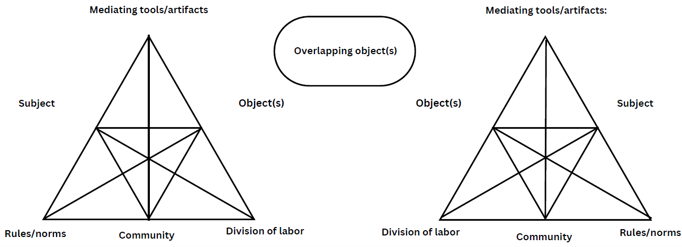
In CHAT, the complex interactions between systems are explicitly considered. In fact, Engeström (2001) suggests that the most learning occurs in times of tension arising from a “conflict of motives” (Engeström, 2017, p. 359) and resulting in a process he calls expansive learning. He considers this to be the creation of new knowledge (in contrast to someone acquiring already existing knowledge), and such a perspective suggests that at its most basic level, no true experts exist within interacting systems and all are learners.
One feature of CHAT that seems particularly salient for understanding how partnerships among different systems come to be (or not be) is that of knotworking. Knotworking refers to the process by which knowledge is co-created when two activity systems come together purposefully in collaboration to solve a novel problem or intersect when a problem arises (Engeström, 2001). In the section that follows, we unpack this process a bit more.
A Closer Look at Knotworking
What was once presented by Engeström (1999) as a largely theoretical construct, knotworking has since been applied in a variety of contexts in an effort to account for and to predict the kinds of negotiations which must take place, both initially and in an ongoing way, in order for that partnership to be productive – that is, to be beneficial to all parties involved. It has been used by scholars and practitioners alike to account for the work done in a partnership in such contexts as diverse as specific-use building construction (such as schools and community centers, e.g., Kerosuo, 2018), healthcare (such as physician education, e.g., Elmberger et al., 2020), patient care teamwork (Colvin, 2017; Varpio & Teunissen, 2020), and K-12 education (such as teacher professional development, e.g., Andrews, 2022). In our work, we use the idea of knotworking as a key feature in the development and maintenance of another kind of partnership, which also involves complex relationships and goals, successful partnerships between different science education entities, both formal and informal.
As noted earlier, knotworking is critical in situations where no single entity within a partnership system possesses the expertise to solve the emerging problem on its own, and it is not uncommon for disagreements or tension to arise. As a core feature of CHAT, this idea of learning through conflict is a valued and named process that is extremely important when two organizations with different goals, histories, and cultures work together.
As tension and conflict are negotiated, the subjects of participating activity systems may evolve and learn to collaborate through shared practices in response to novel problems in a process called co-configuration (Engeström, 2004). “Co-configuration requires flexible ‘knotworking’ in which no single actor has the sole, fixed authority” (Engeström, 2004, p. 13). Learning through co-configuration occurs between and within “loosely interconnected activity systems and organizations … representing different traditions, domains of expertise, and social languages” (Engeström, 2004, p. 16). In other words, as different organizations with different goals, norms, and histories work together to solve a problem, co-configuration occurs as they learn to collaborate and develop some shared practices or merge some existing practices. It does not occur when one partner has authority over the other or tries to force the other to adopt their practices.
Knotworking also is not a ‘one-and-done’ process. Rather, it is “a longitudinal process in which ‘knots’ are formed, dissolved, and reformed as the ‘object’ is co-configured time and time again” (Engeström, 2001, p. 973). The metaphor of knots being tied and untied allows for consideration of each partner as an otherwise separate entity (rope), coming together with another as they collaborate (tie and untie different types of knots). Knotworking also requires “rapid negotiation and improvisation with constantly changing configurations of partners” (Engeström, 2001, p. 973). Most of all, this process requires that each partner organization recognizes the unique knowledge/skills/resources that the other partner(s) bring to the table, along with the value of making use of these unique contributions to ensure a successful outcome with respect to the problem(s) they have jointly identified as the target of their work together. If the knotworking is effective, partners can develop agency (Andrews, 2024) and this can lead to the kind of resilience that allows them to respond to challenges in meaningful, productive, and often innovative ways.
Elmberger et al. (2020) have studied knotworking in the context of a healthcare system and have described three components of knotworking that occur in a cyclical, iterative process. These are negotiation, reconceptualization, and reconciliation. Negotiation is the process of mediating and aligning the goals and practices of the systems. Within a partnership, negotiation includes conversations around goals, norms, and practices of the partner organizations and how these will be addressed, especially if they are in conflict. This would likely happen at the beginning of a partnership, but goals may also need to be renegotiated within this iterative process. Reconceptualization is the testing and adjusting of innovation, as well as working through tensions and conflicts that arise. As partners create new innovative programming, there are likely going to need to be adjustments, and this process of reconceptualization requires good communication and compromise between organizations. Finally, reconciliation is the step that occurs when equilibrium is reached, tensions and conflicts are temporarily solved, but this does not mean the work is finished. Reconciliation is creating a plan for iterative work with no fixed endpoint in sight. In Figure 2, we provide a visual representation of knotworking, representing both the partner components (people, mediating tools, and norms & rules) and processes (negotiation, reconceptualization, and reconciliation).
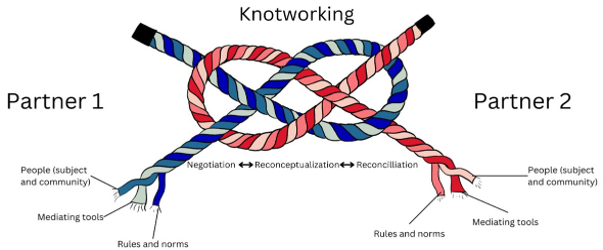
Knotworking produces something new in the center of the intertwining partners; in the case of STEM learning partnerships, this is the new program created by two disparate organizations coming together in a new way. Just like a crochet scarf is made from a series of knots, a new partnership is also made from a series of interactions. We also represent the different aspects of each partner organization as the “plies” within each partner “rope.” Yarn or rope with more plies is stronger; the strength of each partner system exists in its complexity.
STORIES OF KNOTWORKING
We next share two illustrative stories constructed from interviews we conducted with informal science educators whose organizations were involved in STEM partnership work; we use these to illustrate the usefulness of knotworking – either by the presence or absence of their component parts – as a lens through which to examine the conditions necessary for the successful development of STEM education partnerships.
Story 1. A Nature Center and a Boxing Gym
Liam, worked as an interpreter for a nature center. The partnership in question was between this nature center (partner 1) and a local boxing gym (partner 2) that together sponsored an after-school program (mediating tool). Despite being a partnership between two very different organizations with different goals, Liam expressed great pride in the success of the program and explained that through intentional collaborative efforts, the two organizations have each been able to accomplish their distinct goals. The nature center had both experiential educational goals as well as nature conservation goals (norms & rules), wishing to encourage people to “experience and celebrate nature in a way that benefits them and that benefits nature.” By introducing people to the natural world and fostering care for it, something they accomplished through regular programming focused on exploration and appreciation of nature (mediating tool), the nature center’s leadership hoped that such caring would translate into practices that would encourage stewardship and benefit environmental conservation.
In contrast, the boxing gym had very different goals for the students with whom they worked. Liam explained that in discussion with boxing gym staff (people), they learned that the gym staff’s goals were to increase graduation rates for their participants and to provide them with new experiences as well as opportunities for physical activity, with a particular focus on health (norms & rules). Although the goals of these partner organizations were quite distinct when the partnership began, through collaboration, they were able to create programming that converged by having students in outdoor spaces, making movement in and around that space a regular feature, and incorporating direct engagement with nature (mediating tools); as a result, the partnership has not only continued but has grown and flourished over several years.
This does not mean that there were no tensions to work through, especially in the early days of the partnership. Something that was extremely important in the beginning was developing trust. The staff at the boxing gym told Liam that they had worked with many different community partners in the past, some of which had been productive collaborators and some which had withdrawn or not even shown up after initial agreements had been made. Their priority was that students have consistency, specifically consistent adults present in their lives, with an emphasis on continuity of relationships with other organizations. Thus the interpreters at the nature center had to earn staff’s trust by being consistently present and listening to the needs of students and staff. This meant the nature center had to become more flexible with regard to several of their established expectations. More specifically, for example, maintaining high graduation rates was a primary goal of the afterschool program, which meant that if a student was behind academically, they were not allowed to participate in the nature center activities. They also told the nature center interpreters that setting high expectations for students and being firm in these was a norm for their organization. Nature center education most often is more experiential and utilizes free choice learning, so Liam and the other interpreters had to identify common ground with the staff at the boxing gym and take on some of the boxing gym’s norms, particularly since they were conducting programming within the gym’s physical space. This partnership began its fourth semester at the time the interview took place.
Both partners have benefited greatly from this partnership. Through this work, the nature center has been able to reach a larger group of students, many of whom had never visited the center before, even though it is located close by; they have now visited the center as a group at least once each semester. And the afterschool program at the boxing gym has not only maintained the high graduation rates that it is known for but has also been able to provide new experiences for their participants.
This partnership exemplifies some of the key components of the knotworking process in important ways. In terms of negotiation, the boxing gym and the nature center had strong and clear communication from the beginning of their partnership. They took the time to discuss their unique goals and express a willingness to compromise, but at the same time were able to reinforce those aspects of programming they felt were core to their mission and thus were important to retain. In addition, they engaged in shared decision-making, meaning that neither partner had the “last say” or seemed to have more power over the other. Both partners were able to incorporate unique aspects of their own programs to create something new. Similarly, they had co-ownership over the programming. The educators in both spaces had a voice in programming and took on some of the norms held by their partner and as a result were able to create something even more powerful for learners.
In terms of reconceptualization, Liam and the boxing gym staff had come together multiple times to discuss how things were going and to revisit topics of discussion. Because programming took place at the boxing gym location, the nature center did have to compromise more in the beginning to align with the rules and norms of the boxing gym, the main example of which was that students were not allowed to participate if they were behind academically. However, Liam noted that “we’ve talked about different ways that maybe we can work around that,” and he said this interview served as a good reminder to check in about it again with the boxing gym staff. The partnership has been marked by ongoing and open communication and a willingness to renegotiate action and to work through tension, a reflection of reconciliation.
Story 2. A Nature Center and Local School
Coral, also a nature center interpreter, held the position of assistant education director at a Midwest nature center, which had an ongoing partnership with a local school in which they provided nature education programming. The partnership began when, several years previously, the school reached out to the nature center with a desire to do programming that would bring one grade of the school to the center while the teachers stayed back and dealt with administrative tasks. Coral believed that a large part of the success was because the school had already bought into the idea. Coral began working just before the start of a new school year and had several meetings with school administrators to discuss the goals of the partnership.
As school started I was introduced to the principal and the STEM coordinator and in that time they kind of explained what they’ve done in the past with [the school], and explained what they wanted to do in the future, and we had a probably a series of 4 or 5, like small, introductory meetings … I met with the principal alone. I met with the STEM teacher alone. I met with them both together. And we just kind of brainstormed ideas.
Although the partnership was ongoing, Coral felt that more of the teacher and administrative needs of the school, rather than the students’ needs, were being addressed. Large numbers of students at a time meant that the nature of the experience for students was recreational rather than educational. Coral believed one reason for this was that teachers’ schedules were so bound by testing, but also the fact that Coral and the nature center were not always aware of the school’s testing schedule, which impacted programming several times. Staff at the nature center expressed that they would like to be more of a supplement to students’ science learning, but their perception was that the school viewed the programming they provided as more of an engaging distraction or reward for their students around testing time. In addition, the schedule that the school provided for the nature center’s activities has four classes rotating through their programming in 90 minutes. Coral shared the concern that this did not really give them time to do anything meaningful with the students, but that the teachers and administrators of the school preferred this schedule because it aligned with their current school schedule and did not require any shuffling of class schedules or curriculum, which was convenient for teachers. During the interview, Coral also shared that after limited success with email communication, they were planning an in-person meeting to re-evaluate the program in the hopes of “giving students the time to actually do activities and to learn and experience stuff”, providing an opportunity for both partners to now engage in some knotworking, making their goals and reasoning clear, as it seems the reluctance to address any conflict led to a partnership that was not meeting everyone’s needs.
With respect to the ways in which knotworking has been present as part of the partnership process in this case, the nature center was still struggling with negotiations related to having their own goals met through the partnership. Because their rules & norms were not apparent to the school partner, they were unable to engage in effective knotworking. It is interesting to note that the interview was conducted several days before the nature center and school leadership were scheduled to meet in order to articulate their respective goals, rules, and norms, and to hopefully enter into negotiations about how these respective priorities could be met through a reconceptualization of the existing partnership.
DISCUSSION AND CONTRIBUTION
The calls for STEM partnerships have created opportunities for organizations to collaborate in creating new, innovative opportunities for STEM learning in multiple contexts. These partnerships also have the potential to offset the insufficient time spent on science, especially in elementary schools, and declining student interest in STEM (Steidtmann et al., 2023). They also have the potential to supplement classroom science education and to create a richer science learning ecosystem (NRC, 2015). Thus, research on STEM partnerships is vital as a way to provide guidelines for their development and sustainability. In this paper, we offer CHAT as a lens for such research efforts. This lens provides scholars with a tool that affords a roadmap as well as a set of guidelines for exploring both the development and maintenance of such partnerships.
In our empirical work (e.g., Richmond et al., 2024), we found that successful partnerships contain eight fundamental elements: access to resources, good communication, flexibility, trust, time to engage in the partnership, aligned goals, buy-in from stakeholders, and building positive relationships. While these may appear obvious, many partnerships lack one or more of them, and the field would be advanced by understanding more deeply . struggle to reach those goals. This demands a deeper understanding of how it is that partnerships stumble. CHAT appears to us to be a useful theoretical tool for making sense of both successes and failures. This theoretical framework provides a language for talking about how institutional cultures develop and how similarities/differences in these cultures can be navigated among SLE partners and a successful partnership established and maintained. More specifically, knotworking has allowed us to dig deeper into the relationships between organizations, giving us a framework with which to theorize what specific aspects of communication might be key to creating the most successful STEM partnerships.
SLEs is a multi-site, complex idea of how people learn science in a large variety of contexts. In larger partnerships across multiple sites, knotworking could help us understand the complexity of the interactions that occur between these sites and can provide a framework that can be used to build collaboration among partners. As the two stories illustrate, a partnership marked by meaningful knotworking through negotiation, reconceptualization, and reconciliation enabled educators at the nature center and the boxing gym to advocate for their own disparate objectives while also maintaining open lines of communication and flexibility that allowed the partnership to flourish. In contrast, the partnership between the nature center and an elementary school was at a stage where knotworking might have served as a timely and effective way to move that relationship forward in order to increase the probability of success for each of the partners involved. As funding in both informal and formal education spheres has been precariously positioned in recent years, it becomes even more critical that we understand how to foster successful STEM partnerships that have demonstrable, powerful, and long-lasting outcomes on science engagement and literacy for all stakeholders. We hope that this paper encourages further research using knotworking to analyze the efficacy of such partnerships to support the development of STEM literacy across learners’ lives.
Author contributions: All authors sufficiently contributed to this study and agreed with the results and conclusions.
Funding: This study was funded by a grant from the National Science Foundation (GRANT #1907506).
Ethical statement: The empirical work from which several of the ideas contained in this theoretical/conceptual paper were drawn was approved by the institution's review board and consent was obtained from all participants.
AI statement: No generative AI or AI-based tools were used in any phase of this work or the writing of this paper.
Declaration of interest: No conflict of interest is declared by the authors.
Data sharing statement: Data supporting the findings and conclusions are available upon request from the corresponding author.
References
- Allen, P. J., Lewis-Warner, K., & Noam, G. G. (2020). Partnerships to transform STEM learning: A case study of a STEM learning ecosystem. Afterschool Matters, 31, 30-41.
- Andrews, D. (2022). Considering knotworking as a theoretical tool to enable pedagogical responsiveness in complex systems. In E. Walton, & R. Osman (Eds.), Pedagogical responsiveness in complex contexts. Inclusive learning and educational equity, vol 9 (pp. 95-110). Springer. https://doi.org/10.1007/978-3-031-12718-2_6
- Andrews, D. (2024). Sustainability of knotworking as a teacher professional development strategy. Journal of Education, (96), 117-139. https://doi.org/10.17159/2520-9868/i96a07
- Bevan, B., & Dillon, J. (2010). Broadening views of learning: Developing educators for the 21st century through an international research partnership at the exploratorium and King’s College London. New Educator, 6(3/4), 167-180. https://doi.org/10.1080/1547688X.2010.10399599
- Bevan, B., Garibay, C., & Menezes, S. (2018). What is a STEM learning ecosystem? NISE Network. https://www.nisenet.org/sites/default/files/catalog/uploads/informal_science_broadening_participation_bp-7-stem-learning-ecosystem_2019.pdf
- Colvin, J. W. (2017). Knotworking in an emergency response team: Understanding team communication and process. Qualitative Research in Medicine and Healthcare, 1(3), Article 7115. https://doi.org/10.4081/qrmh.2017.7115
- Dillon, J., & Wong, V. (2025). Learning from the past; thinking for the future: Reflections on STEM and its integration in formal and informal settings. International Journal of STEM Education, 12, Article 32. https://doi.org/10.1186/s40594-025-00552-4
- Elmberger, A., Björck, E., Nieminen, J., Liljedahl, M., & Bolander Laksov, K. (2020). Collaborative knotworking – Transforming clinical teaching practice through faculty development. BMC Medical Education, 20, Article 497. https://doi.org/10.1186/s12909-020-02407-8
- Engeström, Y. (1999). Activity theory and individual and social transformation. In Y. Engeström, R. Miettinen, & R.-L. Punamaki (Eds.), Perspectives on activity theory (pp. 19-38). Cambridge University Press. https://doi.org/10.1017/CBO9780511812774.003
- Engeström, Y. (2001). Expansive learning at work: Toward an activity theoretical reconceptualization. Journal of Education and Work, 14(1), 133-156. https://doi.org/10.1080/13639080020028747
- Engeström, Y. (2004). New forms of learning in co-configuration work. Journal of Workplace Learning, 16(1-2), 11-21. https://doi.org/10.1108/13665620410521477
- Engeström, Y. (2017). Expanding the scope of science education: An activity-theoretical perspective. In K. Hahl, K. Juuti, J. Lampiselkä, A. Uitto, & J. Lavonen (Eds.), Cognitive and affective aspects in science education research. Contributions from science education research, vol. 3 (pp. 357-370). Springer. https://doi.org/10.1007/978-3-319-58685-4_26
- Hecht, M., & Crowley, K. (2020). Unpacking the learning ecosystems framework: Lessons from the adaptive management of biological ecosystems. Journal of the Learning Sciences, 29(2), 264-284. https://doi.org/10.1080/10508406.2019.1693381
- Hofstein, A., & Rosenfeld, S. (1996). Bridging the gap between formal and informal science learning. Studies in Science Education, 28(1), 87-112. https://doi.org/10.1080/03057269608560085
- Kerosuo, H. (2018). Knotworking: An emerging form of multi-party collaboration between clients, users and designers in school design. In H. Ming Tse, H. Daniels, A. Stables, & S. Cox (Eds.), Designing buildings for the futures of schooling: Contemporary visions for education (pp. 131-148). Routledge.
- NRC. (2009). Learning science in informal environments: People, places, and pursuits. National Academies Press.
- NRC. (2012). A framework for K-12 science education: Practices, crosscutting concepts, and core ideas. National Academies Press.
- NRC. (2015) Guide to implementing the next generation science standards. National Academies Press.
- Penuel, W. R., Clark, T. L., & Bevan, B. (2016). Infrastructures to support equitable STEM learning across settings. Afterschool Matters, 24, 12-20.
- Richmond, G., Hunter, R., Tal, T., & Tukurah, G. (2024). Communities of practice and the elevation of urban elementary teacher discourse about critical pedagogy of place. Cultural Studies of Science Education, 19(2), 417-442. https://doi.org/10.1007/s11422-024-10221-7
- Schweingruber, H. A., & Fenichel, M. (Eds.). (2010). Surrounded by science: Learning science in informal environments. National Academies Press.
- Shaby, N., Staus, N., Dierking, L. D., & Falk, J. H. (2021). Pathways of interest and participation: How STEM-interested youth navigate a learning ecosystem. Science Education, 105(4), 628-652. https://doi.org/10.1002/sce.21621
- Steidtmann, L., Kleickmann, T., & Steffensky, M. (2023). Declining interest in science in lower secondary school classes: Quasi-experimental and longitudinal evidence on the role of teaching and teaching quality. Journal of Research in Science Teaching, 60(1), 164-195. https://doi.org/10.1002/tea.21794
- Varpio, L., & Teunissen, P. (2020). Leadership in interprofessional healthcare teams: Empowering knotworking with followership. Medical Teacher, 43(1), 32-37. https://doi.org/10.1080/0142159X.2020.1791318
- Wade-Jaimes, K., Ayers, K., & Pennella, R. A. (2023). Identity across the STEM ecosystem: Perspectives of youth, informal educators, and classroom teachers. Journal of Research in Science Teaching, 60(4), 885-914. https://doi.org/10.1002/tea.21820
How to cite this article
APA
Kenimer, E., Richmond, G., & Hunter, R. H. (2026). From not working to knotworking: The role of cultural-historical activity theory in supporting the development of STEM learning ecosystems. Interdisciplinary Journal of Environmental and Science Education, 22(4), e2625. https://doi.org/10.29333/ijese/19938
Vancouver
Kenimer E, Richmond G, Hunter RH. From not working to knotworking: The role of cultural-historical activity theory in supporting the development of STEM learning ecosystems. INTERDISCIP J ENV SCI ED. 2026;22(4):e2625. https://doi.org/10.29333/ijese/19938
AMA
Kenimer E, Richmond G, Hunter RH. From not working to knotworking: The role of cultural-historical activity theory in supporting the development of STEM learning ecosystems. INTERDISCIP J ENV SCI ED. 2026;22(4), e2625. https://doi.org/10.29333/ijese/19938
Chicago
Kenimer, Eleanor, Gail Richmond, and Roberta H. Hunter. "From not working to knotworking: The role of cultural-historical activity theory in supporting the development of STEM learning ecosystems". Interdisciplinary Journal of Environmental and Science Education 2026 22 no. 4 (2026): e2625. https://doi.org/10.29333/ijese/19938
Harvard
Kenimer, E., Richmond, G., and Hunter, R. H. (2026). From not working to knotworking: The role of cultural-historical activity theory in supporting the development of STEM learning ecosystems. Interdisciplinary Journal of Environmental and Science Education, 22(4), e2625. https://doi.org/10.29333/ijese/19938
MLA
Kenimer, Eleanor et al. "From not working to knotworking: The role of cultural-historical activity theory in supporting the development of STEM learning ecosystems". Interdisciplinary Journal of Environmental and Science Education, vol. 22, no. 4, 2026, e2625. https://doi.org/10.29333/ijese/19938