 Full Text (PDF)
Abstract
The development of low-cost alternative laboratory tools has become increasingly important for interdisciplinary teaching in physics, chemistry, and mathematics. In this study, high school students applied project-based learning and investigation teaching sequences methodologies to design and build an alternative viscometer for educational use. This device was employed to measure the flow times and estimate the viscosities of ten commercial detergent brands, classified as Newtonian and quasi-Newtonian fluids. Results showed that the alternative viscometer produced consistent viscosity and density measurements, demonstrating its potential as a practical, low-cost instrument to enhance science and mathematics education.
License
This is an open access article distributed under the Creative Commons Attribution License which permits unrestricted use, distribution, and reproduction in any medium, provided the original work is properly cited.
Article Type: Research Article
INTERDISCIP J ENV SCI ED, Volume 22, Issue 2, 2026, Article No: e2614
https://doi.org/10.29333/ijese/18526
Publication date: 05 May 2026
Article Views: 1011
Article Downloads: 854
Open Access HTML Content Download XML References How to cite this articleHTML Content
INTRODUCTION
The construction of alternative equipment and instruments using recyclable and reusable low-cost materials emerges as a promising and environmentally sustainable solution (Chen & Breeding, 2022; Gonçalves & Goi, 2020; Harrison et al., 2025; Idul et al., 2025), capable of contributing both to reducing environmentally polluting waste (Bhanderi et al., 2023; Enayati et al., 2023; Massoud & Dsilva, 2025; Muringayil et al., 2024) and substantially improving the teaching and learning of curricular components in the Natural Sciences, Mathematics, and its Technologies area.
According to Monegro et al. (2024), it is estimated that by 2050, plastic accumulation in landfills and water bodies will reach an astonishing 12,000 mt, with only 9% being recycled and the remainder incinerated or deposited in landfills.
Zhao et al. (2024) highlights that waste rubber is another pollutant of great concern, commonly referred to as black pollution Approximately 1.5 billion used tires are generated annually worldwide, with China contributing around 20 million tons of used tires each year, growing at an annual rate of 6-8% (Hashamfirooz et al., 2025; Jiang et al., 2023; Machin et al., 2017; Zaki et al., 2025).
Therefore, proposals and resources presented in the literature that address interdisciplinary teaching in physics, chemistry, and mathematics, particularly involving the construction of equipment and instruments made from recyclable and reusable materials (such as rubber, paper, plastic, glass, etc.), are essential today to reduce the disposal of environmentally harmful products (Fritz et al., 2025; Gonçalves & Goi, 2020; Panda et al., 2020; Snovarski Fonseca et al., 2018).
To promote and support interdisciplinary teaching and learning in physics, chemistry, and mathematics at the high school level (Borji & Martínez-Planell, 2023; Gruver & Hawthorne, 2023; Niemann et al., 2024; Setlik & Silva, 2023; Stroumpouli & Tsaparlis, 2022), this study introduces an Alternative Viscometer constructed from low-cost, recyclable, and reusable materials. The device is designed to experimentally determine physicochemical properties such as density and viscosity of surfactant-based detergents widely marketed as household cleaning products in Brazil (Hajikarimi & Moghadas, 2021a, 2021b; Malkin & Isayev, 2012).
Andraca et al. (2013) for instance, studied the temperature-dependent viscosity of honey and observed a linear relationship based on the WLF equation. This shows that it is possible to adapt and present alternative interdisciplinary approaches to teaching Physics, Chemistry, and Mathematics (Andraca et al., 2013; Lähde et al., 2022).
Viscous materials such as lubricating oils can also serve as a viable alternative for studying viscosity in the context of diversified classes. Sodré et al. (2011) presented a study relating to increased oil viscosity with reduced production of unburned hydrocarbons.
The topic of viscosity can be explored in various teaching contexts at the high school level. In a study by Patel et al. (2022) the authors addressed rheology, an interdisciplinary field involving physics, chemistry, biology, and mathematics. They studied the steady and dynamic shear of Indian jujube (ziziphus mauritiana lam.) pulp and were able to determine several physicochemical, textural, and thermal properties of the fruit.
A wide range of commercial products, familiar to students, can be incorporated into diversified classes as tools for teaching and learning. One example is determining the viscosity of ethanol-based hand sanitizing gels (Xie et al., 2023), a widely used pharmaceutical product in recent years as a preventive measure during the COVID-19 pandemic peak in 2020 (Berardi et al., 2020; Oliveira D’Alessandro et al., 2023).
In this work, the main objective was to present an alternative methodology for building a low-cost viscometer instrument for experimental activities in diversified classes of physics, chemistry, and mathematics. The instrument was specifically developed to be applied in measuring the viscosities of sanitizing detergents widely commercialized in Brazil (Hashmi et al., 2022; Liu et al., 2022; Meffan et al., 2023).
INTERDISCIPLINARY EDUCATIONAL METHODOLOGIES
In the context of chemistry education, there is a growing need to implement innovative methodological strategies that promote more effective teaching and learning processes. Considering the limitations currently faced, several problems are associated with students’ difficulties in understanding abstract chemical concepts, which may be linked to the lack of contextualization and the absence of experimental activities, the latter being described as crucial tools for promoting more meaningful learning (Asaki & Adu-Gyamfi, 2025; Almahdawi et al., 2025).
There are many established methodologies in the expert literature directed uniquely for teaching and learning which are poorly explored for both elementary and high school levels. In this work, the combination of educational principles found in the “Metodologias de ensino por aprendizagem baseada em projetos (ABP) e sequência de ensino por investigação (SEI) [Project-based learning teaching methodologies and investigation learning sequence]” was prioritized (Astawa et al., 2017; Bell, 2010; Pérez-Sánchez et al., 2018; Zhang & Ma, 2023).
Through the project-based learning and the investigation learning sequence, teaching models consisting of inciting reflections on issues or necessities perceived in the daily lives of students, were adopted as notable methodologies so that, within an universe of perceptions and observations of products sold and consumed daily, the would propose alternative models of creative experimental projects to verify and/or determine physical and chemical properties of marketed products associated with the interdisciplinary themes applied in the class setting, thus employing mathematical statistical principles and groundwork through the use of software, such as Excel, GeoGebra, Apple Numbers, Quip, EtherCalc, etc., with ample access facilitated by different kinds of electronic devices and equipment. In this work, the adopted methodologies were systematically aligned with criteria based on the learning objectives and goals established in the document “base nacional comum curricular [national common basic curriculum]” (Ministério da Educação, 2018).
Thus, in order to include the interdisciplinarity between different curriculum components, the students worked with theme “Newtonian or quasi-Newtonian fluids”, as this subject encompasses the possibility of interlinking concepts involving different “high school” curricular disciplines, such as physics, chemistry, and mathematics, in “classroom and interdisciplinary experimental laboratory practices” settings.
MATERIALS AND METHODS
Mass and Density Measurement of Commercial Detergents
Three samples of commercial materials in graduated cylinders containing fixed volumes of 100 mL were analyzed for indirect measurements of commercial detergents density. Furthermore, the analysis of samples of different commercial products followed an experimental procedure of triplicate measurements rigorously. This is a recommended model for educational laboratories because it is an acceptable compromise between accuracy and work (Firmani et al., 2020). Thus, the following equipment and instruments used in the triplicate analysis are described in Table 1.
Table 1. Equipment employed for measuring mass and density of commercial detergents
|
The chart in Figure 1 presents the steps for the measurement of “masses (m) and densities (d) of commercial products” taken as examples of Newtonian or quasi-Newtonian fluids (Eq. [1] and Eq. [2]).
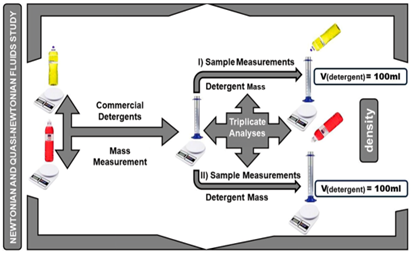
Initially, direct measurements of the integral mass of 10 different brands of commercial detergents were performed on a B-Max® digital electronic scale sold in the “state of tocantins”. Afterwards, the mass of graduated glass cylinders with maximum volume graduation of 100 mL was measured using the same electronic scale. The weighing procedure of measurement recipients containing 100 mL volumetric samples of commercial detergents was repeated in triplicate and, after subtracting the particular mass of each graduated cylinder from the total composition of masses (Eq. [1]), only the amounts for the mass of Newtonian or quasi-Newtonian fluids were obtained. When relating the mass of fluids with the volumes of graduated cylinders, the amounts of “commercial product density” were obtained indirectly (Eq. [2]).
|
\[m_{(commercial\ detergent\ sample)}\] \[= m_{(graduated\ cylinder + detergent)}{- m}_{\lbrack graduated\ cylinder(v = 100ml)\rbrack}\] |
(1) |
|---|
| \[d_{detergent}^{T = 22 \rightarrow 28ºC} = \frac{{Mass}_{(commercial\ detergent\ sample)}}{{Volume}_{(graduated\ cylinder\ with\ fixed\ 100\ mL\ of\ commercial\ detergent)}} = \frac{m}{v}\] | (2) |
|---|
Production of an Alternative Viscometer Based on Low-Cost Materials
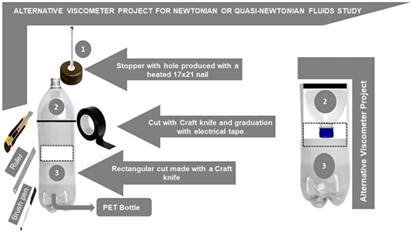
The alternative, low commercial cost materials used in the production of the viscometer prototype to measure “Newtonian or quasi-Newtonian fluids” are presented in (Table 2).
Table 2. Low commercial cost materials used in the production of the viscometer prototype
|
The production of an “alternative viscometer” with alternative, low-cost materials as a proposal of experimental laboratory instrument resource for interdisciplinary teaching and learning in “diversified laboratory classes of physics, chemistry, and mathematics” was produced as presented in the ordered steps of the illustrated flowchart in Figure 2.
Viscosity Measurement of Newtonian or quasi-Newtonian Fluids with Standard and Alternative Viscometers
Ford cup no. 4, manufactured by “Nalgon Equipamentos Científicos LTDA”, is produced with polypropylene, stainless steel, anodized aluminum, brass metallic orifice and is corrosion resistant. This viscometer was standardized as per “NBR rules–5849, MB–1117 and ASTM D–1200. It is distinctly used for analyses involving only Newtonian or quasi-Newtonian fluids.
However, the evaluation of thixotropic products (non-Newtonian) must be intrinsically avoided. Prior to any viscometry assessment with “Ford cups”, perform tests in a windless area, without rapid changes in temperature, and, for greater precision, the local temperature must be between 22 and 28 ºC. The safe viscosity range for flow assessments with “Ford cup no. 4 (∅orifice diameter = 4.12 mm)” is between 40 and 370 CsT (mm2 s-1). Basically, a chronometer and a standing thermometer must be used in the viscometrical analysis when using the viscometer no. 4 for “Newtonian or quasi-Newtonian fluids” (Table 1).
Triplicate measured times characteristic of Newtonian and non-Newtonian fluids must be obtained at the “first visual shearing of commercial products” during the flow process both for the “standard viscometer” and the “alternative viscometer” (Figure 3).
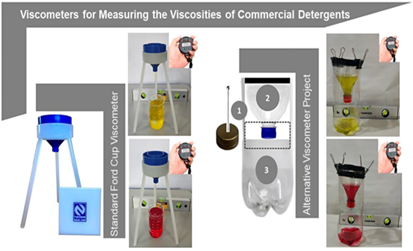
Subsequently, in order to obtain the estimated values for viscosity of the 10 brands of “detergents sold in the state of tocantins”, a “time-dependent (𝑣) viscosity function (𝑡)” already presented by “Nalgon Equipamentos Científicos LTDA” for the “Ford cup no. 4”, as below: 𝑣(𝑡) = 3.85𝑡 − 17.2865 (Eq. [3]).
Where the angular coefficient of the line is 3.85 and the linear correlation coefficient (r) is equal to 0.99, obtained through a thorough conditional statistical procedure study of variables involving “linear regression”, characteristically disposed at the Cartesian time coordinate, and the linear coefficient of the line with a value equal to -17.2865, obtained around the point limits (𝑡 → 0), statistically located and estimated at the viscosity value coordinates 𝑣(𝑡). Nalgon Equipamentos Científicos LTDA has a statistical control data archive regarding the precision and exactness of the “Ford cup no. 4” with assured maximum experimental statistical deviation of 1% at the conditions and temperature range of 22 to 28 ºC.
RESULTS AND DISCUSSION
Students produced (Table 3), which contains statistical data related to the triplicate measurement of the mass of commercial detergents, obtained from employing data treatment with the software Excel. They were encouraged to work with Excel tabs that already contain proposals for building and treating “statistical calculations” (Silva de Souza & Borges, 2023). Thus, the statistical values of means (µg), variances (Δσg), standard deviations (σg) and coefficients of variation as percentages (CV%) were observed as individual statistical parameters for each “commercial product” as examples of Newtonian and/or quasi-Newtonian fluids and presented coherent statistical values between the analyzed parameters. Information on the statistical parameters that establish the comparison between the whole mass of “commercial detergents” as statistical values of mean (µProducts[g]), variance (S2g), standard deviation (sg), and coefficient of variation as percentage (CV%) is presented in Table 3. In terms of analyzed statistical parameters, s(g) = 7.57 and CV = 1.45% are highlighted. The CV indicator observed in Table 3, in probability and statistics theory, is considered a low value for the presented data set, consequently meaning that there is a quality control during the industrial production of commercial detergents of different brands in Brazil.
Table 3. Statistical estimates of mass of different brands of commercial detergents
| |||||||||||||||||||||||||||||||||||||||||||||||||||||||||||||||||||||||||||||||||||||||||||||||||||||||||||||||||||||||||||||||||||||||||||||||
Proceeding with experimental studies and statistical treatments for “commercial products”, classified as Newtonian and/or quasi-Newtonian fluids, as they are presented in Table 4. Students estimated the mean values of relative density for samples of “commercial detergents” in triplicate. Thus, the mean mass of samples was employed as presented in Table 3. Densities estimated from statistical analysis presented a mean of 0.99 g mL-1 with a standard deviation of 0.0136 g mL-1 and a coefficient of variation of 1.37%. Students were able to compare estimated statistical standards for density analysis between the different “commercial products” studied and, overall, were able to show through the observed data that statistical parameters showed dispersion values deemed low and insignificant; thus, the commercial detergents are standardized and follow certain manufacturing quality control parameters.
Table 4. Statistical estimates of density of different commercial detergent brands
| ||||||||||||||||||||||||||||||||||||||||||||||||||||||||||||||||
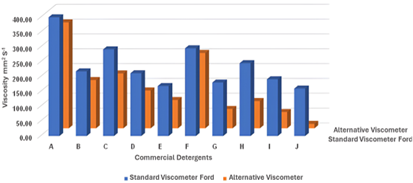
Concerning Table 5 and Table 6, the viscosities estimated from statistical parameters based on flow time obtained by “standard viscosimeter Ford no. 4 and alternative” are presented. In Table 5, note the values of flow time measured for the determination of viscosities (Ѵ1 [mm2 s-1]) of commercial detergents. When observing all brands of commercial products, detergent A showed the greatest estimated mean value of 399.82 mm2 s-1; followed by detergent F 295.33 mm2 s-1; detergent C 291.71 mm2 s-1, detergent H 245.21 mm2 s-1, detergent B 217.60 mm2 s-1, detergent D 211.21 mm2 s-1, detergent I 191.00 mm2 s-1, detergent G 179.99 mm2 s-1, detergent E 168.17 mm2 s-1 e detergent J 159.58 mm2 s-1, respectively, in decreasing order of estimated viscosity values. Seek proposals for the required explanations regarding the decreasing sequence of estimated viscosity values, students performed a thorough investigation on possible causes for the obtained data. Among the several proposals discussed, they arrived at the consensus that the chemical ingredients employed were handled with small percentage variations of its respective masses (m/m%).
Table 5. Statistical Estimates of viscosity with standard viscometer Ford no. 4
| ||||||||||||||||||||||||||||||||||||||||||||||||||||||||||||||||||||||||||||||||||||||||||||||||||||||||||||||||||||||||||||||||||||||||||||||||||||||||
Table 6. Statistical estimates of viscosity with the alternative viscometer
| ||||||||||||||||||||||||||||||||||||||||||||||||||||||||||||||||||||||||||||||||||||||||||||||||||||||||||||||||||||||||||||||||||||||||||||||||||||||||
When comparing the values presented in Table 5 and Table 6, it is possible to observe that estimated viscosity values are distinct and show significant differences regarding those estimated in Table 6, obtained through the “alternative viscometer (Figure 3)”. Therefore, it is also verified that, as observed in the data analysis of Table 5, mean viscosities estimated for the different “detergent brands” follow a decreasing order of values: detergent A 356.66 mm2 s-1, detergent F 253.87 mm2 s-1, detergent C 184.76 mm2 s-1, detergent B 162.28 mm2 s-1, detergent D 127.36 mm2 s-1, detergent E 95.13 mm2 s-1, detergent H 91.78 mm2 s-1, detergent G 65.10 mm2 s-1, detergent I 54.96 mm2 s-1 and detergent J 14.94 mm2 s-1, respectively, measured through the “alternative viscometer”. As the proposed measurement instrument was produced based on the “standard viscometer no. 4”, students hypothesized that the estimated mean viscosities values (Ѵ2 [mm2 s-1]) would also follow a decreasing order of values for the commercial detergents analyzed.
After meticulously analyzing Table 5 and Table 6, students plotted a chart using Excel tools, as shown in Figure 4, one for mean viscosities obtained with the “standard viscometer instrument Ford no. 4 (Ѵ1 [mm2 s-1])” and another with the “alternative viscometer instrument (Ѵ2 [mm2 s-1])”, which was proposed as an alternative for experimental studies with “Newtonian and/or quasi-Newtonian fluids.
The results of this study highlight the importance of implementing low-cost experimental approaches in chemistry education, contributing to the understanding of abstract concepts and promoting student engagement. In this context, the use of recyclable materials supports discussions related to environmental issues by encouraging sustainable practices and the responsible use of resources. These aspects reinforce the relevance of interdisciplinary approaches in science education. Therefore, for future studies, it is recommended to analyze the application of these methodologies in different educational contexts, as well as their long-term impact on the teaching and learning process and on environmental awareness.
CONCLUSION
The importance of developing alternative, low-cost instruments and equipment for experimentally diversified classes of sciences, mathematics, and its technologies has allowed students to better understand themes deemed complex that are presented in the fields of physics, chemistry, and math. The general objective proposed in this work was to determine the physical and chemical properties of 10 different brands of anionic surfactants, such as mass, volume, density, and viscosity, through alternative instruments and equipment produced with recyclable and reusable materials. In addition, through the principles and groundwork set in the “Project-based learning (ABP) teaching methodologies and investigation teaching sequence (SEI)”, students exchanged many kinds of knowledge in a dynamic relationship among their peers and set on to produce a viscometer with alternative materials capable of accurately and safely measuring flow times of “Newtonian and/or quasi-Newtonian fluids” of anionic surfactant products sold in Brazil, also called “Detergents”, by proposing resources for diversified classes that facilitate the understanding and learning of themes deemed complex associated with the teaching of sciences, mathematics, and its technologies.
Thus, through the alternative instrument produced by the students, they were able to determine the measured viscosities and successfully outline them statistically for different triplicate samples of “detergents” sold in Brazil. In light of the foregoing, it is also possible to produce new, alternative viscometers with recyclable and reusable materials based on capillary, falling-piston, rotational, vibrational viscometers, etc., which can be applied in other types of samples and physical and/or chemical systems. In summary, projects developed with alternative materials are becoming more necessary, both to improve teaching and learning and to promote more accessible, low-cost, diversified educational resources to the “teaching of sciences, mathematics, and its technologies”.
Author contributions: ESN: conceptualization, formal analysis, investigation, methodology, project administration, software, supervision, validation, visualization, and writing–review & editing; LLC: conceptualization, data curation, formal analysis, investigation, methodology, project administration, software, supervision, validation, visualization, writing–original draft, and writing–review & editing; MAA: conceptualization, formal analysis, investigation, methodology, software, validation, visualization, and writing–original draft; PLRT: conceptualization, formal analysis, methodology, software, validation, and visualization; GAAA: conceptualization, formal analysis, methodology, software, validation, and visualization; RMF & JHPO: conceptualization, formal analysis, methodology, software, validation, and visualization; & KLGS: conceptualization, data curation, formal analysis, investigation, methodology, software, supervision, validation, visualization, writing–original draft, and writing–review & editing. All authors agreed with the results and conclusions.
Funding: This study was supported by the Adá de Assis Teixeira State School, the Coordination for the Improvement of Higher Education Personnel, and the National Institute of Science and Technology for Food.
Ethical statement: The authors stated that the study did not involve human participants, animals, or any procedures requiring approval by an ethics committee; therefore, ethical approval was not required.
AI statement: The authors stated that no AI tools were used.
Declaration of interest: No conflict of interest is declared by the authors.
Data sharing statement: Data supporting the findings and conclusions are available upon request from the corresponding author.
References
- Almahdawi, M., Qablan, A., & Alyammahi, F. (2025). Factors influencing UAE high school chemistry students’ learning of organic qualitative analysis. Eurasia Journal of Mathematics, Science and Technology Education, 21(7), Article em2672. https://doi.org/10.29333/ejmste/16617
- Andraca, A., Goldstein, P., & del Castillo, L. F. (2013). Description of the viscosity of honeys in the supercooled regime. Physica A: Statistical Mechanics and its Applications, 392(24), 6206-6213. https://doi.org/10.1016/j.physa.2013.08.013
- Asaki, I. A., & Adu-Gyamfi, K. (2025). Teaching organic chemistry at the high school: Which factor predicts most of the difficulties? Educational Point, 2(1), Article e117. https://doi.org/10.71176/edup/16251
- Astawa, N. L. P. N. S. P., Artini, L. P., & Nitiasih, P. K. (2017). Project-based learning activities and EFL students’ productive skills in English. Journal of Language Teaching and Research, 8(6), 1147-1155. https://doi.org/10.17507/jltr.0806.16
- Bell, S. (2010). Project-based learning for the 21st century: skills for the future. The Clearing House: A Journal of Educational Strategies, Issues and Ideas, 83(2), 39-43. https://doi.org/10.1080/00098650903505415
- Berardi, A., Perinelli, D. R., Merchant, H. A., Bisharat, L., Basheti, I. A., Bonacucina, G., Cespi, M., & Palmieri, G. F. (2020). Hand sanitisers amid COVID-19: A critical review of alcohol-based products on the market and formulation approaches to respond to increasing demand. International Journal of Pharmaceutics, 584, Article 119431. https://doi.org/10.1016/j.ijpharm.2020.119431
- Bhanderi, K. K., Joshi, J. R., & Patel, J. V. (2023). Recycling of polyethylene terephthalate (PET Or PETE) plastics–An alternative to obtain value added products: A review. Journal of the Indian Chemical Society, 100(1), Article 100843. https://doi.org/10.1016/j.jics.2022.100843
- Borji, V., & Martínez-Planell, R. (2023). On students’ understanding of volumes of solids of revolution: An APOS analysis. The Journal of Mathematical Behavior, 70, Article 101027. https://doi.org/10.1016/j.jmathb.2022.101027
- Chen, Y., & Breeding, V. M. (2022). Think outside the trash: Transforming recyclables into physical activity equipment. Journal of Physical Education, Recreation & Dance, 93(3), 37-43. https://doi.org/10.1080/07303084.2021.2022043
- Enayati, M., Mohammadi, S., & Bouldo, M. G. (2023). Sustainable PET waste recycling: Labels from pet water bottles used as a catalyst for the chemical recycling of the same bottles. ACS Sustainable Chemistry & Engineering, 11(46), 16618-16626. https://doi.org/10.1021/acssuschemeng.3c04997
- Firmani, P., Vitale, R., Ruckebusch, C., & Marini, F. (2020). ANOVA–Simultaneous component analysis modelling of low-level-fused spectroscopic data: A food chemistry case-study. Analytica Chimica Acta, 1125, 308-314. https://doi.org/10.1016/j.aca.2020.05.059
- Fritz, A. P., Daumann, L. J., & Schwarzer, S. (2025). Bioleaching of rare earth fluorescent lamp phosphors using kombucha. Journal of Chemical Education, 102(5), 2096-2102. https://doi.org/10.1021/acs.jchemed.4c01532
- Gonçalves, R. P. N., & Goi, M. E. J. (2020). Experimentação no ensino de química NA educação básica [Experimentation in chemistry teaching in basic education]. Research, Society and Development, 9(1), Article e126911787. https://doi.org/10.33448/rsd-v9i1.1787
- Gruver, J., & Hawthorne, C. (2023). Classroom interactions that shape the nature of students’ appropriation of a complex mathematical practice. The Journal of Mathematical Behavior, 71, Article 101082. https://doi.org/10.1016/j.jmathb.2023.101082
- Hajikarimi, P., & Moghadas Nejad, F. (2021a). Application of viscoelasticity for experimental tests. In P. Hajikarimi, & F. Moghadas Nejad (Eds.), Applications of viscoelasticity (pp 141-180). Elsevier. https://doi.org/10.1016/b978-0-12-821210-3.00001-2
- Hajikarimi, P., & Moghadas Nejad, F. (2021b). Incremental form of viscoelastic relations. In P. Hajikarimi, & F. Moghadas Nejad (Eds.), Applications of viscoelasticity (pp 181-224). Elsevier. https://doi.org/10.1016/b978-0-12-821210-3.00004-8
- Harrison, T. G., Davies-Coleman, M. T., Rivett, A. C., Khan, M. A. H., Sewry, J. D., Wajrak, M., Barker, N. M., Furze, J., Franklin, S. D., Sellou, L., Shallcross, N. K. R., & Shallcross, D. E. (2025). A pollutant’s tale: An interactive talk on the chemistry of the earth’s climate and its response to pollutants. Journal of Chemical Education, 102(5), 2235-2242. https://doi.org/10.1021/acs.jchemed.4c00532
- Hashamfirooz, M., Dehghani, M. H., Khanizadeh, M., Aghaei, M., Bashardoost, P., Hassanvand, M. S., Hassanabadi, M., & Momeniha, F. (2025). A systematic review of the environmental and health effects of waste tires recycling. Heliyon, 11(2), Article e41909. https://doi.org/10.1016/j.heliyon.2025.e41909
- Hashmi, A. W., Mali, H. S., & Meena, A. (2022). Experimental investigation of an innovative viscometer for measuring the viscosity of ferrofluid. Materials Today: Proceedings, 50, 2037-2043. https://doi.org/10.1016/j.matpr.2021.09.404
- Idul, J. J. A., Jaculbe, Q. M. I., Lucine, N. S., Canama, M. D., Galve, M. D., Sayson, C. L., Suico, M. P., Santiago, K. Z. D., & Walag, A. M. P. (2025). Green modules: Integrating green and sustainable chemistry principles to secondary chemistry modules through process-oriented guided inquiry learning. Journal of Chemical Education, 102(3), 1104-1116. https://doi.org/10.1021/acs.jchemed.4c01360
- Jiang, G., Pan, J., Che, K., Deng, W., Sun, Y., Wu, Y., Yuan, H., Gu, J., Gu, Y., Zhang, W., Zhao, M., & Chen, Y. (2023). Recent developments of waste tires derived multifunctional carbonaceous nanomaterials. Materials Today Sustainability, 24, Article 100576. https://doi.org/10.1016/j.mtsust.2023.100576
- Lähde, T., Giechaskiel, B., Martini, G., Howard, K., Jones, J., & Ubhi, S. (2022). Efeito das características do óleo lubrificante no número de partículas sólidas e nas emissões de CO₂ de um veículo leve Euro 6 movido a gás natural comprimido [Effect of lubricant oil characteristics on the number of solid particles and CO₂ emissions of a Euro 6 light vehicle powered by compressed natural gas]. Fuel, 324, Article 124763. https://doi.org/10.1016/j.fuel.2022.124763
- Liu, N., Gao, H., Xu, Y., Chai, X., Hu, Y., & Duan, L. (2022). Design and use of an online drilling fluid pipe viscometer. Flow Measurement and Instrumentation, 87, Article 102224. https://doi.org/10.1016/j.flowmeasinst.2022.102224
- Machin, E. B., Pedroso, D. T., & de Carvalho, J. A. (2017). Energetic valorization of waste tires. Renewable and Sustainable Energy Reviews, 68, 306-315. https://doi.org/10.1016/j.rser.2016.09.110
- Malkin, A. Y.; Isayev, A. I. (2012). Rheometry experimental methods. In A. Y. Malkin, & A. I. Isayev (Eds.), Rheology concepts, methods, and applications (pp 255-364). Elsevier. https://doi.org/10.1016/b978-1-895198-49-2.50010-4
- Massoud, T., & Dsilva, J. (2025). Closing the PET plastic recycling loop: A sustainable transformation from plastic to fiber. Next Sustainability, 6, Article 100095. https://doi.org/10.1016/j.nxsust.2024.100095
- Meffan, C., Menges, J., Mak, D., Dolamore, F., Fee, C., Nock, V., & Dobson, R. C. J. (2023). A versatile capillaric circuits microfluidic viscometer. Sensors and Actuators A: Physical, 359, Article 114497. https://doi.org/10.1016/j.sna.2023.114497
- Ministério da Educação. (2018). Base nacional comum curricular. Ministério da Educação. http://basenacionalcomum.mec.gov.br/images/BNCC_EI_EF_110518_versaofinal_site.pdf
- Monegro, R. H., Graham, S. R., Steele, J., Robertson, M. L., & Henderson, J. A. (2024). Hands-on activity illustrating the sorting process of recycled waste and its role in promoting sustainable solutions. Journal of Chemical Education, 101(5), 1899-1904. https://doi.org/10.1021/acs.jchemed.3c01128
- Muringayil Joseph, T., Azat, S., Ahmadi, Z., Moini Jazani, O., Esmaeili, A., Kianfar, E., Haponiuk, J., & Thomas, S. (2024). Polyethylene terephthalate (PET) recycling: A review. Case Studies in Chemical and Environmental Engineering, 9, Article 100673. https://doi.org/10.1016/j.cscee.2024.100673
- Niemann, J., Holmegaard, H., & Madsen, L. M. (2024). How upper secondary students figure chemistry. Chemistry Education Research and Practice, 25(4), 1289-1310. https://doi.org/10.1039/D4RP00145A
- Oliveira D’Alessandro, N. C. de, Rezende, R. M., Manso, J. A. X., da Costa, D. C., Saboia-Morais, S. M. T. de, de Melo E Silva, D., D Alessandro, E. B., Nunes, H. F., & Antoniosi Filho, N. R. (2024). Chemical, ecotoxicological, cytotoxic, and mutagenic evaluation of gelling agents used in the production of 70% alcohol gel. Environmental Toxicology and Pharmacology, 105, Article 104322. https://doi.org/10.1016/j.etap.2023.104322
- Panda, D., Patra, S., Awasthi, M. K., & Singh, S. K. (2020). Lab cooked MOF for CO2 capture: A sustainable solution to waste management. Journal of Chemical Education, 97(4), 1101-1108. https://doi.org/10.1021/acs.jchemed.9b00337
- Patel, G., Murakonda, S., & Dwivedi, M. (2022). Steady and dynamic shear rheology of Indian jujube (ziziphus mauritiana lam.) fruit pulp with physiochemical, textural and thermal properties of the fruit. Measurement: Food, 5, Article 100023. https://doi.org/10.1016/j.meafoo.2022.100023
- Pérez-Sánchez, M., Galstyan-Sargsyan, R., Pérez-Sánchez, M. I., & López-Jiménez, P. A. (2018). Experimental equipment to develop teaching of the concept viscosity. Education Sciences, 8(4), Article 179. https://doi.org/10.3390/educsci8040179
- Setlik, J., & da Silva, H. C. (2023). Texts and reading practices in physics education: Analysis of the voices of subjects in initial teacher education. Teaching and Teacher Education, 127, Article 104112. https://doi.org/10.1016/j.tate.2023.104112
- Silva de Souza, R. Jr., & Borges, E. M. (2023). Teaching descriptive statistics and hypothesis tests measuring water density. Journal of Chemical Education, 100(11), 4438-4448. https://doi.org/10.1021/acs.jchemed.3c00402
- Snovarski Fonseca, M. V., Leal Rodrigues, I. M., & Snovarski Fonseca, M. B. (2018). Uma abordagem didática para a pressão interna de foguetes de garrafa PET propulsionados pela reação química entre vinagre e bicarbonato de sódio [A didactic approach to the internal pressure of PET bottle rockets propelled by the chemical reaction between vinegar and sodium bicarbonate]. Revista Brasileira de Ensino de Física, 40, Article e3504. https://doi.org/10.1590/1806-9126-RBEF-2017-0340
- Sodré, J. R., De Albuquerque, P. C. C., De Andrade Ávila, R. N., & Barros Zárante, P. H. (2011). Lubricating oil influence on exhaust hydrocarbon emissions from a gasoline fueled engine. Tribology International, 44(12), 1796-1799. https://doi.org/10.1016/j.triboint.2011.07.003
- Stroumpouli, C., & Tsaparlis, G. (2022). Chemistry students’ conceptual difficulties and problem solving behavior in chemical kinetics, as a component of an introductory physical chemistry course. Chemistry Teacher International, 4(3), 279-296. https://doi.org/10.1515/cti-2022-0005
- Xie, D., Jiang, Y., Xu, R., Zhang, Z., & Chen, G. (2023). Preparation of ethanol-gels as hand sanitizers formed from chitosan and silica nanoparticles. Journal of Molecular Liquids, 384, Article 122276. https://doi.org/10.1016/j.molliq.2023.122276
- Zaki, S. N. R. M., Zainal, N. F. A., & Tay, C. C. (2025). Global trends of waste tire pyrolysis research: A bibliometric analysis. Cleaner Energy Systems, 10, Article 100181. https://doi.org/10.1016/j.cles.2025.100181
- Zhang, L., & Ma, Y. (2023). A study of the impact of project-based learning on student learning effects: A meta-analysis study. Frontiers in Psychology, 14. https://doi.org/10.3389/fpsyg.2023.1202728
- Zhao, S., Liu, M., Meng, X., Liu, A., & Duo, L. (2024). Waste rubber–Black pollution reframed as a global issue: Ecological challenges and sustainability initiatives. Environmental Pollution, 356, Article 124291. https://doi.org/10.1016/j.envpol.2024.124291
How to cite this article
APA
dos Santos Niculau, E., Lima Carvalho, L., dos Anjos Alves, M., Ribeiro Tavares, P. L., de Assis Araújo Alencar, G., Mendes Figueiredo, R., Pereira de Oliveira, J. H., & Gomes da Silva, K. L. (2026). Physicochemical analysis of commercial detergents using standard and alternative instruments: Approaches to teaching exact sciences. Interdisciplinary Journal of Environmental and Science Education, 22(2), e2614. https://doi.org/10.29333/ijese/18526
Vancouver
dos Santos Niculau E, Lima Carvalho L, dos Anjos Alves M, Ribeiro Tavares PL, de Assis Araújo Alencar G, Mendes Figueiredo R, et al. Physicochemical analysis of commercial detergents using standard and alternative instruments: Approaches to teaching exact sciences. INTERDISCIP J ENV SCI ED. 2026;22(2):e2614. https://doi.org/10.29333/ijese/18526
AMA
dos Santos Niculau E, Lima Carvalho L, dos Anjos Alves M, et al. Physicochemical analysis of commercial detergents using standard and alternative instruments: Approaches to teaching exact sciences. INTERDISCIP J ENV SCI ED. 2026;22(2), e2614. https://doi.org/10.29333/ijese/18526
Chicago
dos Santos Niculau, Edenilson, Leandro Lima Carvalho, Melquisedeque dos Anjos Alves, Pedro Lucas Ribeiro Tavares, Gabriel de Assis Araújo Alencar, Rogerio Mendes Figueiredo, José Henrick Pereira de Oliveira, and Karen Leticia Gomes da Silva. "Physicochemical analysis of commercial detergents using standard and alternative instruments: Approaches to teaching exact sciences". Interdisciplinary Journal of Environmental and Science Education 2026 22 no. 2 (2026): e2614. https://doi.org/10.29333/ijese/18526
Harvard
dos Santos Niculau, E., Lima Carvalho, L., dos Anjos Alves, M., Ribeiro Tavares, P. L., de Assis Araújo Alencar, G., Mendes Figueiredo, R., . . . Gomes da Silva, K. L. (2026). Physicochemical analysis of commercial detergents using standard and alternative instruments: Approaches to teaching exact sciences. Interdisciplinary Journal of Environmental and Science Education, 22(2), e2614. https://doi.org/10.29333/ijese/18526
MLA
dos Santos Niculau, Edenilson et al. "Physicochemical analysis of commercial detergents using standard and alternative instruments: Approaches to teaching exact sciences". Interdisciplinary Journal of Environmental and Science Education, vol. 22, no. 2, 2026, e2614. https://doi.org/10.29333/ijese/18526