
 Full Text (PDF)
Abstract
Climate views vary widely and can inform engagement in pro-environmental actions. An underexplored construct that may formulate and maintain climate attitudes and beliefs is emotional responses. The current study examines the relationship between climate views and emotional responses to climate change education. In order to test this question, we utilized the real-world setting of a climate change exhibit at a natural history museum that provided visitors with a scientifically accurate account of the climate crisis. The results suggested that those who were more concerned about and engaged with the climate crisis had negative responses to the section of the exhibit on the realities of the climate crisis, as well as positive responses to the section of the exhibit imagining possibilities for the future through collective action. Findings show that strong climate emotions are an important correlation of climate attitudes and beliefs, highlighting the integral role of emotions in climate education.
License
This is an open access article distributed under the Creative Commons Attribution License which permits unrestricted use, distribution, and reproduction in any medium, provided the original work is properly cited.
Article Type: Research Article
INTERDISCIP J ENV SCI ED, Volume 22, Issue 2, 2026, Article No: e2609
https://doi.org/10.29333/ijese/17847
Publication date: 01 Apr 2026
Online publication date: 03 Feb 2026
Article Views: 2193
Article Downloads: 1391
Open Access HTML Content Download XML References How to cite this articleHTML Content
INTRODUCTION
In 2023, 45% of Americans reported low likelihood of experiencing personal impacts of the climate crisis (Marlon et al., 2023) while climate change continues to be an urgent threat to mankind, causing extensive health, well-being, economic, and social harm (Cunsolo & Ellis, 2018; Ebi et al., 2017; Hsiang et al., 2017; IPCC, 2022; Liu et al., 2016; Mitchell et al., 2016; Obradovich & Minor, 2022). Climate attitudes and risk perceptions can determine whether an individual will engage in climate change action (Leiserowitz et al., 2023; McCright & Dunlap, 2011; Ogunbode et al., 2022; Smith & Leiserowitz, 2014). Emotional responses may play an active role in supporting climate views, yet this connection remains underexplored (Brosch, 2021; Brosch & Sauter, 2023; Clayton & Ogunbode, 2023). The current study aimed to understand the links between climate beliefs and emotional responses to the climate crisis, which can be informative in motivating environmentally friendly mindsets and actions. We first provide background research on climate attitudes and the known relevance of emotions, followed by an examination of the links between the two.
Climate Views, Beliefs, and Attitudes
Understanding of climate science
Individuals’ attitudes toward climate change significantly shape their engagement with it. In the U.S., climate attitudes range from denial and skepticism to cautious worry and deep concern (Hall et al., 2018). This range of attitudes influences both the personal habits people adopt and their support for pro-climate initiatives (Gifford, 2011; Patchen, 2006). Knowledge about climate science (including evidence, mechanisms, and human accountability), affects one’s concern and willingness to act (Milfont, 2012; Pennycook et al., 2022). People are unlikely to hold a deep concern or act if they do not accept or understand the robustness of scientific claims regarding earth’s changing climate (Weber, 2010). Another knowledge factor affecting attitudes toward climate change is an understanding of the immediate, personal risks of climate change (Jones et al., 2016). Individuals who recognize the temporal and spatial urgency of climate change are more likely to engage in pro-climate action (Wang et al., 2019). A third knowledge factor, understanding how climate scientists generate reliable positions, is another critical component of trusting in climate science and being concerned about the consequences of the changing climate (Hamilton et al., 2015; Kovaka, 2019). Collectively, climate literacy is a strong factor in a person’s climate attitudes; knowledge alone is often insufficient for action due to competing socioemotional factors (such as personal significance, values, identities, and norms) (Janney et al., 2024).
Socio-cultural factors informing climate attitudes
Climate attitudes are closely linked to socio-cultural identities and group memberships (Kahan et al., 2011; Kunkle & Monroe, 2018). Political, cultural, and ideological beliefs shape how individuals receive and respond to climate information and calls to action (Herman, 2014; Hornsey et al., 2016). Often, information about climate change and decisions to engage are weighed against the views and norms of one’s own identity and the social groups to which they belong (Herman, 2014). When identities conflict with pro-climate attitudes and initiatives, individuals may display low concern or even resistance to engaging with climate change, instead reaffirming their self-perceptions and sense of belonging within certain group initiatives (Druckman & McGrath, 2019; Hornsey et al., 2018; Stevenson et al., 2016). Overall, socio-cultural factors seem to inform climate attitudes.
Assessing climate attitudes
Irrespective of what shapes them, recent work has developed a standardized way of capturing climate-related attitudes and perspectives. A common way of assessing climate perceptions in the USA is through the six Americas short survey (SASSY) (Chryst et al., 2018), which identifies variability in a population’s climate beliefs, attitudes, and behaviors. It was reduced to four items from the original version to 36 items (Maibach et al., 2011). SASSY captures individual differences in climate change-related worries, concerns, and expectations of personal and other harm due to the climate crisis (Chryst et al., 2018). This work has found that Americans can be divided into six audience segments based on their attitudes regarding climate change. The six categories include alarmed, concerned, cautious, disengaged, doubtful, and dismissive. Further work has also supported such variability in more than 100 countries (Carman et al., 2024; Marlon et al., 2024). Thus, over the years, SASSY has been a reliable and valuable method of assessing individual differences in beliefs and attitudes about climate change.
Even though SASSY provides valuable information about individuals’ climate beliefs and attitudes, its links to climate action is an active area of research. Given that a significant portion of individuals report being disengaged from the climate crisis issue, researchers are interested in understanding what leads to this lack of motivation toward climate action. One construct known to play an important theoretical role in motivating behavior is emotional responses to the climate crisis (Brosh, 2021; Brosh & Steg, 2021). It is possible that certain emotions are connected with greater climate concerns and worries. The role of emotions is critical to consider as it might unpack what may spark engagement in climate discussions and inform future interventions. However, how climate attitudes and beliefs relate to emotional experiences remains underexplored, which informed the purpose of the current study.
The Relevance of Emotions in Climate Perspectives
Recent work has examined climate emotions that include emotional responses relevant to the climate crisis (Neckel & Hasenfratz, 2021; Pihkala, 2022; Swim et al., 2022). Several negative climate emotions have been referred to as eco-anxiety or climate anxiety (Ojala et al., 2021; Pihkala, 2020). A survey showed that climate anxiety was high in a large representative sample of children and young adults (Hickman et al., 2021). Research has examined the role of specific emotions in promoting the intention to behave in an environment-friendly manner. Emotions such as guilt and anger have been linked to climate-friendly behaviors (Harth et al., 2013; Schneider & van der Linden, 2023; Wang et al., 2018). For instance, experiences of guilt inspire behavioral intentions to repair environmental damage, and experiences of anger desire to discipline responsible parties (Harth et al., 2013). Similarly, negative emotions like guilt are linked to backing policies that may be personally costly, and fear is associated with backing regulatory policies (Myers et al., 2023). Along the same lines, other work has reported that the most commonly experienced emotions in response to climate change were sadness, frustration, disappointment, concern, anxiety, anger, and interest (Vercammen et al., 2023). Furthermore, environment activists reported experiencing anger, grief, and guilt, implying the importance of experiencing intense emotions (Coppola & Pihkala, 2023). These findings suggest, albeit indirectly, that emotional responses to the realities of climate change can be a powerful way to motivate engagement with climate policies and possibly develop supportive attitudes.
In the context of climate challenges, negative emotions have been shown to impact mental health (e.g., Boluda-Verdu et al., 2022; Hickman et al., 2021; Ojala et al., 2021; Ogunbode et al., 2021; Ramadan & Ataallah, 2021; Rocque et al., 2021; Zaremba et al., 2022). However, when it comes to climate change conversations, emotions are no nuisance (González-Hidalgo & Zografos, 2020; Pihkala, 2022; Verlie, 2022). Barring extremely dysregulated emotions aside (Lohani et al., 2025c), a growing body of literature has shown that negative emotional reactions to environmental issues are a sign of motivation to engage in pro-climate action (Boluda-Verdu et al., 2022; Rees et al., 2015; van der Linden, 2015; van Valkengoed & Steg, 2019). In fact, strong emotions elicited in response to the climate change crisis is critical to promote adaptive response (Cunsolo et al., 2020; Verplanken & Roy, 2013). In other words, emotions do not interfere with climate change mitigation but are relevant and should not be considered maladaptive (Budziszewska & Kalwak, 2022). This is because negative experiences and concerns can motivate individuals to engage with the issue and develop or maintain attitudes that promote climate action (Boluda-Verdu et al., 2022; Ojala et al., 2021).
Relative to negative, fewer studies have focused on positive climate emotions, such as hope. Hope has been found to align with support for proactive policies (Myers et al., 2023; Ojala, 2012). Indeed, research has experimentally shown that embedding hope in framing policies on environmental initiatives promoted greater advocacy for them (Nabi et al., 2018), suggesting the importance of incorporating emotions in facilitating climate attitudes. Researchers have differentiated between constructive and denial-based hope. Contrary to denial, hope based on constructive thoughts can motivate individuals to act in an environmentally friendly manner (Ojala, 2012). Similarly, others have argued that there are morally responsible aspects of hope that can promote collective concerns and action (McQueen, 2021). Thus, past research suggests that emotions are thought to have an inherent connection with climate risk perceptions (Bradley et al., 2020) and motivations to engage (Rees et al., 2015; Reser & Swim, 2011). These findings suggest that climate views are highly likely to be connected to emotional reactions and were the inspiration for the current research.
Museums Are Suitable for Examining Emotions
In the USA, museums remain trusted public institutions with significant public support (e.g., American Alliance of Museums [AAM], 2018). Thus, they could be key spaces for learning about societally contentious issues, such as climate change (e.g., Hamilton & Christian Ronning, 2018; Newell et al., 2016). Additionally, many museums aspire to be inclusive, offering an accepting environment for learners with diverse perspectives. Furthermore, museums are often spaces of joy, where people can learn and explore in a low-stakes environment in social groups composed of people they care about (e.g., Falk & Dierking, 2018). Because they are naturalistic settings that learners choose to visit, they also offer an opportunity for research on understanding visitors’ genuine emotional responses (Janney et al., 2025).
The Current Study
The current study was conducted in a climate change museum where participants reported their emotional reactions to the contents of the exhibit. We were interested in examining whether climate attitudes and beliefs (assessed via SASSY; Chryst et al., 2018) were linked to specific emotional responses that participants felt with regard to climate change challenges and community action. We expected that pro-environmental attitudes of concerns and worries about climate change would be associated with stronger emotional negative responses. This is expected because emotions are deeply connected to motivation to act, moral responsibility, and mental health (e.g., Boluda-Verdu et al., 2022; Brosch & Sauter, 2023; Clayton & Ogunbode, 2023; Cunsolo et al., 2020; Rees et al., 2015; van der Linden, 2015; van Valkengoed & Steg, 2019; Verplanken & Roy, 2013).
Furthermore, given the negligible prior understanding, an important goal of the current study was to examine how positive emotions are associated with climate attitudes. This is critical because we believe that experiences of positive emotions despite the climate crisis could represent successful and effective emotion regulation (Lohani et al., 2025a, 2025c, 2025e). We predicted that learning about progress and the future potential of dealing with climate change and motivation to act will be strongly linked to positive emotions (e.g., Myers et al., 2023; Nabi et al., 2018; Ojala, 2012; Pihkala, 2022).
METHOD
Participants
The study included 183 community members (meanage = 32, standard deviation = 15.16, 45.3% females) who agreed to participate in this study while they were visiting the city museum. The sample included 64.7% who were Caucasian, 9% were Asians, 8% were mixed race, 5% were Pacific Islander, 1.5% were African American, 1.5% were American Indian, and 11.5% reported other as their choice.
Exhibit Details
There were two sections of the exhibit that were of most interest to this study. One section, called “heating up” (HU), displayed the current state of the climate crisis with the help of image and video galleries so that museum visitors could interact with HU. This section had particularly negative content compared to the rest of the exhibit. It presented facts on climate change progression and its impact on the local community. Another section of interest, called “community-oriented action” (COA), was heavily focused on ways the community could come together to mitigate the climate crisis. The COA section presented ideas on connecting with the community, acting, and imagining possibilities for the future.
Measures
Emotional responses to climate change
In order to examine the emotional responses to climate change, an ecological momentary assessment methodology (Shiffman et al., 2008) was adopted. Just after participants experienced an exhibit, they were asked to report how they felt about it. This approach has been widely used in affective science (Watson et al., 1988). This was particularly done to limit biases (e.g., such as memory biases) after museum visitors had already seen other content. To learn about participants’ most recent experiences of the exhibit, they were presented with a few emotional words and were asked to report how much they felt each emotional experience as they viewed the exhibit, from not at all to a great deal. The negative emotional words were sad, hopeless, afraid/scared, anxious, indifferent, guilty, numb, angry/frustrated, and stressed. The positive emotional words were optimistic, hopeful, inspired, and happy. A composite for negative and positive words was created separately to assess the affective response to climate exhibits.
Six Americas short survey
The SASSY (Chryst et al., 2018) is a 4-item measure that captures attitudes and beliefs about global warming. First, to assess the importance of global warming, participants were asked on a scale of not at all important (0) to extremely important (4), “How important is the issue of global warming to you personally?” Second, to assess worry or concern, on a scale of not at all worried (0) to very worried (3), “How worried are you about global warming?”. Third, to assess concerns of personal harm, on a scale of not at all (0) to a great deal (3), “How much do you think global warming will harm you personally?” Four, to assess concerns about harming future generations, on a scale of not at all (0) to a great deal (3), “How much do you think global warming will harm future generations of people?” Even though the items use global warming to improve understanding of the topic for the public, this measure has been used to make broad interpretations about climate change in general.
Participants responded to Likert scale options, all assessing broad concerns and worries about climate change on one end and lack thereof on the other. Given that all items were on a Likert scale, a composite can be created by averaging the four items. As a result, a composite score of all four items was developed. A lower score indicated dismissive attitudes toward climate issues, such as the perceived unimportance of climate change and a lack of concern about its effects. Conversely, a higher score suggested stronger pro-environmental beliefs and attitudes, including increased consideration and concern as well as worries for both self and future generations regarding the climate crisis. This composite score allows examining the relationship between climate attitudes and emotions using continuous scales.
Procedure
All procedures were in accordance with the approved study protocol by the Institutional Review Board at the University of Utah. Before the beginning of the study, all participants provided informed consent by signing the consent form. Participants were given an iPad that they could carry with them through the museum exhibit. They answered a few pre-exhibit questions on the survey, including the four questions from SASSY (Chryst et al., 2018) and some demographic questions as well. Next, they were free to explore the exhibit as they would. At the end of the most negative section, “heating up” (HU) and the most positive change-focused section, “community-oriented action” (COA), they were asked to report how they felt about the exhibit content and report their experiences (Watson et al., 1988) before they proceeded to the next section. Once they were done, participants returned to the iPad and were free to explore the rest of the museum.
RESULTS
Links Between Climate Attitudes and Negative Experiences
We found individual items of SASSY capturing different aspects of climate attitudes and beliefs to be positively linked to negative emotions. The personal importance of the issue of climate change during the most negative section (HU) was moderately associated with experiences of negative emotions, r (179) = .459, p < .001. It also has a smaller correlation with negative emotions during COA (the less negative section), r (177) = .180, p = .016. Similarly, worries about climate change were linked to negative emotions during the HU section, r (179) = .495, p < .001, and the COA section, r (177) = .180, p = .016. In line with these findings, beliefs about personal harm due to climate change were linked to negative emotions during the HU section, r (173) = .490, p < .001, and the COA section, r (171) = .307, p < .001. Finally, beliefs about how climate change will harm future generations were significantly related to negative effects during the HU section, r (179) = .443, p < .001, and the COA section, r (177) = .177, p = .018. Given the limited research, the relationship between individual negative words and SASSY items is presented in Table 1 and Figure 1.
Table 1. The scientifically accurate facts presented at the museum exhibit elicited experiences of negative emotions that were linked to climate beliefs and attitudes, as measured by SASSY (Chryst et al., 2018)
| |||||||||||||||||||||||||||||||||||||||||||||||||||||||||||||||||||||||||||||||||||||||||||||||||||||||||||||||||||||||||||||||||||||||||||||||||
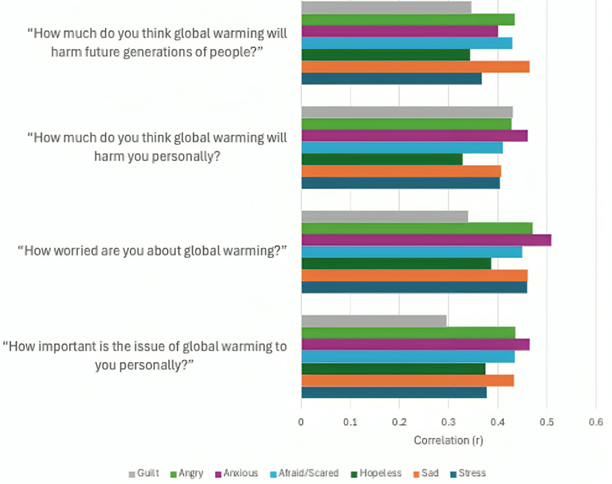
For the exhibit section, HU, that presented the realities of climate change, each negative emotion was positively associated with each attitude and belief captured by SASSY. As depicted in Figure 1, a small to moderate association was found.
Links Between Climate Attitudes and Positive Experiences
Overall, for the HU section with primarily negative content, there wasn’t a significant relationship between climate attitudes and beliefs captured by individual SASSY items (Chryst et al., 2018) and positive emotions, except for the personally relevant item. Only the personal harm caused by climate change was linked to a weak correlation with positive emotions in the HU section, r (173) = .162, p = .033. Given the limited research, the relationships between individual positive words and SASSY items during the COA section of the museum are presented in Table 2 and Figure 2. As depicted in Figure 2, a small to moderate association was found.
Table 2. The community and action-focused section (COA) elicited experiences of positive emotions that were linked to climate beliefs and attitudes, as measured by SASSY (Chryst et al., 2018)
| ||||||||||||||||||||||||||||||||||||||||||||||||||||||||||||||||||||||||||||||||||||||||
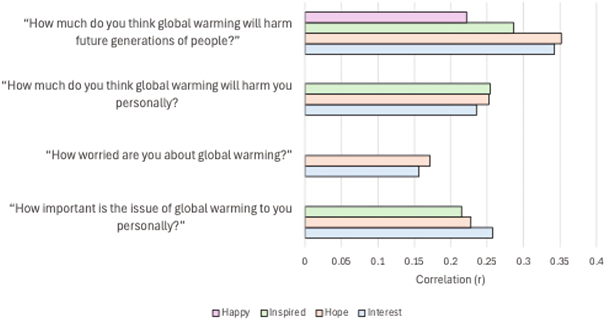
However, the individual items of SASSY were correlated with positive emotions experienced during the section that inspired a hopeful future and community action, i.e., COA. Specifically, for the COA section, the item capturing attitudes of the personal importance of the climate change issue was (positively) related to experiences of positive emotions, r (179) = .241, p = .001. Similarly, attitudes of worry about climate change were linked to positive emotions, r (177) = .15, p = .046. Furthermore, believing that climate change is harmful to individuals personally, r (171) = .250, p = .001, and future generations, r (177) = .344, p < .001, was associated with positive emotions. Together, these findings suggest that pro-environmental attitudes and beliefs assessed by SASSY had strong positive links to positive emotions in response to community climate action.
DISCUSSION
The context of a welcoming community-oriented museum provided an ideal environment to examine climate change issues that have been described as a humanitarian emergency. An important contribution of the current study is in building connections between climate attitudes and emotional reactions to environmental challenges. Climate attitudes and beliefs (as measured by SASSY; Chryst et al., 2018) were significantly linked to strong negative emotional reactions regarding the science-based realities of climate change presented at a museum exhibit. Furthermore, we found that specific positive emotions generated in response to a museum section about collective climate action were linked to pro-environmental climate attitudes and beliefs. Together, these findings highlight the importance of understanding emotional responses and their inherent connection with the formation and maintenance of climate attitudes that, in turn, determine climate action. The current research extends our understanding of climate attitudes by linking them to felt emotion and implicit emotion regulation efforts in a real-world context of climate change.
Climate Attitudes Are Linked to Negative and Positive Climate Emotions
Climate attitudes and beliefs are commonly assessed by SASSY (Chryst et al., 2018), which measures a combination of the personal importance of the issue of climate change, worries about climate change, and anticipated harm to self and future generations. All these climate views were found to be linked to negative emotions examined in this work, including experiences of stress, sadness, hopelessness, fear, anxiety, anger, and guilt. Unsurprisingly, general negative affect (an average of all negative emotions) was strongly linked to climate attitudes as well. Further work is needed to understand how a complex mix of emotions may interact with climate attitudes to motivate climate action (Martin et al., 2023). Emotional responses to climate change, such as fear and guilt, play a significant role in shaping attitudes and motivations to act (Brosch & Steg, 2021). At the same time, negative emotions like fear, hopelessness, or guilt that can emerge when confronted with the reality of climate change can lead to unproductive and detrimental coping strategies such as denial, avoidance, or apathy (Norgaard, 2011; Salas Reyes et al., 2021; Lohani et al., 2025c).
Similar to negative emotions, positive emotions were also connected to climate attitudes, specifically with hopeful and community-oriented solutions being presented at the museum exhibition. Specifically, positive emotional responses in response to the community action portion of the exhibit, including interest, hope, inspiration, and happiness, were linked to more attitudes of concern about the climate change challenges. Past work has suggested that constructive hope and a sense of efficacy–believing that solutions are possible and that one’s actions matter–can strengthen pro-climate attitudes and decisions to act (Ojala, 2023). In line with the current findings of hope, feeling inspired while experiencing future possibilities of collective action was also linked with pro-environmental attitudes. These findings are supported by past work (Hiser & Lynch, 2021). Interest and happiness showed similar patterns. These findings suggest the relevance of not only negative but also positive emotions when thinking about climate solutions. In fact, it is possible that such experiences of positive emotions are a sign of effective emotion regulation. For example, a recent study found that those who used more eco-conscious cognitions and behaviors reported experiencing positive emotions; however, those who felt apathy or a sense of doom did not, which speaks to the ability to process the adverse state of climate change and yet be able to feel hopeful in mitigating the crisis (Lohani et al., 2025c, 2025e).
Limitations and Future Directions in Incorporating Climate Emotions
Several limitations need consideration. First, the data collection of emotions occurred in near real-time, because of which we really had to limit the number of emotions to not disrupt the museum experience. However, learning more about additional emotions would be helpful. For instance, pride has been linked to environmental protection (Hart et al., 2013) and would be good to incorporate in future work. Similarly, many other positive emotions need to be incorporated, including compassion, love, belonging, and empowerment (for review, see Pihkala, 2022). Second, expanding on the first point, while the current study examined a few important negative emotions, many other emotions remain underexplored. For example, a recent study identified a complex interplay of 23 emotions in climate activists (Coppolo & Pihakala, 2023), and thus, much more needs to be learned about their links with climate attitudes and beliefs (Pihkala, 2022). Third, the current findings provide evidence of correlations between these important constructs and a rationale for further pursuing these connections. Expanding on this current work would help to know how emotions inform climate views and actions. Finally, it would be helpful to know how these climate emotions and perspectives change over time (Lohani & Blodgett, 2025). Further work should examine these longitudinal relationships in ecologically valid contexts, such as museums.
The current study shows that the emotional responses utilized by museum visitors have a meaningful connection to climate attitudes and beliefs. Those who may have deeper concerns about climate change and its impact on self and others also have more negative responses toward climate change challenges. It is also possible that some individuals effectively regulated their emotional responses to climate change, barring them from considering climate action. In fact, in a recent study (Lohani et al., 2025e), we found that those experiencing apathy are linked to less negative responses to climate change. However, eco-consciousness was linked to more intense negative reactions to the realities of climate change, as presented at the museum. Thus, emotional reactions reported by responders may be the end result of resulting emotions after participants have used dispositional ways of regulating their emotions (Gyurak et al., 2011; Mauss & Robinson, 2009). Further explorations of these implicit efforts to regulate emotion in the service of personal wellbeing and the resulting impact on climate-friendly behaviors remain to be understood better.
This also raises the question of what effective emotional regulation is in climate change contexts. We argue that optimal regulation in the context of climate change is having manageable negativity and yet being able to engage in climate action (Lohani et al., 2025a). An example of ineffective regulation in the climate change context would be to be apathetic, dismissive, or indifferent, and even withdrawn from climate change realities to protect one’s personal wellbeing. Another example of ineffective regulation also includes too much negativity, which is unhealthy for personal wellbeing (Lohani et al., 2022). In line with this, some research has also suggested that personally relevant issues regarding climate change can also lead to some maladaptive efforts to deal with overwhelming emotions (Clayton & Karazsia, 2020). It remains to be understood what adaptive ways are to manage emotions and be able to meet one’s intentions to engage with climate change mitigation efforts. Failure to optimally regulate one’s emotions can not only hurt personal wellbeing but also limit productive engagement in climate action (Lohani et al., 2025a, 2025b, 2025c, 2025d). Further work is needed to examine individual differences in managing responses to climate change.
CONCLUSION
The current study, embedded in a museum exhibit-based education, highlights the valuable environment they provide in studying psychosocial views and their relevance to the local community and society at large. The informal and welcoming atmosphere provided by the museum allowed us to study wide variability in climate beliefs and attitudes, which has direct implications for social engagement in climate challenges (Janney et al., 2025). Instead of confining the questions to those who would be willing to visit a laboratory, the museum setting allowed us to study the emotional reaction to a critical social matter using ecologically valid methods and gain an understanding of community views around climate change. Climate attitudes and beliefs, as assessed by SASSY (Chryst et al., 2018), are related to positive and negative emotional experiences specific to the climate crisis. Together, the current findings suggest that when considering the climate crisis, emotions matter as they may signify concerns and willingness to mitigate climate change.
Author contributions: ML, LZ, & BJ: methodology, data curation, and writing–review & editing & ML: conceptualization, formal analysis, writing–original draft. All authors agreed with the results and conclusions.
Funding: No funding source is reported for this study.
Ethical statement: The authors stated that the study was approved by the Institutional Review Board at the University of Utah on 10 December 2023 with approval code IRB_00171280. Written informed consents were obtained from the participants.
AI statement: The authors stated that no generative AI tools were used during the study.
Declaration of interest: No conflict of interest is declared by the authors.
Data sharing statement: Data supporting the findings and conclusions are available upon request from the corresponding author.
References
- AAM. (2018). Museums & public opinion: Summary of findings from national public opinion polling. American Alliance of Museums. https://www.aam-us.org/wp-content/uploads/2018/04/Museums-Public-Opinion-FINAL.pdf
- Boluda-Verdu, I., Senent-Valero, M., Casas-Escolano, M., Matijasevich, A., & Pastor-Valero, M. (2022). Fear for the future: Eco-anxiety and health implications, a systematic review. Journal of Environmental Psychology, 84, Article 101904. https://doi.org/10.1016/j.jenvp.2022.101904
- Bradley, G. L., Babutsidze, Z., Chai, A., & Reser, J. P. (2020). The role of climate change risk perception, response efficacy, and psychological adaptation in pro-environmental behavior: A two nation study. Journal of Environmental Psychology, 68, Article 101410. https://doi.org/10.1016/j.jenvp.2020.101410
- Brosch, T. (2021). Affect and emotions as drivers of climate change perception and action: A review. Current Opinion in Behavioral Sciences, 42, 15-21. https://doi.org/10.1016/j.cobeha.2021.02.001
- Brosch, T., & Sauter, D. (2023). Emotions and the climate crisis: A research agenda for an affective sustainability science. Emotion Review, 15(4), 253-257. https://doi.org/10.1177/17540739231193741
- Brosch, T., & Steg, L. (2021). Leveraging emotion for sustainable action. One Earth, 4(12), 1693-1703. https://doi.org/10.1016/j.oneear.2021.11.006
- Budziszewska, M., & Kałwak, W. (2022). Climate depression. Critical analysis of the concept. Psychiatria Polska, 56(1), 171-182. https://doi.org/10.12740/PP/127900
- Carman, J., Verner, M., Rosenthal, S., Ballew, M., Leiserowitz, A., Wood, E., Thulin, E., Ordaz Reynoso, N., Marlon, J., & Buttermore, N. (2024). Global warming’s six audiences: International update, 2023. Yale Program on Climate Change Communication. https://climatecommunication.yale.edu/publications/six-audiences-around-the-world/
- Chryst, B., Marlon, J., Van Der Linden, S., Leiserowitz, A., Maibach, E., & Roser-Renouf, C. (2018). Global warming’s “six Americas short survey”: Audience segmentation of climate change views using a four question instrument. Environmental Communication, 12(8), 1109-1122. https://doi.org/10.1080/17524032.2018.1508047
- Clayton, S., & Karazsia, B. T. (2020). Development and validation of a measure of climate change anxiety. Journal of Environmental Psychology, 69, Article 101434. https://doi.org/10.1016/j.jenvp.2020.101434
- Clayton, S., & Ogunbode, C. (2023). Looking at emotions to understand responses to environmental challenges. Emotion Review, 15(4), 275-278. https://doi.org/10.1177/17540739231193757
- Coppola, I., & Pihkala, P. (2023). Complex dynamics of climate emotions among environmentally active Finnish and American young people. Frontiers in Political Science, 4. https://doi.org/10.3389/fpos.2022.1063741
- Cunsolo, A., & Ellis, N. R. (2018). Ecological grief as a mental health response to climate change-related loss. Nature Climate Change, 8(4), 275-281. https://doi.org/10.1038/s41558-018-0092-2
- Cunsolo, A., Harper, S. L., Minor, K., Hayes, K., Williams, K. G., & Howard, C. (2020). Ecological grief and anxiety: the start of a healthy response to climate change?. The Lancet Planetary Health, 4(7), e261-e263. https://doi.org/10.1016/S2542-5196(20)30144-3
- Druckman, J. N., & McGrath, M. C. (2019). The evidence for motivated reasoning in climate change preference formation. Nature Climate Change, 9(2), 111-119. https://doi.org/10.1038/s41558-018-0360-1
- Ebi, K. L., Ogden, N. H., Semenza, J. C., & Woodward, A. (2017). Detecting and attributing health burdens to climate change. Environmental Health Perspectives, 125(8), Article 085004. https://doi.org/10.1289/EHP1509
- Falk, J. H., & Dierking, L. D. (2018). Learning from museums. Rowman & Littlefield.
- Gifford, R. (2011). The dragons of inaction: Psychological barriers that limit climate change mitigation and adaptation. American Psychologist, 66(4), 290-302. https://doi.org/10.1037/a0023566
- González-Hidalgo, M., & Zografos, C. (2020). Emotions, power, and environmental conflict: Expanding the ‘emotional turn’in political ecology. Progress in Human Geography, 44(2), 235-255. https://doi.org/10.1177/0309132518824644
- Gyurak, A., Gross, J. J., & Etkin, A. (2011). Explicit and implicit emotion regulation: A dual-process framework. Cognition and emotion, 25(3), 400-412. https://doi.org/10.1080/02699931.2010.544160
- Hall, M. P., Lewis, N. A., & Ellsworth, P. C. (2018). Believing in climate change, but not behaving sustainably: Evidence from a one-year longitudinal study. Journal of Environmental Psychology, 56, 55-62. https://doi.org/10.1016/j.jenvp.2018.03.001
- Hamilton, L. C., Hartter, J., & Saito, K. (2015). Trust in scientists on climate change and vaccines. SAGE Open, 5(3). https://doi.org/10.1177/2158244015602752
- Hamilton, P., & Christian Ronning, E. (2020). Why museums? Museums as conveners on climate change. Journal of Museum Education, 45(1), 16-27. https://doi.org/10.1080/10598650.2020.1720375
- Harth, N. S., Leach, C. W., & Kessler, T. (2013). Guilt, anger, and pride about in-group environmental behaviour: Different emotions predict distinct intentions. Journal of Environmental Psychology, 34, 18-26. https://doi.org/10.1016/j.jenvp.2012.12.005
- Herman, B. C. (2014). The influence of global warming science views and sociocultural factors on willingness to mitigate global warming. Science Education, 99(1), 1-38. https://doi.org/10.1002/sce.21136
- Hickman, C., Marks, E., Pihkala, P., Clayton, S., Lewandowski, R. E., Mayall, E. E., Wray, B., Mellor, C., & van Susteren, L. (2021). Climate anxiety in children and young people and their beliefs about government responses to climate change: A global survey. The Lancet Planetary Health, 5(12), e863-e873. https://doi.org/10.1016/S2542-5196(21)00278-3
- Hiser, K. K., & Lynch, M. K. (2021). Worry and hope: What college students know, think, feel, and do about climate change. Journal of Community Engagement and Scholarship, 13(3), 97-107. https://doi.org/10.54656/IOWF3526
- Hornsey, M. J., Harris, E. A., & Fielding, K. S. (2018). Relationships among conspiratorial beliefs, conservatism and climate scepticism across nations. Nature Climate Change, 8(7), 614-620. https://doi.org/10.1038/s41558-018-0157-2
- Hornsey, M. J., Harris, E. A., Bain, P. G., & Fielding, K. S. (2016). Meta-analyses of the determinants and outcomes of belief in climate change. Nature Climate Change, 6(6), 622-626. https://doi.org/10.1038/nclimate2943
- Hsiang, S., Kopp, R., Jina, A., Rising, J., Delgado, M., Mohan, S., Rasmussen, D. J., Muir-Wood, R., Wilson, P., Oppenheimer, M., Larsen, K., & Houser, T. (2017). Estimating economic damage from climate change in the United States. Science, 356(6345), 1362-1369. https://doi.org/10.1126/science.aal4369
- IPCC. (2022). Climate change 2022: Impacts, adaptation, and vulnerability. Cambridge University Press.
- Janney, B., Zummo, L., Lohani, M., Sanchez-Torres, S., & Bertuzzi, D. (2025). Fostering hope: Exploring climate change learning in an informal museum setting. Visitor Studies, 28(2), 226-244. https://doi.org/10.1080/10645578.2024.2446135
- Janney, B. A., Zummo, L., & Lohani, M. (2024). Shifting the desired outcome from climate literacy to climate agency: Education that empowers civic leaders. Interdisciplinary Journal of Environmental and Science Education, 20(3), Article e2412. https://doi.org/10.29333/ijese/14657
- Jones, C., Hine, D. W., & Marks, A. D. G. (2016). The future is now: Reducing psychological distance to increase public engagement with climate change. Risk Analysis, 37(2), 331-341. https://doi.org/10.1111/risa.12601
- Kahan, D. M., Jenkins-Smith, H., & Braman, D. (2010). Cultural cognition of scientific consensus. Journal of Risk Research, 14(2), 147-174. https://doi.org/10.1080/13669877.2010.511246
- Kovaka, K. (2019). Climate change denial and beliefs about science. Synthese, 198, 2355-2374. https://doi.org/10.1007/s11229-019-02210-z
- Kunkle, K. A., & Monroe, M. C. (2018). Cultural cognition and climate change education in the U.S.: Why consensus is not enough. Environmental Education Research, 25(5), 633-655. https://doi.org/10.1080/13504622.2018.1465893
- Leiserowitz, A., Maibach, E., Rosenthal, S., Kotcher, J., Ballew, M., Marlon, J., Carman, J., Verner, M., Lee, S., Myers, T., & Goldberg, M. (2023). Global warming’s six Americas. Yale Program on Climate Change Communication. https://climatecommunication.yale.edu/publications/global-warmings-six-americas-december-2022/
- Liu, J. C., Mickley, L. J., Sulprizio, M. P., Dominici, F., Yue, X., Ebisu, K., Anderson, G. B., Khan, R. F. A., Bravo, M. A., & Bell, M. L. (2016). Particulate air pollution from wildfires in the Western US under climate change. Climatic Change, 138(3), 655-666. https://doi.org/10.1007/s10584-016-1762-6
- Lohani, M., & Blodgett, G. (2025). Innovative and ecological: integrating ecological momentary assessment into environmental science research. Frontiers in Psychology, 16, Article 1557055. https://doi.org/10.3389/fpsyg.2025.1557055
- Lohani, M., Cachelin, A., Banerjee, D., Brunelle, A. R., Yeo, S. K., Zummo, L., & Follstad Shah, J. J. (2025a). Student responses to the climate crisis: Managing distress and exploring support systems. International Journal of Sustainability in Higher Education. https://doi.org/10.1108/IJSHE-03-2025-0154
- Lohani, M., Elsey, J. S., Dutton, S., & Zummo, L. (2025b). Climate change and daily wellbeing: The role of environmental, governmental, and commute-related stressors. Cogent Mental Health, 4(1), Article 2539201. https://doi.org/10.1080/28324765.2025.2539201
- Lohani, M., Janney, B., Wei, W., Zummo, L., & Blodgett, G. (2025c). From eco-consciousness to apathy: The ECO-SHADOW inventory to assess cognitive and behavioral affect regulation and its role in climate action. Frontiers in Psychology, 16, Article 1575185. https://doi.org/10.3389/fpsyg.2025.1575185
- Lohani, M., Velásquez-Franco, S., Janney, B., & Zummo, L. (2025d). Voices unheard: Meaning, implications, and challenges for historically marginalized communities at the forefront of climate change. Interdisciplinary Journal of Environmental and Science Education, 21(3), Article e2512. https://doi.org/10.29333/ijese/16618
- Lohani, M., Zummo, L., Janney, B., & Giron, J. (2025e). Exploring Emotional Reactions and Regulation Strategies in Climate Change Contexts: Insights from a Museum Exhibit. Journal of Museum Education, 1-15. https://doi.org/10.1080/10598650.2025.2494873
- Lohani, M., Dutton, S., & Elsey, J. S. (2022). A day in the life of a college student during the COVID‐19 pandemic: An experience sampling approach to emotion regulation. Applied Psychology: Health and Well‐Being, 14(4), 1333-1352. https://doi.org/10.1111/aphw.12337
- Maibach, E. W., Leiserowitz, A., Roser-Renouf, C., & Mertz, C. K. (2011). Identifying like-minded audiences for global warming public engagement campaigns: An audience segmentation analysis and tool development. PloS one, 6(3), Article e17571. https://doi.org/10.1371/journal.pone.0017571
- Marlon, J., Goddard, E., Howe, P., Mildenberger, M., Jefferson, M., Fine, E., Leiserrowitz, A. (2023). Yale climate opinion maps 2023. Yale Program on Climate Change Communication. https://climatecommunication.yale.edu/visualizations-data/ycom-us/
- Marlon, J., Leiserowitz, A., Thaker, J., Goddard, E., Neyens, L., Kolluri, S., Rosenthal, S., Carman, J., & Modala, N. R. (2024). Variations in climate opinions across India. Yale Program on Climate Change Communication. https://climatecommunication.yale.edu/publications/climate-awareness-india/
- Martin, G., Cosma, A., Roswell, T., Anderson, M., Treble, M., Leslie, K., Card, K. G., Closson, K., Kennedy, A., & Gislason, M. (2023). Measuring negative emotional responses to climate change among young people in survey research: A systematic review. Social Science & Medicine, 329, Article 116008. https://doi.org/10.1016/j.socscimed.2023.116008
- Mauss, I. B., & Robinson, M. D. (2009). Measures of emotion: A review. Cognition and Emotion, 23(2), 209-237. https://doi.org/10.1080/02699930802204677
- McCright, A. M., & Dunlap, R. E. (2011). Cool dudes: The denial of climate change among conservative white males in the United States. Global Environmental Change, 21(4), 1163-1172. https://doi.org/10.1016/j.gloenvcha.2011.06.003
- McQueen, A. (2021). The wages of fear?. Philosophy and climate change, 152.
- Milfont, T. L. (2012). The interplay between knowledge, perceived efficacy, and concern about global warming and climate change: A one-year longitudinal study. Risk Analysis, 32(6), 1003-1020. https://doi.org/10.1111/j.1539-6924.2012.01800.x
- Mitchell, D., Heaviside, C., Vardoulakis, S., Huntingford, C., Masato, G., Guillod, B. P., Frumhoff, P., Bowery, A., Wallom, D., & Allen, M. (2016). Attributing human mortality during extreme heat waves to anthropogenic climate change. Environmental Research Letters, 11(7), Article 074006. https://doi.org/10.1088/1748-9326/11/7/074006
- Myers, T. A., Roser-Renouf, C., & Maibach, E. (2023). Emotional responses to climate change information and their effects on policy support. Frontiers in Climate, 5, Article 1135450. https://doi.org/10.3389/fclim.2023.1135450
- Nabi, R. L., Gustafson, A., & Jensen, R. (2018). Framing climate change: Exploring the role of emotion in generating advocacy behavior. Science Communication, 40(4), 442-468. https://doi.org/10.1177/1075547018776019
- Neckel, S., & Hasenfratz, M. (2021). Climate emotions and emotional climates: The emotional map of ecological crises and the blind spots on our sociological landscapes. Social Science Information, 60(2), 253-271. https://doi.org/10.1177/0539018421996264
- Newell, J., Robin, L., & Wehner, K. (2016). Introduction: Curating connections in a climate-changed world. In J. Newell, L. Robin, & K. Wehner (Eds.), Curating the future: Museums, communities and climate change (pp. 25-40). Routledge. https://doi.org/10.4324/9781315620770
- Norgaard, K. M. (2011). Living in denial: Climate change, emotions, and everyday life. MIT Press. https://doi.org/10.7551/mitpress/9780262015448.001.0001
- Obradovich, N., & Minor, K. (2022). Identifying and preparing for the mental health burden of climate change. JAMA Psychiatry, 79(4), 285-286. https://doi.org/10.1001/jamapsychiatry.2021.4280
- Ogunbode, C. A., Doran, R., Hanss, D., Ojala, M., Salmela-Aro, K., van den Broek, K. L., Bhullar, N., Aquino, S. D., Marot, T., Schermer, J. A., Wlodarczyk, A., Lu, S., Jiang, F., Maran, D. A., Yadav, R., Ardi, R., Chegeni, R., Ghanbarian, E., Zand, S., … & Karasu, M. (2022). Climate anxiety, wellbeing and pro-environmental action: Correlates of negative emotional responses to climate change in 32 countries. Journal of Environmental Psychology, 84, 1-14. https://doi.org/10.1016/j.jenvp.2022.101887
- Ogunbode, C. A., Pallesen, S., Böhm, G., Doran, R., Bhullar, N., Aquino, S., Marot, T., Schemer, J. A., Wlodarczyk, A., Lu, S., Jiang, F., Salmela-Aro, K., Hanss, D., Maran, D. A., Ardi, R., Chegeni, R., Tahir, H., Ghanbarian, E., Park, J. … Lomas, M. J. (2021). Negative emotions about climate change are related to insomnia symptoms and mental health: Cross-sectional evidence from 25 countries. Current Psychology, 42, 845-854. https://doi.org/10.1007/s12144-021-01385-4
- Ojala, M. (2012). Hope and climate change: the importance of hope for environmental engagement among young people. Environmental Education Research, 18(5), 625-642. https://doi.org/10.1080/13504622.2011.637157
- Ojala, M. (2023). Hope and climate-change engagement from a psychological perspective. Current Opinion in Psychology, 49, Article 101514. https://doi.org/10.1016/j.copsyc.2022.101514
- Ojala, M., Cunsolo, A., Ogunbode, C. A., & Middleton, J. (2021). Anxiety, worry, and grief in a time of environmental and climate crisis: A narrative review. Annual Review of Environment and Resources, 46(1), 35-58. https://doi.org/10.1146/annurev-environ-012220-022716
- Patchen, M. (2006). Public attitudes and behavior about climate change: What shapes them and how to influence them. Columban. https://www.columban.jp/upload_files/data/EE0063_AttitudeChange.pdf
- Pennycook, G., Bago, B., & McPhetres, J. (2023). Science beliefs, political ideology, and cognitive sophistication. Journal of Experimental Psychology: General, 152(1), 80-97. https://doi.org/10.1037/xge0001267
- Pihkala, P. (2020). Climate grief: How we mourn a changing planet. BBC. https://www.bbc.com/future/article/20200402-climate-grief-mourning-loss-due-to-climate-change
- Pihkala, P. (2022). Toward a taxonomy of climate emotions. Frontiers in Climate, 3. https://doi.org/10.3389/fclim.2021.738154
- Ramadan, A. M. H., & Ataallah, A. G. (2021). Are climate change and mental health correlated? General Psychiatry, 34(6), Article e100648. https://doi.org/10.1136/gpsych-2021-100648
- Rees, J. H., Klug, S., & Bamberg, S. (2015). Guilty conscience: Motivating pro-environmental behavior by inducing negative moral emotions. Climatic Change, 130(3), 439-452. https://doi.org/10.1007/s10584-014-1278-x
- Reser, J. P., & Swim, J. K. (2011). Adapting to and coping with the threat and impacts of climate change. American Psychologist, 66(4), 277-289. https://doi.org/10.1037/a0023412
- Rocque, R. J., Beaudoin, C., Ndjaboue, R., Cameron, L., Poirier-Bergeron, L., Poulin-Rheault, R. A., Fallon, C., Tricco, A. C., & Witteman, H. O. (2021). Health effects of climate change: An overview of systematic reviews. BMJ Open, 11(6), Article e046333. https://doi.org/10.1136/bmjopen-2020-046333
- Salas Reyes, R., Nguyen, V. M., Schott, S., Berseth, V., Hutchen, J., Taylor, J., & Klenk, N. (2021). A research agenda for affective dimensions in climate change risk perception and risk communication. Frontiers in Climate, 3. https://doi.org/10.3389/fclim.2021.751310
- Schneider, C. R., & van der Linden, S. (2023). An emotional road to sustainability: How affective science can support pro-climate action. Emotion Review, 15(4), 284-288. https://doi.org/10.1177/17540739231193742
- Shiffman, S., Stone, A. A., & Hufford, M. R. (2008). Ecological momentary assessment. Annual Review of Clinical Psychology, 4, 1-32. https://doi.org/10.1146/annurev.clinpsy.3.022806.091415
- Smith, N., & Leiserowitz, A. (2014). The role of emotion in global warming policy support and opposition. Risk Analysis, 34(5), 937-948. https://doi.org/10.1111/risa.12140
- Stevenson, K. T., Peterson, M. N., & Bondell, H. D. (2016). The influence of personal beliefs, friends, and family in building climate change concern among adolescents. Environmental Education Research, 25(6), 832-845. https://doi.org/10.1080/13504622.2016.1177712
- Swim, J. K., Aviste, R., Lengieza, M. L., & Fasano, C. J. (2022). OK Boomer: A decade of generational differences in feelings about climate change. Global Environmental Change, 73, Article 102479. https://doi.org/10.1016/j.gloenvcha.2022.102479
- van der Linden, S. (2015). The social-psychological determinants of climate change risk perceptions: Towards a comprehensive model. Journal of Environmental Psychology, 41, 112-124. https://doi.org/10.1016/j.jenvp.2014.11.012
- van Valkengoed, A. M., & Steg, L. (2019). Meta-analyses of factors motivating climate change adaptation behaviour. Nature Climate Change, 9(2), 158-163. https://doi.org/10.1038/s41558-018-0371-y
- Vercammen, A., Wray, B., Crider, Y. S., Belkin, G., & Lawrance, E. L. (2025). Psychological impacts of climate change on US youth. Proceedings of the National Academy of Sciences, 122(16), Article e2311400122. https://doi.org/10.1073/pnas.2311400122
- Verlie, B. (2022). Learning to live with climate change: From anxiety to transformation. Routledge. https://doi.org/10.4324/9780367441265
- Verplanken, B., & Roy, D. (2013). “My worries are rational, climate change is not”: habitual ecological worrying is an adaptive response. PloS one, 8(9), Article e74708. https://doi.org/10.1371/journal.pone.0074708
- Wang, S., Hurlstone, M. J., Leviston, Z., Walker, I., & Lawrence, C. (2019). Climate change from a distance: An analysis of construal level and psychological distance from climate change. Frontiers in Psychology, 10. https://doi.org/10.3389/fpsyg.2019.00230
- Wang, S., Leviston, Z., Hurlstone, M., Lawrence, C., & Walker, I. (2018). Emotions predict policy support: Why it matters how people feel about climate change. Global Environmental Change, 50, 25-40. https://doi.org/10.1016/j.gloenvcha.2018.03.002
- Watson, D., Clark, L. A., & Tellegen, A. (1988). Development and validation of brief measures of positive and negative affect: The PANAS scales. Journal of Personality and Social Psychology, 54(6), Article 1063. https://doi.org/10.1037/0022-3514.54.6.1063
- Weber, E. U. (2010). What shapes perceptions of climate change? Wiley Interdisciplinary Reviews: Climate Change, 1(3), 332-342. https://doi.org/10.1002/wcc.41
- Zaremba, D., Kulesza, M., Herman, A. M., Marczak, M., Kossowski, B., Budziszewska, M., Michałowski, J. M., Klöckner, C. A., Marchewka, A., & Wierzba, M. (2022). A wise person plants a tree a day before the end of the world: Coping with the emotional experience of climate change in Poland. Current Psychology, 42, 27167-27185. https://doi.org/10.1007/s12144-022-03807-3
How to cite this article
APA
Lohani, M., Zummo, L., & Janney, B. (2026). Emotions matter: Lessons learned about community members’ climate attitudes from an educational climate change museum exhibit. Interdisciplinary Journal of Environmental and Science Education, 22(2), e2609. https://doi.org/10.29333/ijese/17847
Vancouver
Lohani M, Zummo L, Janney B. Emotions matter: Lessons learned about community members’ climate attitudes from an educational climate change museum exhibit. INTERDISCIP J ENV SCI ED. 2026;22(2):e2609. https://doi.org/10.29333/ijese/17847
AMA
Lohani M, Zummo L, Janney B. Emotions matter: Lessons learned about community members’ climate attitudes from an educational climate change museum exhibit. INTERDISCIP J ENV SCI ED. 2026;22(2), e2609. https://doi.org/10.29333/ijese/17847
Chicago
Lohani, Monika, Lynne Zummo, and Benjamin Janney. "Emotions matter: Lessons learned about community members’ climate attitudes from an educational climate change museum exhibit". Interdisciplinary Journal of Environmental and Science Education 2026 22 no. 2 (2026): e2609. https://doi.org/10.29333/ijese/17847
Harvard
Lohani, M., Zummo, L., and Janney, B. (2026). Emotions matter: Lessons learned about community members’ climate attitudes from an educational climate change museum exhibit. Interdisciplinary Journal of Environmental and Science Education, 22(2), e2609. https://doi.org/10.29333/ijese/17847
MLA
Lohani, Monika et al. "Emotions matter: Lessons learned about community members’ climate attitudes from an educational climate change museum exhibit". Interdisciplinary Journal of Environmental and Science Education, vol. 22, no. 2, 2026, e2609. https://doi.org/10.29333/ijese/17847