 Full Text (PDF)
Abstract
This study evaluates the potential of a museum educational program held at the Zoological Museum of the University of Athens. The aim is to analyze the improvement of students’ knowledge and attitude on endangered Greek reptiles and mollusks through pre- and post-program questionnaires, worksheets, and an evaluation sheet. A total of 112 high school students living in and outside Attica Region of Greece participated in the study. The data was analyzed using non-parametric methods, while the internal consistency was confirmed. The tests highlighted a statistically significant improvement in 10 out of 15 knowledge questions. Students’ attitude towards museums and educational programs improved after participating in the program and spending quality time in the Zoological Museum. Analyzing the evaluation sheets, statistically significant differences were detected in second grade students achieving the highest scores. These findings demonstrate that this educational program can effectively improve students’ understanding on fauna threats, using printed materials and reliable methods and can, as a result, be used as a guide for future museum programs.
License
This is an open access article distributed under the Creative Commons Attribution License which permits unrestricted use, distribution, and reproduction in any medium, provided the original work is properly cited.
Article Type: Research Article
INTERDISCIP J ENV SCI ED, Volume 22, Issue 3, 2026, Article No: e2618
https://doi.org/10.29333/ijese/18796
Publication date: 23 Jun 2026
Article Views: 823
Article Downloads: 544
Open Access HTML Content Download XML References How to cite this articleHTML Content
INTRODUCTION
Greece is home to 11 endemic species of reptiles and 76 species in total (Natural Environment and Climate Change Agency [NECCA], 2024). Hotspots like lake Trichonida houses 5 endemic species of mollusks and 33 species in total (Albrecht et al., 2009). In spite of its uniqueness, a lot of Greek fauna is facing threats such as habitat loss, invasive species and climate change, thus many animals are classified as vulnerable, endangered or critically endangered. According to Goulandris Natural History Museum (2025), educational programs are capable of spreading awareness, but few engage in this problem.
The purpose of this study is to evaluate the effectiveness of a non-formal museum-based education through a program aimed to increase secondary school students’ understanding of Greek reptiles and mollusks, in order to recognize their conservation challenges and ecological threats. By incorporating interactive learning modules, specimen-based activities, and threat mitigation strategies aligned with the principles of preventive conservation, this research proves that interdisciplinary museum education has the ability to fill knowledge gaps and cultivate environmentally protective behaviors in younger generations. The analysis uses rigorous statistical methods, including non-parametric tests, to account for non-normal data distributions and to assess the cognitive benefits among the 112 participants. By examining both quantitative outcomes (pre- and post-program scores) and qualitative feedback (post-program evaluation sheet), this study seeks to determine which program elements most effectively engage students and reinforce ecological conservation values. The findings aim to shape the future of environmental educational strategies in museums, ensuring alignment with global biodiversity protection frameworks.
Formal, Informal, and Non-Formal Education
Formal education is institutionalized and systematic, characterized by curricula and assessments (Nikonanou, 2015). Informal learning takes place throughout the individual’s life, is neither organized nor systematic, often has no “purpose” and is offered by the individual’s everyday life (Filippoupoliti, 2015). On the contrary, non-formal educational environments, such as museums, feature organized experiential learning outside traditional classrooms, using engagement which results in richer, more interesting learning and deeper understanding (Filippoupoliti, 2015; Maridakis, 2015).
A museum program with specific cognitive and measurable outcomes has a duration of 1 to 2 hours, concentrates on selected specimens and employs complex assessments on the personal and sociocultural ways of understanding (Fourliga & Veropoulidou, 2022). However, the efficiency of a museum program depends on the educators’ knowledge and abilities: communication skills, teaching strategies and expertise (Filippoupoliti, 2015).
Museum Education
The eternal role of museums is to promote scientific literacy and awareness and to address educational inequalities, thus uniting the school curriculum with either an informal or a non-formal experiential learning, while also supporting teachers’ professional development (Hammerness et al., 2023; Wunar & Kowrach, 2017). This union connects the theoretical scientific information to real-life events and provides details on multidisciplinary subjects, like climate change (Chaniotou et al., 2025; Gata et al., 2023; Georgiou et al., 2022; Mujtaba et al., 2018). In other words, museums such as natural history and science museums, can complement the traditional classroom (Falk & Dierking, 2010; Mutjaba et al., 2018) and encourage ecological thinking and behavior (Ardoin et al., 2020; Ballantyne & Packer, 2009).
Interdisciplinary methods, incorporating scientific information and methods from multiple sciences, help students make connections between biology, geology, history and technology. In addition to the engagement offered by museums and the complex issues they feature, interdisciplinary education is essential in museum programs (Jensen & Schack, 2006; Wunar & Kowrach, 2017), especially in environmental programs which examine complicated topics, such as climate change (You, 2017). These interdisciplinary programs can promote skills like cooperation, empathy, problem solving, social interaction and identity strength (Berardinetti et al., 2024).
Experiential education though interaction with exhibitions has shown enhanced understanding and long-lasting knowledge preservation among students (Anderson et al., 2000; Wunar & Kowrach, 2017). To measure these outcomes, a vigorous evaluation that compares the knowledge, skills and/or attitudes before and after the program (Gata et al., 2023; Monroe et al., 2017) is crucial to determine the impact of the program and the guidelines for future programs (Hammerness et al., 2023; Stern et al., 2013). However, the complexity of educational interventions, which are often delivered to heterogeneous groups with diverse backgrounds, requires careful selection of assessment tools and statistical methods. This is particularly true when the data does not meet normality assumptions, requiring the use of nonparametric techniques (Field, 2018; Ramachandran & Tsokos, 2021).
Environmental Museum Programs
Educational museum programs are evaluated based on the incorporation of conservation biology topics, educational tools and statistical methods in order to provide unique learning environments (Falk & Dierking, 2010; Mujtaba et al., 2018). Based on the engagement and deep understanding through experiential educational methods (Allen & Gutwill, 2009; Ballantyne & Packer, 2009), effective environmental programs are able to strengthen knowledge and alter attitudes resulting in well informed citizens who comprehend the environmental threats and challenges (Ardoin et al., 2020; Jensen & Schack, 2006) and are able to solve problems associated with biodiversity conservation (Bonney et al., 2009; Monroe et al., 2017). To examine the effectiveness of the program, thorough statistical analysis must be followed, using the appropriate tests and tools to confirm the results. When the data distribution deviates from normality, non-parametric methods have to be used (Ballantyne & Packer, 2009; Nakagawa & Cuthill, 2007).
Internationally, museums offer programs for endangered species that combine scientific research, interactive learning, and conservation advocacy. Whale Museum (2025), for example, offers an educational program (“Southern resident killer whales”) that educates students about the biology, ecology, social structure, and conservation measures surrounding whales. The program includes interactive activities, such as identifying whales by their characteristics and learning about federal population recovery plans, to deepen and understand endangered species and ways to conserve them (Whale Museum, 2025). Similarly, Desert Museum’s (2025) endangered species program provides an educational program in which students examine live animals and biological facts, participating in discussions about endangered species in the Sonoran Desert Region. As a result, they become informed about the reasons why species are threatened, the human impacts on ecosystems, and the country’s legislative conservation measures (Desert Museum, 2025).
Studies show that students find it easier to recognize mammals and birds, as well as the threats these groups face (Chyleńska & Rybska, 2018; Kattmann, 2012). On the other hand, educational programs on environmental issues, given Greece’s rich biodiversity and the growing number of endangered species (IUCN, 2025; NECCA, 2024), should address lesser-known animal groups that students may encounter in their country, such as invertebrates or reptiles. However, while there is ongoing research on the biology and conservation of Greek reptiles and mollusks, there is a clear gap in specialized educational interventions targeting these groups. It is also important for educational interventions to address not only knowledge, but also a positive attitude towards non-formal education that raises awareness about endangered animals and promotes conservation behaviors.
In this study a museum educational program is evaluated to validate its ability to increase high school students’ knowledge on endangered reptiles and mollusks of Greece and their ecological threats. Therefore, the hypotheses include whether the students’ scores in knowledge questions would improve statistically after the museum program and if the results would show consistency among the different grades. The findings aim to guide future targeted environmental education strategies in museums or other non-formal educational environments.
MATERIALS AND METHODS
Participants
In this study, data were collected from high school students from public schools in Greece, who randomly participated in the educational program held at the Zoological Museum of the National and Kapodistrian University of Athens. The data collection process was carried out in three stages. In the first stage, a pilot test was carried out with opportunistic sampling involving 29 students who attended their school’s biology club. Then, the topics were taught to two study groups (22 and 25 students). Finally, based on the results of these groups (a total of 76 samples), four questions were added in order to assess more aspects of the topic. These 76 samples were not included in the final group of 112 students.
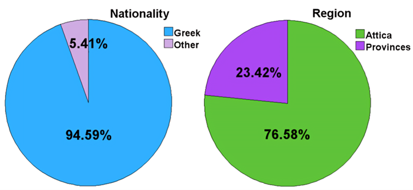
In the end, the study involved 112 high school students (46 girls, 63 boys, 3 others) aged 12 to 15, who were enrolled in various grades: 42.9% in the first year, 20.5% second year, and 36.6% third year. As shown in Figure 1, most students were Greek citizens residing mainly in the Attica Region, with a minority from other regions and nationalities. The initial pilot and test groups (76 students in total) helped to improve the questionnaires for clarity and appropriateness but were excluded from the final analysis.
Instruments
The materials used for the museum program included photographs of the exhibits that were both addressed by the program and are located in the Zoology Museum of the National and Kapodistrian University of Athens. The species that were chosen to be introduced through the photographs were the following due to their conservation status (IUCN, 2025; NECCA, 2024):
-
Podarcis milensis–Vulnerable
-
Lacerta graeca–Near threatened
-
Algyroides moreoticus–Near threatened
-
Macrovipera schweizeri–Endangered
-
Vipera berus–Least concern, decreasing
-
Pinna nobilis–Critically endangered
-
Unio crassus–Vulnerable
-
Haliotis tuberculata–Vulnerable
-
Oxychilus aegopinoides–Possibly endangered
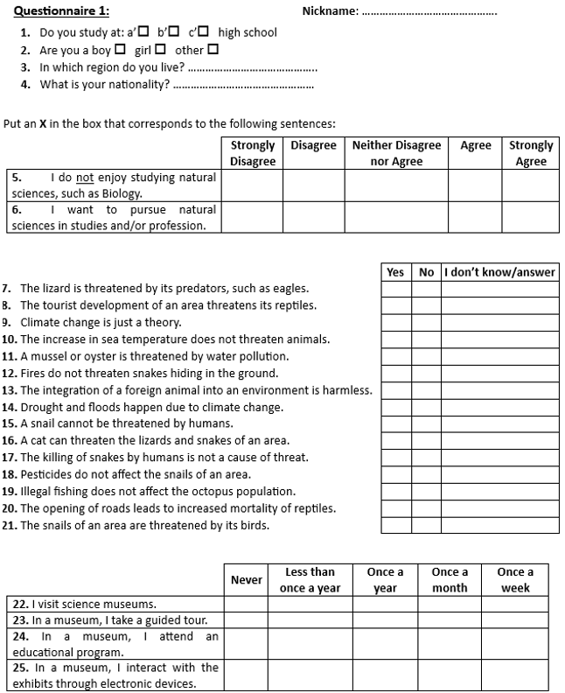
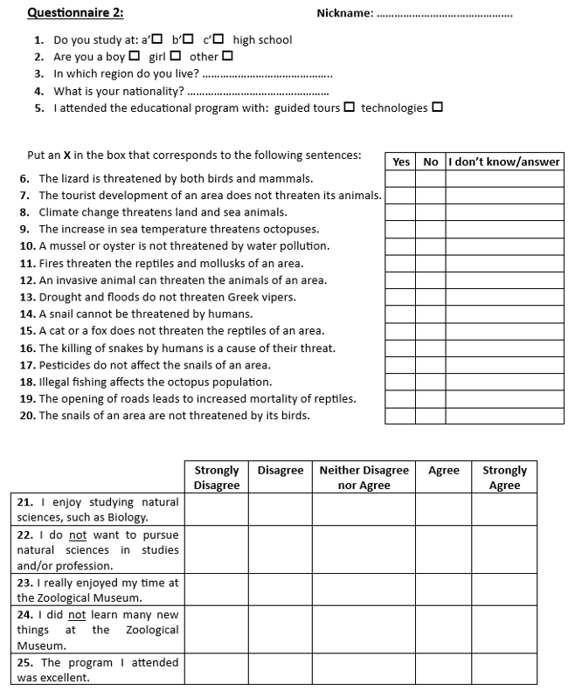
Students also received two questionnaires (as shown in Appendix A and Appendix B), each of which contained 4-5 demographic questions, 15 knowledge questions with three possible answers (“yes”, “no”, “I don’t know”) and 5-6 attitude questions with a five-point Likert scale (Joshi et al., 2015). The knowledge questions in the pre-program questionnaire highlighted both the misconceptions and the lack of factual knowledge of each student on basic ecological and environmental subjects, for example on predators and human intervention, respectively. The knowledge questions in the post-program questionnaire emphasized the knowledge gain of each student due to their participation in the program. The attitude questions examined student’s opinions on the subject of biology and in the program they participated.
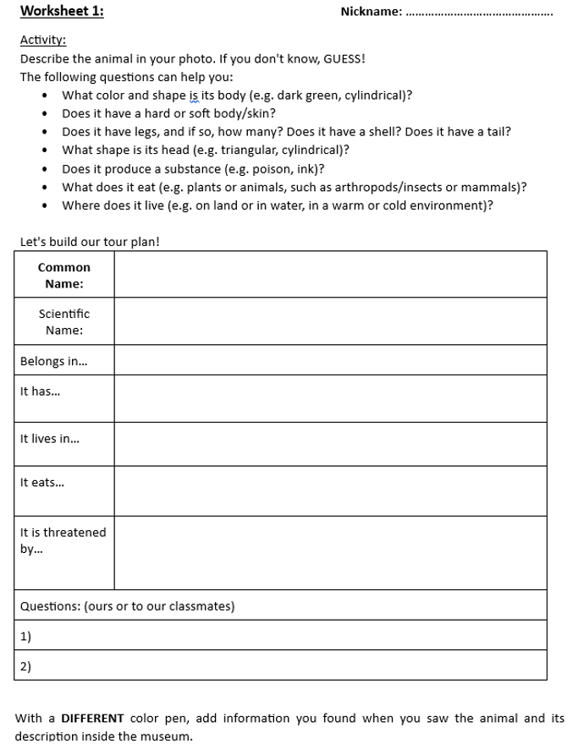
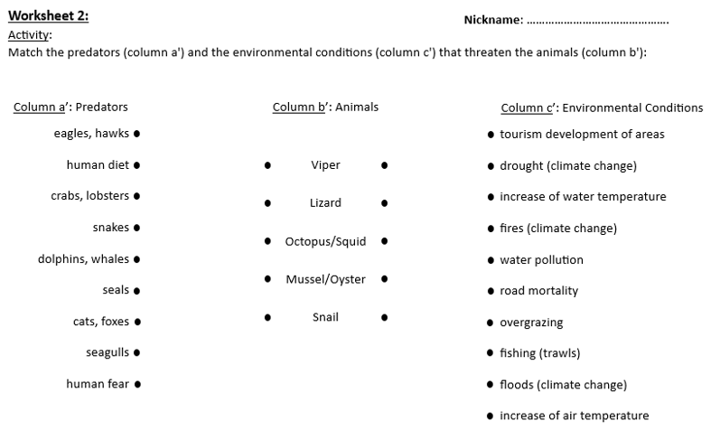
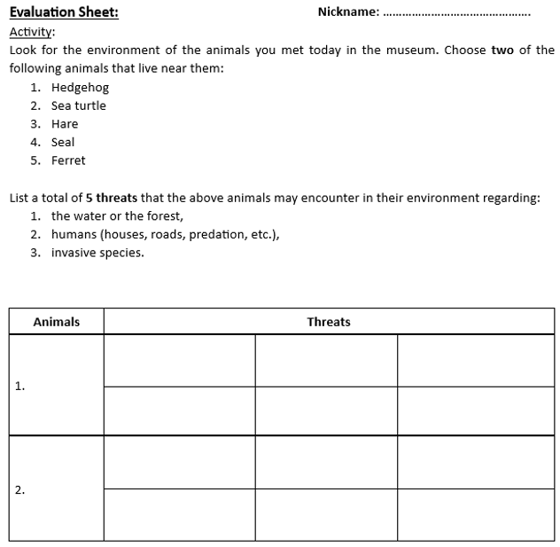
Two worksheets (Appendix C and Appendix D) were also given to each participant. The first worksheet included questions on characteristics, habitats and threats to help students with their tour, while the second worksheet was a matching exercise. Finally, the students filled in an evaluation sheet (Appendix E), which numbered five animals, different from those students encountered in the program. Students chose two of the five given animals and generalized their new knowledge, in order to list a total of five possible threats. On every sheet, in order to remain anonymous, students wrote a pseudonym given by the educator.
Educational Program
The intervention was a museum-based educational program held at the Zoological Museum of the University of Athens, focused on endangered reptiles and mollusks in Greece and lasted about an hour, engaging students in interactive, experiential learning. Under our supervision, the students acted as guides for the species assigned to them, competing for rewards based on the knowledge they acquired through exploration and discussion.
At the beginning, students filled in the first questionnaire (Appendix A) individually, while being given a pseudonym. Then, students were divided into groups of four and each group was given a photo of the species mentioned before. Each student also received a tour plan (worksheet 1–Appendix C) which they completed collaboratively in their group, according to what they saw in the photo or what they assumed about the animal assigned to them, describing the morphology, habitat and probable threats. After this initial contact with the animals, the students were guided to the museum displays, where they searched for their animal and corrected or added information that they identified both by reading the descriptions and by looking closely at the animal.
After touring the museum, revising and adding notes with the help of targeted questions from the educator, the tours began. While one team presented their animal, the other teams filled in the second worksheet (Appendix D), matching animals to their threats. When all the teams were done, each student completed the evaluation sheet (Appendix E) individually by choosing two animals different from those met on the tour and writing down in total five possible threats. While waiting for the announcement of the winner with the best performance, students filled in individually the second questionnaire (Appendix B).
Statistical Analysis
The statistical analysis was performed on SPSS (version 29.0.2.0), using the basic normality tests (Kolmogorov-Smirnov, skewness, and kurtosis) to assess the data distribution (Massey, 1951; DeCarlo, 1997). Deviating from normality, non-parametric tests were used. The Wilcoxon (1945) signed-rank test was used to compare students’ answers before and after the program, the Kruskal-Wallis H test (Kruskal & Wallis, 1952; Laerd Statistics, 2025) to detect differences between scores and the Dunn-Bonferroni (Dunn, 1961, 1964) pairwise comparisons to highlight statistically significant results (Storey & Tibshirani, 2003).
To inspect type I error rates, three multiple comparison corrections were used: Bonferroni, Holm-Bonferroni (Holm, 1979), and Benjamini-Hochberg (Benjamini & Hochberg, 1995), while the reliability of the questionnaires was confirmed through their internal consistency check with Cronbach’s (1951) alpha (> .7), in spite of the non-parametric analysis (Bulmer, 1966; Wilk & Gnanadesikan, 1968; Tabachnick & Fidell, 2019).
RESULTS
Using the Kolmogorov-Smirnov test for the 112 samples collected, deviation from normality was observed before (p = .014) and after (p < .001) the program, rejecting the null hypothesis of normally distributed data. The skewness of data was negative both before and after the program and the kurtosis was slightly positive before and negative after. These values displayed the absence of extreme scores and the gathering of data points.
As shown in Table 1, the Wilcoxon (1945) signed-rank test depicted statistically significant increase in the correct answers of students after the educational program. Specifically, statistically significant improvement was observed in 78 students (Z = -7.322, p < .001), while the sum of improved scores (3,563) surpassed the negative (178). The effect size was large (r ≈ .79, 95% confidence interval), meaning that both the statistical significance and the impact of the program were strong. After correction for multiple comparisons, the Holm-Bonferroni (Holm, 1979) method retained significance for 7 questions and the Benjamini-Hochberg (Benjamini & Hochberg, 1995) method for 10 questions, while the strict Bonferroni correction did not yield any significant questions.
Table 1. The comparison of right answers after to right answers before the program showed an increase in student scores after the educational program, confirming that the program achieved its cognitive objectives
| ||||||||||||||||||||||||
The Wilcoxon (1945) signed-rank test was also performed for each question, matching each pre-program to its corresponding post-program answer. Each test compares the paired responses for every question, assessing whether the median difference between the pre- and post-test responses is zero. According to this multiple hypothesis test, it was found that 11 out of the 15 pairs of questions showed a statistically significant (p < 0.05) difference (Table 2).
Table 2. The right answers after compared to right answers before the program showed improvement on 10 out of 15 knowledge questions
| ||||||||||||||||||||||||||||||||||||||||||||||||||||||||||||||||||||||||||||||||||||||||||||||||||||||||||||
The four pairs of questions that did not show a statistically significant difference had |Z| < 1, while the three of them (1.9 → 2.8, 1.10 → 2.9, 1.14 → 2.13) had a high degree of similarity between the answers of each student before and after the program (ties > 73). Substantial improvement was observed on 10 out of 15 knowledge questions, which focused on ecological matters such as natural predators and human activities that cause threats, as well as invasive species that harm native populations. The only question that confused students and had negative effect was whether fires can affect reptiles.
Regarding students’ attitude towards museums, in the first questionnaire many students expressed low visitation and interest in museums, museum tours and educational programs. In the second questionnaire, students revealed that they enjoyed the time spent in the Zoological Museum, learned a lot and liked the program they participated in (Table 3). If the mean is lower than 2.5, then students have a negative attitude and if the mean is higher than 2.5, then students display positive attitude towards museums and their educational programs.
Table 3. Students’ attitude towards museums before (questions 1-4) and after (questions 5-7) the educational program based on five-point Likert scale
|
Cronbach’s (1951) alpha assessed the good internal consistency of the questionnaires both before (0.755) and after (0.716) the program, despite the non-normality of the data. The correlations between questions and sets were moderate, and no questions were found to significantly reduce reliability.
The reliability test using Cronbach’s (1951) alpha revealed that the internal consistency of the 112 questions before the training program showed a value of 0.755 and after the program 0.716, indicating good reliability. The correlations between items and sets ranged from 0.219 to 0.494 in the pre-program data and from 0.117 to 0.454 in the post-program data. For the data before the program, no item was found to significantly increase the alpha if deleted, while for the data after the program, it was found that if question 2.6 was deleted, Cronbach’s (1951) alpha value would increase to 0.725.
The students completed an evaluation sheet listing possible threats to two species of animals other than those observed in the program. Normality tests showed a significant non-normal distribution (p < 0.05) with negative skewness and positive kurtosis. The Kruskal-Wallis test (Kruskal & Wallis, 1952) found statistically significant differences between high school grades and assessment scores (χ²[2] = 6.051, p = 0.049) with the second grade scoring higher, but Post-Hoc pairwise comparisons did not identify specific significant differences between groups. An overall performance variable that combines the assessment sheet scores with the differences in scores before and after the questionnaire was calculated. Normality tests confirmed the non-normal distribution (p < 0.001), while the Kruskal-Wallis test (Kruskal & Wallis, 1952) showed no statistically significant differences between high school grades in the total scores (χ²[2] = 1.575, p = 0.455).
Initial Tests
Prior to the main study, 76 additional samples were collected during the pilot (29 students) and second trial (47 students) phases but were excluded from the final analysis due to different questionnaire formats. The data from both the pilot and second trial showed non-normality and statistically significant improvements in knowledge, albeit with lower effect sizes and less pronounced changes than the final sample. The lessons learned from these stages led to improvements in the questionnaire, including the addition of four knowledge questions to better differentiate students’ understanding.
DISCUSSION
The results of this study confirmed that a museum educational program on endangered reptiles and mollusks can significantly improve high school students’ ecological and environmental knowledge of Greek ecosystems and the threats their fauna faces–natural predators, human intervention and environmental destruction, and invasive species. Similarly to previous studies that acknowledged the role of an experiential environmental education in spreading ecological awareness and understanding (Allen & Gutwill, 2010; Ardoin et al., 2020; Gata et al., 2023; Mujtaba et al., 2018; Wunar & Kowrach, 2017), the large effect size and the constant improvement in multiple questions of the present study highlight the program’s effectiveness. The study also verifies the ability of experiential learning in effectively engaging students more than the traditional approaches (Ballantyne & Packer, 2009; Falk & Dierking, 2010), thus promoting the cultivation of research curiosity and inquiry skills (Wunar & Kowrach, 2017). Focusing on endangered reptiles and mollusks of Greece and using interdisciplinary approaches, this study expands the capabilities of environmental museum programs to review taxa often ignored in traditional curricula (Prokop & Frančovičová, 2010), emphasizing more on the megafauna of mammals and birds (Bonney et al., 2009). The observed cognitive benefits, particularly in topics related to threats to specific species and conservation strategies, highlight the argument that students can develop a substantial understanding of and interest in less familiar animal taxa, when the educational content is related to local species and correlated with everyday human actions.
Like King and Eckersley (2019) and Ramachandran and Tsokos (2021), the present study validates the use of non-parametric analysis in educational research when the data deviates from normality. In museum education, on the other hand, the unnecessary and incorrect use of parametric tests has been noted by the Smithsonian Institution (2004), underlining the importance of proper statistical analysis of real-world data. Despite the absence of normality, using Cronbach’s (1951) alpha to measure the internal consistency was proven to be reliable (Sheng & Sheng, 2012). In addition, the multiple comparison correction appears to balance the Type I error in educational research (Armstrong, 2014; Magis & De Boeck, 2014; Nakagawa & Cuthill, 2007; Perneger, 1998).
The results of this study reinforce existing research, demonstrating that adequately structured and targeted educational programs can significantly improve students’ knowledge and awareness of conservation issues, even for taxa that are often neglected in curricula. The rigorous statistical approach and focus on local biodiversity make this work a valuable contribution to the field of conservation biology education. Furthermore, while parametric tests dominate museum education studies, nonparametric approaches are gaining recognition for their suitability in complex real-world data scenarios where parametric assumptions fail.
Limitations and Future Research
In the future, the presented program could be adapted to similar taxa facing challenges in different locations, adjusting the species of an area and their threats (Jensen & Schnack, 2006). Alterations could also be made to impact other ages (Ardoin et al., 2020), to identify perspectives and cultivate conservation behaviors (Stevenson et al., 2013). The amount of knowledge retention and the changes on attitude and behavior should be evaluated overlooking the immediate responses and short-term behavioral modification (Stern et al., 2013). A follow-up evaluation after 6-12 months could assess the retention of knowledge and determine whether the program promoted long-term changes in attitudes and behaviors toward the conservation of Greece’s threatened fauna.
The analysis of groups based on prior knowledge revealed interesting patterns, but additional variables such as connection to nature or environmental values could extract equally valuable information about individual differences in learning outcomes. The replication of this study in diverse educational and ecological contexts would enhance the generalizability of the findings. Adapting the program for different age groups, in informal teaching environments or areas with biodiversity challenges, would confirm the resilience of the present educational approach (Monroe et al., 2019).
Integration of demographic and psychosocial aspects that impact students’ perspectives and learning objectives could also be considered, in order to aim the intervention more effectively (Chawla & Derr, 2012). Cross-cultural comparisons could be particularly valuable, examining how similar programs could be implemented in other Mediterranean countries facing similar conservation challenges for endemic reptiles and mollusks.
CONCLUSION
The present study demonstrates the significant improvement of high school students’ knowledge and awareness on the endangered Greek reptiles and mollusks after attending an educational program at a university zoological museum. Students were introduced to frequently ignored species and their threats but were asked to generalize this new knowledge on the evaluation sheet, which required the brainstorming of possible threats different species from other taxa face. Based on students’ answers and despite their minor variation, the majority showed improvement, hence highlighting the program’s effectiveness and its potential use in environmental education.
In conclusion, the findings of this study validate the ability of a complete and thorough educational museum program in promoting environmental knowledge, ecological behavior and conservation awareness among young students. This educational tool contributes an adaptable and measurable teaching method that can be altered for different species, habitats or educational environments. Future studies could also monitor the long-term effects and integrate additional assessments to implement knowledge and enhance conservation attitudes.
Author contributions: CCD: conceptualization, formal analysis, writing – original draft; EDV: conceptualization, writing – review & editing; PP: writing – review & editing; MG: conceptualization, supervision. All authors agreed with the results and conclusions.
Funding: This study was supported by the Zoological Museum of the National and Kapodistrian University of Athens, Greece.
Acknowledgments: The authors would like to thank the team of the Zoological Museum of the National and Kapodistrian University of Athens for their support and all students who voluntarily participated in this study.
Ethical statement: The authors stated that ethical approval was not required, since the data was collected anonymously, without any personal information restraint.
AI statement: Generative Artificial Intelligence tools were used for the precision of translation, as well as grammar improvement and sentence structure. The analysis, interpretation and conclusions were not generated by Artificial Intelligence.
Declaration of interest: No conflict of interest is declared by the authors.
Data sharing statement: Data supporting the findings and conclusions are available upon request from the corresponding author.
APPENDIX A: PRE-PROGRAM QUESTIONNAIRE
APPENDIX B: POST-PROGRAM QUESTIONNAIRE
APPENDIX C: WORKSHEET 1
APPENDIX D: WORKSHEET 2
APPENDIX E: EVALUATION SHEET
References
- Albrecht, C., Hauffe, T., Schreiber, K., Trajanovski, S., & Wilke, T. (2009). Mollusc biodiversity and endemism in the potential ancient lake Trichonis, Greece. Malacologia, 51(2), 357-375. https://doi.org/10.4002/040.051.0209
- Allen, S., & Gutwill, J. P. (2009). Creating a program to deepen family inquiry at interactive science exhibits. Curator: The Museum Journal, 52(3), 289-306. https://doi.org/10.1111/j.2151-6952.2009.tb00352.x
- Anderson, D., Lucas, K. B., Ginns, I. S., & Dierking, L. D. (2000). Development of knowledge about electricity and magnetism during a visit to a science museum and related post-visit activities. Science Education, 84(5), 658-679. https://doi.org/10.1002/1098-237X(200009)84:5<658::AID-SCE6>3.0.CO;2-A
- Ardoin, N. M., Bowers, A. W., & Gaillard, E. (2020). Environmental education outcomes for conservation: A systematic review. Biological Conservation, 241, Article 108224. https://doi.org/10.1016/j.biocon.2019.108224
- Armstrong, R. A. (2014). When to use the Bonferroni correction. Ophthalmic and Physiological Optics, 34(5), 502-508. https://doi.org/10.1111/opo.12131
- Ballantyne, R., & Packer, J. (2009). Introducing a fifth pedagogy: Experience-based strategies for facilitating learning in natural environments. Environmental Education Research, 15(2), 243-262. https://doi.org/10.1080/13504620802711282
- Benjamini, Y., & Hochberg, Y. (1995). Controlling the false discovery rate: A practical and powerful approach to multiple testing. Journal of the Royal Statistical Society: Series B (Methodological), 57(1), 289-300. https://doi.org/10.1111/j.2517-6161.1995.tb02031.x
- Berardinetti, V., Finestrone, F., Lavanga, A., & Toto, G. A. (2024). Environmental education in instructional design and museum education: Impacts on identity construction, social welfare and future horizons. In Proceedings of the ATINER’s Conference. Athens Institute for Education and Research.
- Bonney, R., Cooper, C. B., Dickinson, J., Kelling, S., Phillips, T., Rosenberg, K. V., & Shirk, J. (2009). Citizen science: A developing tool for expanding scientific knowledge and scientific literacy. BioScience, 59(11), 977-984. https://doi.org/10.1525/bio.2009.59.11.9
- Bulmer, M. G. (1966). Principles of statistics. MIT Press.
- Chaniotou, Z., Bardi, C., & Georgiou, M. (2025). Climate change as a socio-scientific issue in science education-A systematic review. APEduC Revista-Investigação e Práticas em Educação em Ciências, Matemática e Tecnologia, 6(1), 73-85. https://doi.org/10.58152/APEduCJournal.587
- Chawla, L., & Derr, V. (2012). The development of conservation behaviors in childhood and youth. In S. D. Clayton (Ed.), The Oxford handbook of environmental and conservation psychology (pp. 527-555). Oxford University Press. https://doi.org/10.1093/oxfordhb/9780199733026.013.0028
- Chyleńska, Z. A., & Rybska, E. (2018). Understanding students ideas about animal classification. Eurasia Journal of Mathematics, Science and Technology Education, 14(6), 2145-2155. https://doi.org/10.29333/ejmste/86612
- Cronbach, L. J. (1951). Coefficient alpha and the internal structure of tests. Psychometrika, 16(3), 297-334. https://doi.org/10.1007/BF02310555
- DeCarlo, L. T. (1997). On the meaning and use of kurtosis. Psychological Methods, 2(3), 292-307. https://doi.org/10.1037/1082-989X.2.3.292
- Desert Museum. (2025). Teacher resources. Desert Museum. https://desertmuseum.org/center/edu/resources.php
- Dunn, O. J. (1961). Multiple comparisons among means. Journal of the American Statistical Association, 56(293), 52-64. https://doi.org/10.1080/01621459.1961.10482090
- Dunn, O. J. (1964). Multiple comparisons using rank sums. Technometrics, 6(3), 241-252. https://doi.org/10.1080/00401706.1964.10490181
- Falk, J. H., & Dierking, L. D. (2010). The 95 percent solution: School is not where most Americans learn most of their science. American Scientist, 98(6), Article 486. https://doi.org/10.1511/2010.87.486
- Field, A. (2018). Discovering statistics using IBM SPSS statistics. SAGE.
- Filippoupoliti, A. (2015). Educational theories and museum learning. In N. Nikonanou, A. Bounia, A. Filippoupoliti, A. Hourmouziadi, & N. Giannoutsou (Eds.), Museum learning and experience in the 21st century. Open Academic Publications.
- Fourliga, E., & Veropoulidou, R. (2022). Interdisciplinary approaches to museum education. Museum of Byzantine culture. In Proceedings of the Ioulia Gavriilidou Memorial Conference.
- Gata, D., Valakos, E., & Georgiou, M. (2023). Engaging and assessing students via a museum educational program. Eurasia Journal of Mathematics, Science and Technology Education, 19(10), Article em2334. https://doi.org/10.29333/ejmste/13574
- Georgiou, M., Fonseca, M. J., Fortin, C., Turpin, S., & Roux-Goupille, C. (2022). SSI approach out of schools–How can these approaches be used in science museums and other non formal education contexts? In X. Xa-Pinto, A. Bennierman, T. H. Børsen, M. Georgiou, A. Jeffries, P. Pessoa, B. Soussa, & D. Zeidler (Eds.), Learning evolution through socioscientific issues. UA Editora. https://doi.org/10.48528/4sjc-kj23
- Goulandris Natural History Museum. (2025). Natural history exhibition programs. Goulandris Natural History Museum. https://www.gnhm.gr
- Hammerness, K., MacPherson, A., Gupta, P., Wallace, J., Chaffee, R., & Jain, N. (2023). What we’ve learned: A research Agenda for a museum, 7 years later. Curator: The Museum Journal, 66(4), 589-608. https://doi.org/10.1111/cura.12568
- Holm, S. (1979). A simple sequentially rejective multiple test procedure. Scandinavian Journal of Statistics, 6(2), 65-70.
- IUCN. (2025). The IUCN red list of threatened species. Version 2025-1. IUCN. https://www.iucnredlist.org
- Jensen, B. B., & Schnack, K. (2006). The action competence approach in environmental education: Reprinted from Environmental Education Research (1997) 3(2), 163-178. Environmental Education Research, 12(3-4), 471-486. https://doi.org/10.1080/13504620600943053
- Joshi, A., Saket, K., Satish, C., & Pal, D. K. (2015). Likert scale: Explored and explained. Current Journal of Applied Science and Technology, 7(4), 396-403. https://doi.org/10.9734/BJAST/2015/14975
- Kattmann, U. (2012). Students’ alternative conceptions of animal classification. Studia ad Didacticam Biologiae Pertinentia II, 1, 178-193.
- King, A. P., & Eckersley, R. J. (2019). Inferential statistics III: Nonparametric hypothesis testing. In A. P. King, & R. J. Eckersley (Eds.), Statistics for biomedical engineers and scientists (pp. 119-145). Academic Press. https://doi.org/10.1016/b978-0-08-102939-8.00015-3
- Kruskal, W. H., & Wallis, W. A. (1952). Use of ranks in one-criterion variance analysis. Journal of the American Statistical Association, 47(260), 583-621. https://doi.org/10.1080/01621459.1952.10483441
- Laerd Statistics. (2025). Kruskal-Wallis H test in SPSS statistics. Laerd Statistics. https://statistics.laerd.com/spss-tutorials/kruskal-wallis-h-test-using-spss-statistics.php
- Magis, D., & De Boeck, P. (2014). Type I error inflation in DIF identification with Mantel-Haenszel: An explanation and a solution. Educational and Psychological Measurement, 74(4), 713-728. https://doi.org/10.1177/0013164413516855
- Maridakis, G. (2015). The educational role of the museum and the educational dimensions of new technologies in museums. Open University of Cyprus.
- Massey, F. J. (1951). The Kolmogorov-Smirnov test for goodness of fit. Journal of the American Statistical Association, 46(253), 68-78. https://doi.org/10.1080/01621459.1951.10500769
- Monroe, M. C., Plate, R. R., Oxarart, A., Bowers, A., & Chaves, W. A. (2017). Identifying effective climate change education strategies: A systematic review of the research. Environmental Education Research, 25(6), 791-812. https://doi.org/10.1080/13504622.2017.1360842
- Mujtaba, T., Lawrence, M., Oliver, M., & Reiss, M. J. (2018). Learning and engagement through natural history museums. Studies in Science Education, 54(1), 41-67. https://doi.org/10.1080/03057267.2018.1442820
- Nakagawa, S., & Cuthill, I. C. (2007). Effect size, confidence interval and statistical significance: A practical guide for biologists. Biological Reviews, 82(4), 591-605. https://doi.org/10.1111/j.1469-185X.2007.00027.x
- NECCA. (2024). The Greek red list of threatened species. Natural Environment and Climate Change Agency. https://redlist.necca.gov.gr
- Nikonanou, N. (2015). Educational tools: Forms and materials. In N. Nikonanou, A. Bounia, A. Filippoupoliti, A. Hourmouziadi, & N. Giannoutsou (Eds.), Museum learning and experience in the 21st century., Open Academic Publications.
- Perneger, T. V. (1998). What’s wrong with Bonferroni adjustments. BMJ, 316, Article 1236. https://doi.org/10.1136/bmj.316.7139.1236
- Prokop, P., & Frančovičová, J. (2010). Perceived body condition is associated with fear of a large carnivore predator in humans. Annales Zoologici Fennici, 47(6). 417-425. https://doi.org/10.5735/086.047.0606
- Ramachandran, K. M., & Tsokos, C. P. (2021). Chapter 12–Nonparametric statistics. Mathematical Statistics with Applications in R, 3, 491-530. https://doi.org/10.1016/b978-0-12-817815-7.00012-9
- Sheng, Y., & Sheng, Z. (2012). Is coefficient alpha robust to non-normal data? Frontiers in Psychology, 3. https://doi.org/10.3389/fpsyg.2012.00034
- Smithsonian Institution. (2004). The evaluation of museum educational programs: A national perspective. Smithsonian Institution. http://hdl.handle.net/10088/17237
- Stern, M. J., Powell, R. B., & Hill, D. (2013). Environmental education program evaluation in the new millennium: What do we measure and what have we learned? Environmental Education Research, 20(5), 581-611. https://doi.org/10.1080/13504622.2013.838749
- Stevenson, K. T., Peterson, M. N., Bondell, H. D., Mertig, A. G., & Moore, S. E. (2013). Environmental, institutional, and demographic predictors of environmental literacy among middle school children. PLoS ONE, 8(3), Article e59519. https://doi.org/10.1371/journal.pone.0059519
- Storey, J. D., & Tibshirani, R. (2003). Statistical significance for genomewide studies. PNAS, 100(16), 9440-9445. https://doi.org/10.1073/pnas.1530509100
- Tabachnick, B. G., & Fidell, L. S. (2019). Using multivariate statistics. Pearson.
- Whale Museum. (2025). Southern resident killer whales. Whale Museum. https://whalemuseum.org/pages/education-programs
- Wilcoxon, F. (1945). Individual comparisons by ranking methods. Biometrics Bulletin, 1(6), 80-83. https://doi.org/10.2307/3001968
- Wilk, M. B., & Gnanadesikan, R. (1968). Probability plotting methods for the analysis of data. Biometrika, 55(1), 1-17. https://doi.org/10.2307/2334448
- Wunar, B., & Kowrach, N. (2017). The changing role of museums in advancing science education. In Proceedings of the International Conferences: New Perspectives in Science Education.
- You, H. S. (2017). Why teach science with an interdisciplinary approach: History, trends, and conceptual frameworks. Journal of Education and Learning, 6(4), 66-77. https://doi.org/10.5539/jel.v6n4p66
How to cite this article
APA
Daskalaki, C. C., Valakos, E. D., Pafilis, P., & Georgiou, M. (2026). Evaluating the impact of a museum educational program on student knowledge of endangered Greek reptiles and molluscs. Interdisciplinary Journal of Environmental and Science Education, 22(3), e2618. https://doi.org/10.29333/ijese/18796
Vancouver
Daskalaki CC, Valakos ED, Pafilis P, Georgiou M. Evaluating the impact of a museum educational program on student knowledge of endangered Greek reptiles and molluscs. INTERDISCIP J ENV SCI ED. 2026;22(3):e2618. https://doi.org/10.29333/ijese/18796
AMA
Daskalaki CC, Valakos ED, Pafilis P, Georgiou M. Evaluating the impact of a museum educational program on student knowledge of endangered Greek reptiles and molluscs. INTERDISCIP J ENV SCI ED. 2026;22(3), e2618. https://doi.org/10.29333/ijese/18796
Chicago
Daskalaki, Christina C., Efstratios D. Valakos, Panayiotis Pafilis, and Martha Georgiou. "Evaluating the impact of a museum educational program on student knowledge of endangered Greek reptiles and molluscs". Interdisciplinary Journal of Environmental and Science Education 2026 22 no. 3 (2026): e2618. https://doi.org/10.29333/ijese/18796
Harvard
Daskalaki, C. C., Valakos, E. D., Pafilis, P., and Georgiou, M. (2026). Evaluating the impact of a museum educational program on student knowledge of endangered Greek reptiles and molluscs. Interdisciplinary Journal of Environmental and Science Education, 22(3), e2618. https://doi.org/10.29333/ijese/18796
MLA
Daskalaki, Christina C. et al. "Evaluating the impact of a museum educational program on student knowledge of endangered Greek reptiles and molluscs". Interdisciplinary Journal of Environmental and Science Education, vol. 22, no. 3, 2026, e2618. https://doi.org/10.29333/ijese/18796