 Full Text (PDF)
Abstract
Ten graduate students from different disciplines in engineering, geography and public health were engaged in a hands-on teaching-learning experience to determine the effect of an interdisciplinary approach on their understanding of sustainability concepts, and on their competence in solving real-world problems. After in-class interdisciplinary training, they were assigned to field research in Guyana. Students completed a survey and submitted essays before and after the field exercise. They reported increased understanding of sustainability as a result of the course. While they felt well prepared for the field assignment, they were divided on whether the experience enhanced their ability to solve real-world problems. This work illustrates the importance of incorporating interdisciplinary and hands-on experiences in graduate sustainability education.
License
This is an open access article distributed under the Creative Commons Attribution License which permits unrestricted use, distribution, and reproduction in any medium, provided the original work is properly cited.
Article Type: Research Article
INTERDISCIP J ENV SCI ED, Volume 22, Issue 3, 2026, Article No: e2617
https://doi.org/10.29333/ijese/18735
Publication date: 09 Jun 2026
Article Views: 1203
Article Downloads: 459
Open Access HTML Content Download XML References How to cite this articleHTML Content
INTRODUCTION
Guyana, located on the northeastern border of South America, is still the newest country to become an oil-producing nation since first lifting oil in December 2019 (U.S. Energy Information Administration, 2024). With an estimated population of less than one million, Guyana is set to become a major global oil supplier with estimated commercially recoverable petroleum reserves of over 11 billion barrels (IMF, 2022). This relatively new sector has exposed the critical need for the development of local technical expertise to deal with the demand for managing oil production while protecting the environment and existing natural resources. This in turn is driving the need for strategic educational initiatives that can quickly deliver this expertise.
Overlaying the ‘oil boom’ are the dynamic fortunes of Guyana’s traditional extractive industries—mainly forestry, and bauxite and gold mining. The most common threats to the sector—deforestation and price fluctuations for gold and bauxite—pose challenges to sustainability apart from those inherent in managing and mitigating their environmental impacts. Overcoming these hurdles is increasingly important in the thrust to reach markets that demand sustainable production of goods. For instance, small to medium scale gold mining has received negative attention as much for the highly visible impacts of hydraulic mining and deforestation, as for the country’s commitment to phase out the use of mercury in goldmining. The estimated 45% increase in gold prices in 2025 (World Gold Council, 2026) only serves to increase the tension between the competing needs for economic wealth and environmental protection.
In light of these complex, multi-faceted challenges, it is now critical for Guyana and other countries with similar mining practices and similar tensions between development and environmental conservation (e.g., Suriname, Venezuela, Brazil, the Democratic Republic of the Congo, and Papua New Guinea) to invest in innovative environmental education to develop the cadre of engineers, scientists and other professionals who can drive and support sustainable development, in both the new oil sector as well as the traditional extractive sectors. This paper describes one such educational initiative designed to implement and assess an interdisciplinary, integrated research model to teach graduate students about sustainability.
Since the conceptualization of sustainability and systems thinking, the theme of an interdisciplinary approach has been espoused (Lugg, 2007; Warburton, 2003). An interdisciplinary approach is defined as one in which an issue is explored from multiple disciplinary perspectives, with the aim of integrating the diverse perspectives into a synergistic understanding of the issue (SERC, 2018). This approach calls for providing interdisciplinary training through formal education where students can attempt to make connections between social, political and economic spheres (Buckhingham-Hatfield, 1996) and which allows for the inculcation of broader holistic ways of critical assessment and eventual solution of real world sustainability issues (Clark et al., 1995; Sprain & Timpson, 2012). When successfully done, perceived disciplinary barriers by both students and departmental officials are removed, allowing for the further propagation of the offering of this type of educational experience (Filho, 2000), as well as the development of new cognitive models/approaches for problem-solving and research (Repko, 2008).
In previous years, there have been several challenges creating resistance to the development of interdisciplinary approaches (Schelhas & Lassoie, 2001). Paramount, and to some extent still persistent among these, is that interdisciplinary approaches are often undervalued in academia but highly valued in the workplace (Müller & Kaltenbrunner, 2019; Wear, 1999). Schelhas and Lassoie (2001) posited that as more graduate students continue to enter fields of applied work, educational institutions that provide these types of courses will view such offerings as important.
Earlier researchers suggested that the students that are exposed to interdisciplinary training will be more competitive job seekers (Wear, 1999); moreover, it was felt that preparing students to function as global citizens should be the aim of interdisciplinary education (Lessor et al., 1997). These predictions have borne fruit; interdisciplinary approaches have not only gained traction but are accepted as important to sustainability education (Horn et al., 2022; Lam et al., 2014; McChesney et al., 2025).
Interdisciplinary approaches have been credited with learning outcomes for graduate students that are not only desirable, but critical for tackling sustainability issues. These include deep learning—greater and more nuanced understanding of their own discipline, including disciplinary biases and blind spots, integration skills—being able to recognize interdisciplinary connectivity and integrate knowledge from different fields, and being able to view and tackle problems from multiple perspectives collectively (Borrego & Newswander, 2010; Ivanitskaya et al., 2002; Repko, 2008). Improved teamwork and communication skills were also observed.
The pursuit of interdisciplinary learning outcomes is, however, not without challenges. Morse et al. (2007) report on challenges to interdisciplinary graduate research, and mechanisms for overcoming them, which are also applicable to the graduate teaching-learning experience. They articulated individual, disciplinary and programmatic “barriers and bridges” to interdisciplinary work. At the critical individual level, three multifaceted core attributes constituted either the challenge or the successful adaptive behavior, in summary:
-
vision: preference for the comfort of the familiar disciplinary boundaries vs. willingness to adapt a broader perspective,
-
dedication: low investment of time and energy vs. commitment and accountability to team goals, and
-
problem-solving: poor vs. proficient teamwork skills like conflict resolution and communication.
The educational experiences are designed and intended to foster the “bridging” skills. Moreover, these skills are needed for interdisciplinary work, particularly in sustainability. Horn et al. (2022) summarized important competencies required for addressing sustainability issues such as being able to communicate across disciplinary barriers, being able to negotiate fairly with non-academic stakeholders, and being able to integrate knowledge, not only across disciplines, but also with societal or non-disciplinary forums. Konrad et al. (2021) describes these skillsets as ‘interpersonal competencies’, noting that they require iterations of practice and feedback to be developed. The substantial overlap between these desired competencies and the learning outcomes of interdisciplinary approaches is the best justification for investing in this interdisciplinary approach.
Having established the motivation and need for an interdisciplinary approach to graduate education in sustainability, it is critical to assess the effectiveness of the approach. The focus of this article is to report from the students’ perspective whether an experiential interdisciplinary sustainability course is effective in teaching sustainability for work force development. The specific questions to be answered by this assessment were:
-
Did the educational experience alter or enhance students’ understanding of sustainability? If so, how?
-
Did the interdisciplinary nature of the class enhance or contribute to new understanding of sustainability? If so, how?
-
Did the experience enhance students’ confidence in their ability to solve real world sustainability problems?
MATERIALS AND METHODS
The approach was based on the goals of an institutional grant centered on developing “sustainable healthy communities.” The interdisciplinary structure of the course was achieved through
-
team planning and curricular design, and team teaching by faculty with different disciplinary backgrounds and
-
peer interactions among students of different disciplinary backgrounds.
The course was delivered using an active teaching/learning strategy employing various teaching and learning activities. Active teaching is an umbrella term for a number of strategies in which students are actively engaged in discovering and co-creating knowledge, facilitated by the faculty. This is distinct from passively assimilating knowledge as per traditional lectures. The main active teaching/learning modality used was problem-based, cooperative learning where students were assigned a research problem to complete as a team. Central hands-on activities were community outreach and an immersive field research experience.
The interdisciplinary nature of the wider project research questions and educational objectives required the input of a multidisciplinary team. Ten students and three faculty members were involved in the course.
The multi-disciplinary faculty team were from the departments of environmental and occupational health (college of public health), civil and environmental engineering (college of engineering), and geography (college of arts & sciences), all from the University of South Florida. Their collective expertise contributed to the project included modelling environmental pollutant transport, environmental sampling (soil, water, and sediments) and mercury analysis, and evaluating social and cultural issues affecting human-environmental-pollution interactions. The faculty team led the courses and modeled working as an interdisciplinary unit. The students were graduates majoring in chemical engineering, environmental engineering, public health, and geography. Three of these participants (two students and one faculty member) were from Guyana.
The course being reviewed in this case study was part of a wider graduate educational experience related to the project, with the objective of educating graduate students to investigate and address issues of sustainability through an integrated systems approach. The components of the experience were
-
the development of a two-course graduate sequence,
-
the integration of speakers on mercury issues into an established lecture series, and
-
graduate student education through involvement in project research.
The two-course graduate sequence was designed to combine technical and social science training, system modeling, community outreach, and field experience. This paper addresses the second course which was aimed at learning how to apply the integrated sustainability approaches in a developing country setting and focused on mercury issues in Guyana.
The focal point of the course was a one-week field trip to visit a mining area in Guyana to administer community surveys and collect environmental samples and archival data and information. Class sessions were held once weekly over a 15-week semester period. These sessions took the form of round-table discussions and lectures aimed at preparation for the field trip, sharing and discussing personal and theoretical concepts of sustainability, reading assignments, and teaching discipline-specific skills to the class. Preparation for the field trip consisted of training in qualitative methods of analysis for evaluating risk perception, refining the survey instrument, and training in research ethics and Institutional Review Board (IRB) compliant protocols for research. Discipline-specific skills of environmental sampling methodology, resource personnel interviewing, focus group techniques and systems modeling were exposed through in-class presentations, literature review, lecture, assignments, and discussion.
The field experience work was primarily carried out at two sites in Guyana; Iwokrama (a forest conservation program area) was chosen as a low mercury use and low mercury impact area, and Mahdia (a mining community) was chosen as a high mercury use and high mercury impact area. The students particularly advocated Iwokrama as a study site to provide a model of sustainable forestry practices as an alternative to mining. At the study sites, several types of data were collected, mainly physical observations of the mining operations, interviewing miners and operators, water and soil quality sampling. The team also met with experts from the University of Guyana, Guyana Geology and Mines Commission, World Wildlife Fund, Iwokrama International Center for Rain Forest Conservation and Development, and policymakers from the Caribbean Community Secretariat. Upon return from the trip, the student team was tasked to produce collaborative project reports on the experience in the form of draft papers for dissemination in journals and for the community participant organizations. Two students from the cohort completed dissertation research connected to the study sites using data collected during the field trip.
To determine and evaluate the educational benefit of the experience, two methods were chosen. Each is detailed below.
Knowledge of students’ pre-course understanding of sustainability issues was critical to determining the contribution of the course toward their post-course status. This was achieved by comparing free response essays completed at the beginning and end of the course, where students self-reported on their learning and understanding of sustainability issues. Specifically, students’ essay précis of their literature reviews and opinions on sustainability in mining, both before and after the field trip experience, was analyzed qualitatively. Prior to the field trip, students were given a reading assignment on sustainability and mining, after which they had to turn in their views on what sustainability in mining meant to them. They were asked to examine the challenges that developing countries faced in demanding sustainable mining and social responsibility from mining companies. The submissions were discussed in the following class. On returning from the field assignment, students were asked to record their reflections on the Guyana trip, paying specific attention to the impact of the trip on their concept of sustainability and their views on the educational merit of trip.
Second, a course experience evaluation survey instrument was completed by the student participants and analyzed. The objective of the survey was to record students’ perceptions of the effectiveness and importance of this interdisciplinary integrated research model to their education on sustainability. The specific areas surveyed were:
-
the effectiveness of the entire educational experience in teaching sustainability issues,
-
the importance and contribution of the interdisciplinary approach and training,
-
the importance and contribution of the field component, and
-
the overall educational value and impact of the course as a teaching method.
The instrument was aimed at addressing the research questions described earlier, viz., the impact of the educational experience on students’ understanding of sustainability, the contribution of the interdisciplinary nature of the class to students’ new understanding of sustainability and the impact of the class on students’ confidence in their ability to solve real world sustainability problems.
The study, including the protocol for interviewing human subjects, received approval from the University of South Florida IRB (protocol # 106211).
RESULTS
Overall, students reported an increased understanding of sustainability related issues over the period of the course. Student responses in the survey (sample size of 10) to the questions about increased understanding are presented in Figure 1. For the first question regarding understanding of sustainability issues generally, 6 of 10 respondents reported an increase in understanding while 3 reported no change and 1 reported a decrease. Eight respondents reported an increased understanding of sustainability issues related to developing countries, and 7 reported an increased understanding of career options in sustainability. One student reported a decreased understanding in all three areas. Eight out of 10 student reported improved understanding of sustainability issues related to developing countries.

Although the survey responses suggest cumulative contributions to understanding from all aspects of the course together, viz. the interdisciplinary training and collaboration, the field research, and the integrated research model used to tackle the case study problem, the contribution of individual components was highlighted by the pre- and post-course essay analysis.
First, self-reported learning discussed through essays indicated how the students’ perceptions and/or learning were swayed by the interdisciplinary field experience. During the initial week of the class, students were asked to answer the following in the form of an essay: What challenges do developing countries such as Guyana face in demanding corporate social responsibility from mining companies and controlling the artisanal mining industry? The responses of this homework assignment were considered the pre-field experience for analytical purposes. Similarly, upon return from the field trip, all students were asked in the week prior to do a post-field experience essay entitled: Prepare a one-page write-up on the impact of the Guyana trip on your concept of sustainability and your views on the educational merit of the trip. In both cases students were asked to do these essays away from the classroom with a one week turn-around time. The pre-field experience essays highlighted the common theme for all students that sustainability largely meant environmental protection, while the post essays showed a shift in the personal meanings/understandings of sustainability to incorporate social and economic factors. Further to this, the post-field experience essays brought out as a common theme the understanding that to solve real world sustainability problem, an integrated interdisciplinary approach is required.
Two representative quotations from the students’ responses of the post-field essays were:
The mercury issues in Guyana class trip expanded my view of sustainability to include a more social component in addition to environmental and revealed the complicated nature of implementing sustainability concepts.
… my idea of sustainability only really entailed the environmental aspect. This course […] taught me about the other two important pillars of sustainability (economic and social) and how they interrelate with environment.
Self-reported assessments were based on the essays of seven of the 10 student participants, as three did not submit responses.
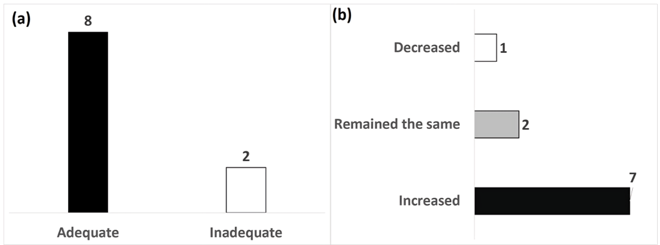
Interdisciplinary training and collaboration were a major aspect of this course; hence, it was important to assess students’ perception of the effectiveness of this component. Students were asked to complete the statements “The interdisciplinary nature of the class provided adequate or inadequate training to understand the field case” and “I now have increased or decreased or the same research skills to solve sustainability problems.” The majority (8 of 10 students) stated that the interdisciplinary training was adequate for the field work project while 7 reported that their research skills had increased. These results are summarized in Figure 2. Taken together, these responses show that most students felt well-prepared by the interdisciplinary training and collaboration to effectively address the research questions of the field case. One student did not feel the preparation was adequate and also reported a decrease in their research skills to solve sustainability issues.
Students were asked to write a short, free response paragraph about whether working in an interdisciplinary team contributed to learning sustainability and whether this exercise was easy or difficult given the international setting. Further, they were to address the question “Do you feel more confident in your ability to solve real world sustainability problems?”
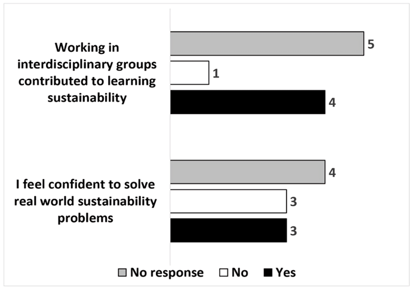
8 of 10 respondents completed the free response sections. Half of the respondents (4 of 8) stated that working in an interdisciplinary team contributed to learning of sustainability. One respondent disagreed and three did not address that question. A common response theme was that (students) were impacted by being exposed to problem-definition and problem-solving from different perspectives than their disciplinary protocols. One student commented:
Working [in] interdisciplinary teams did contribute to the learning of sustainability as it allowed for different perspectives to be highlighted that might have ordinarily been missed in a typical geography, public health, or engineering class. It also allowed [me] to see how different disciplines assess the same issue of sustainability.
The experience was not equally beneficial to all the participants. Another student commented:
The interdisciplinary class did not improve learning on sustainability. Travel to an international location was an interesting experience and the mere fact that it was exposure to a new environment meant that one would observe new things. But it did not produce additional or different learning on sustainability.
There was an even split among the student responses on their confidence in their ability to solve real world problems. Interestingly, a common theme appeared on both sides of the arguments; students reported an increased awareness and understanding of the multifaceted complexity of real-world sustainability problems. The responses are summarized in Figure 3. The majority of those who provided a response (4 of 5) felt that working in an interdisciplinary group was helpful for learning about sustainability, while one respondent did not find it helpful.
Another important function of the survey was to gather students’ perspectives on the educational value of the course by asking whether they would recommend the course, and to describe whether the course had influenced their decision to continue learning about sustainability. Seven of 10 respondents stated they would recommend the course. Further, 8 of 10 respondents said they were more likely to continue their sustainability education. These responses indicate that the educational experience was viewed as valuable by most of the students.
In their responses, students offered recommendations for improving the course. Some felt the course was too short and suggested a longer, more in-depth version of the course to gain more knowledge and experience. One student opined that more coverage of sustainability methods would have been beneficial. Yet another was that more organization and preparation were needed in the course design.
DISCUSSION
The first research question was “Did the educational experience alter or enhance students’ understanding of sustainability?” This question sought to elicit students’ evaluation of the course in its entirety. To answer this question, students’ pre- and post-course essays were analyzed as well as their survey responses. From the foregoing results, the answer is clearly positive; the majority of the students’ reported that their understanding of sustainability was enhanced by the overall experience. This was in keeping with the results of other researchers employing similar educational approaches to sustainability education in that their students also self-reported positive impacts on their learning (Abbonizio & Ho, 2020; Mobley et al., 2014; San Carlos et al., 2017). While this is typical for self-selecting cohorts, it also suggests value in replication of the course.
Notably, “understanding of sustainability issues related to developing countries” had the largest number of student responses reporting improvement. This was thought to reflect the focus of the course on preparing the students for work in a developing country, as well as the novelty of developing country issues for the majority of the students.
A few students reported no change in their understanding of sustainability; we hypothesize that this was most likely because they entered the experience with a previously well-developed understanding of sustainability issues. In contrast, one participant reported a decrease in understanding. This may be because the course challenged their pre-conceived notions and confidence in their disciplinarily-derived knowledge about sustainability; we inferred that the course perturbed that confidence and hence left the student more confused about sustainability after the educational intervention. Although this may be indicative of a first step in learning, several issues may have contributed (Morse et al., 2007); we could not confirm while preserving anonymity. Mining unexpected outcomes will be instructive for future iterations of similar courses and is a recommendation for future research.
The second research question was “Did the interdisciplinary nature of the class enhance or contribute to new understanding of sustainability?” Again, the results were predominantly positive. The interdisciplinary approach was central to this educational intervention; at the time it was still a relatively new approach. While the theory predicted that an interdisciplinary approach would be successful in tackling multi-dimensional sustainability issues, it is critical and validating to get corroborative results. We inferred the usefulness of the interdisciplinary approach from the students’ articulation of their understanding of sustainability as a broadening of the concept from predominantly focused on the environment, to one encompassing economic and social aspects. This led us to conclude that the students were able to engage in perspective-taking, which is the first in the hierarchy of interdisciplinary learning outcomes as articulated by Repko (2008). This was the outcome that was expected or hoped for as it was hypothesized that the combination of interdisciplinary instruction, multi-disciplinary problem-solving and team fieldwork would lead to growth and learning regardless of the students’ disciplinary background. Other environmental researchers and educators implementing interdisciplinary approaches to sustainability challenges reported positively on the experience of working in interdisciplinary teams on complex real-world problems or case studies (Abbonizio & Ho, 2020; Piccardo et al., 2022; Roy et al., 2020).
Once again, we noted that not all the students found the approach adequate or helpful. One instructive insight was the difficulty students recorded with the novelty of working in a multidisciplinary team. We infer that while the approach had a beneficial impact on individual learning, it would take more time and practical exposure to operationalize that knowledge into being fully functional in a multidisciplinary team.
The answer to the third research question “Did the experience enhance students’ confidence in their ability to solve real world sustainability problems?” could best be interpreted as mixed. While students felt well-prepared for the field case, this confidence did not extend to solving real world sustainability problems in general. From the post-survey, if non-response is interpreted as undecided, then the majority of the responses were not positive. This ambivalent assessment contrasted with the findings of other teaching/learning experiments where students reported feeling more confident in their ability to contribute to real-world sustainability issues (Abbonizio & Ho, 2020; Noy et al., 2017). Notably, these studies both had larger cohorts. While this was not the expected outcome, it suggests that students had a deeper understanding of the complexity involved in solving real world sustainability problems after the class and field experiences. Since interpersonal competencies take several rounds of practice and feedback to develop (Konrad et al., 2021), it is reasonable to infer that the timespan of one course may have been too short for students to feel confident in the new skillset. Another potential reason for the difference may have been the choice of wording of the survey prompt. We speculate that students may have felt intimidated by the implication of being able to “solve real-world problems” as against less demanding terms like “contribute to” or “improved ability to solve.”
Both the experiential learning and the findings of this study are significant, particularly when considering the context of Guyana, and the observed need for interdisciplinarians who can advise and manage truly sustainable development. One clear takeaway is that there is no quick fix to building an interdisciplinary mindset, and to becoming skilled at working in interdisciplinary settings. Significant investments in time, thought, expertise, and financial resources are required to develop and refine the programs and activities designed to produce interdisciplinary practitioners.
There are several hurdles or limitations to mainstreaming interdisciplinary education in the Guyanese context which may well be true of other emerging economies. The most fundamental limitation is a lack of awareness and clarity of what interdisciplinarity is, for instance, as compared to multi-disciplinarity. This lack of awareness underpins the second hurdle: low institutional buy-in and faculty incentive structures supportive of interdisciplinary programs. Without awareness and institutional buy-in, it will be difficult to garner resources, both human and capital, to spearhead interdisciplinary programs.
Interdisciplinary education in Guyana is not immune to the more global challenges facing tertiary institutions either considering or currently executing interdisciplinary programs. One inherent, pervasive challenge is the disciplinary academic and administrative structure of most tertiary institutions which creates knowledge silos and serves as the first hurdle to multi-, inter- and transdisciplinary programs (Ajiga et al., 2025; Cai & Lönnqvist, 2022; Holley, 2017). Faculty perspectives, often shaped by disciplinary background, also provide significant barriers to creating or adopting multi-, inter- or transdisciplinary educational programs and activities (Ashby & Exter, 2019; Iram & Mahmood, 2025). Practical challenges like administrative placement of non-disciplinary programs, accreditation complications, and institutional inertia can retard or hamper institutional buy-in without which there will be no advocacy for human and capital resources (Ajiga et al., 2025; Anand & Singh, 2025; Lyall et al., 2015; Satin, 1987).
At the University of Guyana, the country’s only national university, there has been a noticeable need-based shift toward multi-disciplinarity resulting in the creation of the school of entrepreneurship and business innovation and several research institutes including the Institute for Human Resilience, Strategic Security and the Future, the Institute for Food and Nutrition Security, and the Institute for Marine and Riverine Ecologies and Economies. Their multidisciplinary nature necessitated the homing of these entities outside of the disciplinary faculties while allowing them to draw resources and input from the existing disciplinary structures.
Flipping the barriers readily reveals what it will take to support interdisciplinary education in Guyana and in countries with similar contexts. Firstly, awareness and education about multi-, inter-, and transdisciplinary approaches, academic programs and research is needed. Exposure to examples will underscore the importance and relevance of these programs. Faculty buy-in and preparation are a crucial component. However, institutional buy-in, whether intrinsic or driven by external stakeholders, is the critical step to providing human and capital resources to realize interdisciplinary activities and programs. Institutional support structures that could be helpful include cross-department funding, administrative reforms that lower the barriers for resource sharing across units, and teaching load reductions for interdisciplinary instruction. Furthermore, collaboration with local stakeholders, such as miners, policymakers, and industry leaders in the research and education programs as knowledge co-creators, i.e., moving toward a transdisciplinary model, could further improve the alignment of research and educational outcomes with local community needs, while potentially enhancing funding support streams. As with most new initiatives, champions, advocates and success stories can help to overcome the inertia inherent in embracing new approaches. For this reason, sharing the results of approaches like the current study are an important part of moving closer to the goal of multi-, inter- and transdisciplinary education in Guyana.
CONCLUSIONS
An overall assessment of the course was positive, both from the faculty’s perspective of achieving learning outcomes, as well as the students’ endorsement of the usefulness of the course. The use of an interdisciplinary research model was successful as a tool for graduate education on sustainability, within the scope of this assessment. Specifically, students reported increased understanding of sustainability and related issues as a result of the course. Students reported that the interdisciplinary nature of the class did contribute to new understanding of sustainability; notably by being given the opportunity to define and approach the problem from different disciplinary perspectives. Students reported that they felt well-prepared by the interdisciplinary training and collaboration to effectively address the research questions of the field case. There was no consensus of opinion on whether the experience enhanced students’ confidence in their individual ability to solve real world sustainability problems. Nevertheless, students reported an increased awareness and understanding of the complexity of such problems.
Despite these findings, the study has limitations. The study reports on a small sample size of ten students over a single iteration of the course, which limits the generalizability of the results. Future work should focus on increasing the same size, such as by generating aggregate data from multiple iterations of similar courses across a broad range of disciplines. The study relied on students’ self-report in surveys and pre- and post-experience essays. Self-report is vulnerable to several biases. These may be mitigated in the future by garnering objective data such as baseline data on previous knowledge and experience of course participants, and criterion-based formative and summative assessments (e.g., tests and quizzes). These pieces of objective data may then be used to validate and contextualize self-report responses. Five of the authors (DIF, KDT, JW, CCN, and JH) were part of the student cohort for the study. During the course, the student authors were not aware nor had any intention to publish; as such, we feel that performance bias was not a significant issue. Nevertheless, this reinforces the need for the collection of objective data for reference. Response bias could also have affected our findings, as only 8 of the 10 students chose to complete the free response questions, and only 7 submitted the short essays. Additionally, no control group of students learning about sustainability from a non-interdisciplinary perspective was available for inclusion in this work; future studies could benefit from comparing outcomes for an intervention cohort to those from a cohort using more conventional methods. Finally, the results here only capture the immediate outcomes from the course, whereas following the cohort longitudinally would be beneficial to determining the long-term impacts of the course on sustainability learning.
Outcomes of this study suggest a need for comparison of several iterations of the course or similar courses in future work. We propose that future work should use existing frameworks, such as proposed by Repko (2008), to craft measurable milestones for interdisciplinary learning outcomes. These should be assessed both during, and at the end of the course. Since one of the tacit objectives of the course was to positively impact graduate students’ career trajectory toward interdisciplinary work and research, an interesting direction for future work would be longitudinal studies using in-depth interviews of past course participants. In-depth interviews during the course experience and more nuanced performance indicators could also be useful for understanding the psychological drivers behind changes in student confidence. Finally, transformation of this course into a longer multi-course sequence could also be beneficial to providing repeated cycles of practice and feedback that reinforce the interdisciplinary mindset and perspectives targeted. Nonetheless, overall the course demonstrated that an active, problem-based, interdisciplinary approach was effective, even over a single course, to integrate a multidisciplinary group of graduate students to formulate and implement research to address a sustainability problem.
Author contributions: DIF: investigation, formal analysis, data curation, visualization, writing – original draft, writing – review & editing; KDT: investigation, formal analysis, data curation, visualization, writing – original draft; JW: investigation, writing – original draft; CCN: investigation, writing – original draft; JH: investigation, writing – original draft, writing – review & editing; MAT: conceptualization, methodology, resources, investigation, funding acquisition, project administration, supervision, writing – original draft; ALS: conceptualization, methodology, resources, investigation, funding acquisition, project administration, supervision, writing – original draft, writing – review & editing; FAA: conceptualization, methodology, resources, investigation, funding acquisition, project administration, supervision, writing – original draft. All authors agreed with the results and conclusions.
Funding: This study was supported by the University of South Florida through a Sustainable Healthy Communities Grant.
Ethical statement: This study was approved by the Institutional Review Board at University of South Florida on 6 March 2009 with approval number #106211.
AI statement: No generative AI tools or AI-based tools were used in the study.
Declaration of interest: No conflict of interest is declared by the authors.
Data sharing statement: Data supporting the findings and conclusions are available upon request from the corresponding author.
References
- Abbonizio, J. K., & Ho, S. S. Y. (2020). Students’ perceptions of interdisciplinary coursework: An Australian case study of the master of environment and sustainability. Sustainability, 12(21), Article 8898. https://doi.org/10.3390/su12218898
- Ajiga, D. I., Hamza, O., Eweje, A., Kokogho, E., & Odio, P. E. (2025). Developing interdisciplinary curriculum models for sustainability in higher education: A focus on critical thinking and problem solving. Journal of Public Administration and Social Welfare Research, 10, 87-102.
- Anand, A., & Singh, P. (2025). Interdisciplinary studies: Issues, perspectives, and challenges from national education program 2020. In N. D. Son (Ed.), Integrating personalized learning methods into STEAM education (pp. 233-260). IGI Global Publishing. https://doi.org/10.4018/979-8-3693-7718-5.ch011
- Ashby, I., & Exter, M. (2019). Designing for interdisciplinarity in higher education: Considerations for instructional designers. TechTrends, 63(2), 202-208. https://doi.org/10.1007/s11528-018-0352-z
- Borrego, M., & Newswander, L. K. (2010). Definitions of interdisciplinary research: Toward graduate-level interdisciplinary learning outcomes. The Review of Higher Education, 34(1), 61-84. https://doi.org/10.1353/rhe.2010.0006
- Buckhingham-Hatfield, S. (1996). Sustainability and planning. In S. Buckhingham-Hatfield, & R. Evans (Eds.), Environmental planning and sustainability. John Wiley & Sons.
- Cai, Y., & Lönnqvist, A. (2022). Overcoming the barriers to establishing interdisciplinary degree programmes: The perspective of managing organisational innovation. Higher Education Policy, 35(4), 946-968. https://doi.org/10.1057/s41307-021-00242-0
- Clark, N., Perez-Trejo, F., & Allen, P. (1995). Evolutionary dynamics and sustainable development: A systems approach. Edward Elgar. https://doi.org/10.4337/9781035334605
- Filho, W. L. (2000). Dealing with misconceptions on the concept of sustainability. International Journal of Sustainability in Higher Education, 1, 9-19. https://doi.org/10.1108/1467630010307066
- Holley, K. A. (2017). Interdisciplinary curriculum and learning in higher education. In K. hytten (Ed.), Oxford research encyclopedia of education. Oxford Academic. https://doi.org/10.1093/acrefore/9780190264093.013.138
- Horn, A., Scheffelaar, A., Urias, E., & Zweekhorst, M. B. M. (2022). Training students for complex sustainability issues: A literature review on the design of inter- and transdisciplinary higher education. International Journal of Sustainability in Higher Education, 24(1), 1-27. https://doi.org/10.1108/IJSHE-03-2021-0111
- IMF. (2022). IMF Executive Board concludes 2022 article IV consultation with Guyana. International Monetary Fund. https://www.imf.org/en/News/Articles/2022/09/27/pr22323-imf-executive-board-concludes-2022-article-iv-consultation-with-guyana
- Iram, N., & Mahmood, A. (2025). Faculty perceptions and barriers in interdisciplinary curriculum implementation: A quantitative study. Contemporary Journal of Social Science Review, 3(4), 173-184. https://contemporaryjournal.com/index.php/14/article/view/1358
- Ivanitskaya, L., Clark, D., Montgomery, G., & Primeau, R. (2002). Interdisciplinary learning: Process and outcomes. Innovative Higher Education, 27(2), 95-111. https://doi.org/10.1023/A:1021105309984
- Konrad, T., Wiek, A., & Barth, M. (2021). Learning processes for interpersonal competence development in project-based sustainability courses–Insights from a comparative international study. International Journal of Sustainability in Higher Education, 22(3), 535-560. https://doi.org/10.1108/IJSHE-07-2020-0231
- Lam, J. C. K., Walker, R. M., & Hills, P. (2014). Interdisciplinarity in sustainability studies: A review. Sustainable Development, 22, 158-176. https://doi.org/10.1002/sd.533
- Lessor, R., Reeves, M., & Andrade, E. (1997). Interdisciplinary team teaching on sustainable development in Costa Rica. Teaching Sociology, 25, 134-149. https://doi.org/10.2307/1318659
- Lugg, A. (2007). Developing sustainability-literate citizens through outdoor learning: Possibilities for outdoor education in higher education. Journal of Adventure Education and Outdoor Learning, 7(2), 97-112. https://doi.org/10.1080/14729670701609456
- Lyall, C., Meagher, L., Gill, J. B., & Kettle, A. (2015). Interdisciplinary provision in higher education: Current context and future challenges. University of Edinburgh. https://www.research.ed.ac.uk/files/23462207/Lyall_et_al_2015.pdf
- McChesney, E. T., Weng, Y.-H., Winkler, C. E., Selznick, B., & Mayhew, M. J. (2025). The effect of interdisciplinary training on cultivating graduate student innovation capacities. Innovative Higher Education, 51, 925-950. https://doi.org/10.1007/s10755-025-09848-3
- Mobley, C., Lee, C., Morse, J. C., Allen, J., & Murphy, C. (2014). Learning about sustainability: An interdisciplinary graduate seminar in biocomplexity. International Journal of Sustainability in Higher Education, 15(1), 16-33. https://doi.org/10.1108/IJSHE-09-2011-0063
- Morse, W. C., Nielsen-Pincus, M., Force, J. E., & Wulfhorst, F. D. (2007). Bridges and barriers to developing and conducting interdisciplinary graduate-student team research. Ecology and Society, 12(2), Article 8. https://doi.org/10.5751/ES-02082-120208
- Müller, R., & Kaltenbrunner, W. (2019). Re-disciplining academic careers? Interdisciplinary practice and career development in a Swedish Environmental Sciences Research Center. Minerva, 57(4), 479-499. https://doi.org/10.1007/s11024-019-09373-6
- Noy, S., Patrick, R., Capetola, T., & McBurnie, J. (2017). Inspiration from the classroom: A mixed method case study of interdisciplinary sustainability learning in higher education. Australian Journal of Environmental Education, 33(2), 97-118. https://doi.org/10.1017/aee.2017.22
- Piccardo, C., Goto, Y., Koca, D., Aalto, P., & Hughes, M. (2022). Challenge-based, interdisciplinary learning for sustainability in doctoral education. International Journal of Sustainability in Higher Education, 23(7), 1482-1503. https://doi.org/10.1108/IJSHE-06-2021-0232
- Repko, A. F. (2008). Assessing interdisciplinary learning outcomes. Academic Exchange Quarterly, 2008, 171-178.
- Roy, S. G., de Souza, S. P., McGreavy, B., Druschke, C. G., Hart, D. D., & Gardner, K. (2020). Evaluating core competencies and learning outcomes for training the next generation of sustainability researchers. Sustainability Science, 15, 619-631. https://doi.org/10.1007/s11625-019-00707-7
- San Carlos, R., Yoshida, Y., & Kudo, S. (2017). Fostering the next generation of sustainability professions–Assessing field courses in a sustainability science graduate program. Challenges in Sustainability, 5(1), 52-61. https://doi.org/10.12924/cis2017.05010052
- Satin, D. G. (1987). The difficulties of interdisciplinary education: Lessons from three failures and a success. Educational Gerontology, 13(1), 53-69. https://doi.org/10.1080/0380127870130105
- Schelhas, J., & Lassoie, J. P. (2001). Learning conservation and sustainable development: An interdisciplinary approach. Journal of Natural Resources and Life Sciences Education, 30, 111-119. https://doi.org/10.2134/jnrlse.2001.0111
- SERC. (2018). What is interdisciplinary teaching? Science Education Resource Center at Carleton College. https://serc.carleton.edu/48977
- Sprain, L., & Timpson, W. M. (2012). Pedagogy for sustainability science: Case-based approaches for interdisciplinary instruction. Environmental Communication, 6(4), 532-550. https://doi.org/10.1080/17524032.2012.714394
- U.S. Energy Information Administration. (2024). Guyana becomes key contributor to global crude oil supply growth. Today in Energy. www.eia.gov/todayinenergy/detail.php?id=62103
- Warburton, K. (2003). Deep learning and education for sustainability. International Journal of Sustainability in Higher Education, 4(1), 44-56. https://doi.org/10.1108/14676370310455332
- Wear, D. N. (1999). Challenges to interdisciplinary discourse. Ecosystems, 2, 299-301. https://doi.org/10.1007/s100219900080
- World Gold Council. (2026). Gold demand trends Q4 and full year 2025. World Gold Council. https://www.gold.org/goldhub/research/gold-demand-trends/gold-demand-trends-full-year-2025
How to cite this article
APA
Fox, D. I., Thomas, K. D., Walker, J., Naughton, C. C., Howard, J., Trotz, M. A., Stuart, A. L., & Akiwumi, F. A. (2026). Mercury issues in Guyana: Case study of an interdisciplinary research model in graduate sustainability education. Interdisciplinary Journal of Environmental and Science Education, 22(3), e2617. https://doi.org/10.29333/ijese/18735
Vancouver
Fox DI, Thomas KD, Walker J, Naughton CC, Howard J, Trotz MA, et al. Mercury issues in Guyana: Case study of an interdisciplinary research model in graduate sustainability education. INTERDISCIP J ENV SCI ED. 2026;22(3):e2617. https://doi.org/10.29333/ijese/18735
AMA
Fox DI, Thomas KD, Walker J, et al. Mercury issues in Guyana: Case study of an interdisciplinary research model in graduate sustainability education. INTERDISCIP J ENV SCI ED. 2026;22(3), e2617. https://doi.org/10.29333/ijese/18735
Chicago
Fox, Dawn I., Ken Darrie Thomas, Justin Walker, Colleen C. Naughton, Joniqua Howard, Maya A. Trotz, Amy L. Stuart, and Fenda A. Akiwumi. "Mercury issues in Guyana: Case study of an interdisciplinary research model in graduate sustainability education". Interdisciplinary Journal of Environmental and Science Education 2026 22 no. 3 (2026): e2617. https://doi.org/10.29333/ijese/18735
Harvard
Fox, D. I., Thomas, K. D., Walker, J., Naughton, C. C., Howard, J., Trotz, M. A., . . . Akiwumi, F. A. (2026). Mercury issues in Guyana: Case study of an interdisciplinary research model in graduate sustainability education. Interdisciplinary Journal of Environmental and Science Education, 22(3), e2617. https://doi.org/10.29333/ijese/18735
MLA
Fox, Dawn I. et al. "Mercury issues in Guyana: Case study of an interdisciplinary research model in graduate sustainability education". Interdisciplinary Journal of Environmental and Science Education, vol. 22, no. 3, 2026, e2617. https://doi.org/10.29333/ijese/18735