 Full Text (PDF)
Abstract
Environmental perception plays a crucial role in shaping effective adaptation strategies among citizens. This study examined perceptions of climate change among public and private school teachers, as well as homeschoolers, in Puerto Rico. A 40-item Likert-type questionnaire was administered to a non-probability sample of 102 participants from 37 municipalities nationwide. Statistical analyses revealed a high overall concern for climate issues, with significant differences based on educational sector (χ2 [4] = 13.90, p = 0.008). Public and private school teachers showed greater concern than homeschoolers. The instrument demonstrated excellent reliability (α = 0.91). Exploratory factor analysis identified four perception dimensions: ecological impacts, institutional environmental education, social awareness, and climate change in the curriculum. No significant correlations were found between teaching experience and climate concern. These findings emphasize the importance of strengthening environmental education strategies through a comprehensive and inclusive approach that engages all educational sectors.
License
This is an open access article distributed under the Creative Commons Attribution License which permits unrestricted use, distribution, and reproduction in any medium, provided the original work is properly cited.
Article Type: Research Article
INTERDISCIP J ENV SCI ED, Volume 22, Issue 2, 2026, Article No: e2612
https://doi.org/10.29333/ijese/18103
Publication date: 01 Apr 2026
Online publication date: 13 Mar 2026
Article Views: 1826
Article Downloads: 878
Open Access HTML Content Download XML References How to cite this articleHTML Content
INTRODUCTION
According to the World Health Organization (2023), climate change poses a serious threat to human health. Its effects are felt across environmental, physical, social, cultural, and economic levels, mainly affecting how health systems function (Climate Rights International, 2023). It is projected that between 2030 and 2050, climate change will cause about 250,000 additional deaths each year, due to heat-related illnesses, malnutrition, malaria, and diarrhea (Wuebbles et al., 2017). In Latin America and the Caribbean, countries are vulnerable to natural disasters, rising sea levels, and changes in precipitation (Cavallo et al., 2023). Puerto Rico is located in the Caribbean and is the sixth most vulnerable country according to a GreenWave study (Crespo, 2022; Eckstein et al., 2021). Storms, hurricanes, coastal erosion, and economic inequality affect the population to a greater extent than in other countries, especially after Hurricane Maria in 2017 (Rivera, 2020). According to research by the nonprofit organization Amigos del Yunque, more than 50% of Puerto Ricans have suffered some trauma from climate-related events (Vázquez, 2025). Clayton (2019) states that psychology plays a key role in helping society adapt to climate change by understanding and addressing growing threats. Studying individuals’ perceptions and beliefs about climate change can improve disaster management strategies and encourage better adaptation and resilience practices (Clayton, 2019). Events related to climate change, such as floods, hurricanes, wildfires, and earthquakes, can also impact mental health (Ndetei et al., 2024). A key concept in this field is eco-anxiety, which is chronic anxiety caused by environmental threats, with symptoms including psychological stress, depression, and overall distress (Cosh et al., 2024). Several studies show a link between the effects of climate change and its impact on mental health, especially from a young age, often leading to anxiety in response to various weather events (Gianfredi et al., 2024). According to Hayes et al. (2018), the global threats of climate change can also trigger feelings of despair and hopelessness, as actions to combat the problem often seem distant or insignificant compared to the scale of the threats. If not managed properly, despair can turn into anxiety. One study found that 71.6% of psychotherapists have treated patients worried about climate change. Meanwhile, 66.6% reported that between one and ten of their patients had concerns related to climate change (Trost et al., 2024). Children and teenagers are especially vulnerable, as they make up a large percentage of those affected by climate-related illnesses and experience lasting psychological effects. Studies reveal that only 46% of university students surveyed from universities in the Colombian Caribbean region are informed about the issue of climate change (Rodríguez Pacheco et al., 2022). Environmental education has become a key tool for addressing natural challenges; it is a process that aims to promote knowledge and generate resources to mitigate the impacts of climate change (Universidad de los Andes, 2023). For public environmental education strategies to be effective, it is important to understand individuals’ perceptions of climate change and their needs related to this issue in their communities (Dayton et al., 2022; Nistor, 2024).
METHODOLOGY
This research focused on understanding the perceptions of climate change among K-12 science teachers from public and private schools, as well as homeschooling parents and guardians in Puerto Rico.
Type of the Study
This research was a non-experimental, quantitative study with a cross-sectional design, adopting an exploratory and correlational approach. The aim was to describe and compare the perceptions of climate change among science teachers in the public and private education systems, as well as homeschoolers in Puerto Rico.
Participants
A non-probability convenience sample was used. The target population consisted of science teachers and homeschoolers. A final sample of 102 participants was obtained, although a minimum of 200 was expected.
This difference may have affected the statistical power of the study, but the data collected provide relevant trends for exploratory analyses.
Instruments
A structured questionnaire was used, consisting of three sections (https://forms.gle/GwFrjNCZTBDX3X2XA):
-
Digital informed consent
-
Sociodemographic data sheet
-
A 40-item Likert-type questionnaire (5-point scale) designed to measure different dimensions of climate change perception (urgency, effects, stakeholders, and education)
Data Collection
Data were collected using a digital form (Google Forms), distributed through institutional channels (the department of education, the Association of Private Schools, and homeschooling groups in Puerto Rico). Participation was voluntary, anonymous, and without compensation.
Statistical Analysis
The data were analyzed using statistical tools, including IBM SPSS statistics. The following analyses were performed:
Cronbach’s alpha
To assess the internal reliability of the 40-item Likert-type instrument, the Cronbach’s alpha test was used. The formula used was: \(\alpha = \frac{N\overline{c}}{\overline{v} + \left\lfloor N - 1 \right\rfloor\overline{c}}\), where N is equal to the number of items, \(\overline{c}\) is the average inter-item covariance among the ítems and \(\overline{v}\) equals the average variance (Bruin, 2006).
Calculation of the environmental concern index
To quantify the level of environmental concern in the sample, a composite index was constructed using four items from the original Likert-type questionnaire (scale from 1 to 5): \(Index = \frac{x_{1i} + x_{2i} + x_{3i} + x_{4i}}{4}\), where x1i, x2i, … are the item scores for each participant i. The resulting index ranges from 1 (low concern) to 5 (high concern).
This index was calculated by averaging the individual responses to the following items for each participant. If a participant selects answers 5, 4, 4, and 3 in the selected items, their environmental concern index is calculated as: (5 + 4 + 4 + 3)/4 = 4.0, which corresponds to the high concern category.
The selected items reflect perceptions of climate vulnerability, the urgency of environmental attention, and associated risks:
-
Puerto Rico is socially and physically vulnerable to natural and anthropogenic hazards.
-
Coastal erosion is a problem that must be addressed as an environmental emergency.
-
Rising sea levels require immediate attention from agencies and citizens.
-
The lack of awareness in the country about climate change is a source of great concern to me as a teacher.
The environmental concern index was calculated as the average of the individual responses to these four items for each participant. This approach is statistically valid when the assumptions demonstrate a high internal correlation, as confirmed by Cronbach’s alpha reliability analysis. For the statistical analysis of association, this index was divided into three categories based on the Likert scale response.
-
High concern: ≥ 4.0
-
Medium concern: 3.0-3.9
-
Low concern: ˂ 3.0
Kruskal Wallis
The Kruskal-Wallis test was performed to compare means among more than one independent group. In this nonparametric test, the H statistic is calculated using the following formula: \(H = \frac{12}{n(n + 1)} = \sum_{j = 1}^{c}{\frac{T_{j}^{2}}{n_{j}} - 3(n + 1)}\), where n is the total number of observations across all groups, Tj is the total number of ranks for each group, and nj is the number of observations in each group. The value 12 is kept constant in this formula because it occurs naturally about the mean sum of squares across the ranked groups (McClenaghan, 2024).
Spearman correlation
To measure the relationship between years of experience and environmental perception, the Spearman correlation analysis was performed using the following formula (Looney & Hagan, 2011): \(\rho = 1 - 6\sum_{}^{}\frac{d_{i}^{2}}{n(n^{2} - 1)}\), where \(\rho\) is the Spearman’s correlation coefficient, di is the difference between the two ranges of each observation, and n is the number of observations.
Chi-square analysis
To analyze the association between the education sector and levels of concern using the following formula (Abdul Rahman et al., 2025): \(X^{2} = \sum_{}^{}\frac{O_{i} - E_{j}}{E_{j}}\), where Oi is the observed value and Ei is the expected value.
Exploratory factor analysis
A factor loading was performed, which represents the correlation between a premise and a latent factor (Fontaine, 2005). This factor loading is determined by how much a premise contributes to a given factor. This value ranges from -1 to 1, as is the case with correlation. In this case, if the correlation is close to 1 or -1, the item is highly related to the factor, while if the correlation is close to 0, the item has little or no correlation with that factor. To conduct this analysis, the principal components method with varimax rotation was applied to facilitate factor interpretation. The retention criterion was used, retaining the factors with Kaiser’s method, complemented by the observation of the screen plot. This analysis allowed the items to be reduced to four conceptually coherent factors that reflect distinct dimensions of climate change perception. Using SPSS, all correlations between items are analyzed, and those that behave similarly to the sample are grouped.
RESULTS
Sociodemographic Data
In this study, conducted using a randomized questionnaire, the participants were representatives of schools and colleges from 37 municipalities in Puerto Rico. 83.3% of participants were women and 16.7% were men. Of these participants, 28.4% were between 41 and 50 years old, 27.5% between 51 and 60 years old, 24.5% between 31 and 40 years old, 11.8% between 61 and 70 years old, and 7.8% between 61 and 70 years old. This age distribution is important for assessing environmental perception from different age perspectives. Figure 1 presents the data obtained from the academic preparation of the participants, where 50% or more already have a master’s degree.
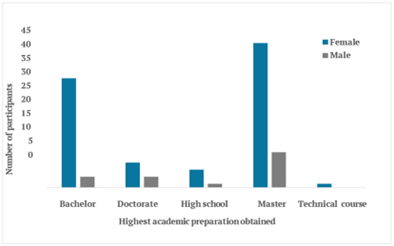
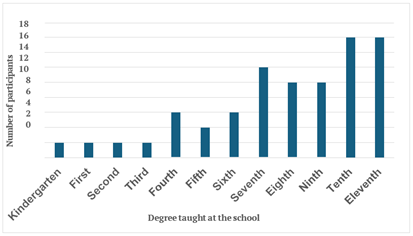
Figure 2 displays the distribution of participating teachers by grade level in their schools. The most common grade level among participants is in the secondary grades.
Statistical Tests
Instrument reliability
The internal consistency of the 40-item Likert-type instrument was assessed using Cronbach’s alpha coefficient. The analysis yielded a value of α = 0.91 (Table 1).
Table 1. Instrument reliability
|
This indicates excellent internal reliability according to the criteria established for this test (George & Mallery, 2003). This result validates the use of a composite perception index based on the premises included in the questionnaire.
Calculation of the environmental concern index
This index was constructed from four statements related to vulnerability, environmental urgency, and threat perception.
Figure 3 shows the high averages for these selected statements from the questionnaire, suggesting a high level of environmental concern among respondents. The graph shows the Likert-scale averages (1 = strongly disagree to 5 = strongly agree) of the four items used to construct the index of environmental concern among educators in Puerto Rico.
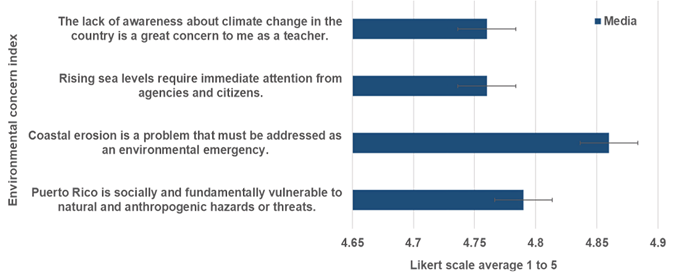
All items obtained average scores above 4.65, reflecting high concern about the effects of climate change, such as coastal erosion, sea level rise, and social vulnerability to natural and anthropogenic threats. The bars include margins of error.
Comparison of educational sectors
The Kruskal-Wallis test was used to perform this comparison. This test is a nonparametric method for determining whether these data groups come from the same population. The dependent variable was the general perception index, and the groups compared included teachers from the public and private sectors, as well as those responsible for homeschooling.
H was calculated to compare the average perceptions of climate change among participants from the different sectors and homeschooling. No statistically significant differences were found between the groups (H [2] = 3.00, p = 0.223), indicating that the general perception of climate change stays consistent across various educational sectors.
Correlation between experience and environmental concern
The Spearman correlation was performed to assess the relationship between years of teaching experience and individual climate concern. The result obtained was rs = -0.034, p = .748, indicating no significant relationship. To further the analysis, a composite index of environmental concern was constructed based on four premises related to vulnerability, urgency, and climate threats (see Table 2).
Table 2. Correlations between teaching experience and environmental concern
|
Table 2 presents the Spearman correlation coefficients between years of teaching experience and two indicators: a direct question about concern for climate change and the environmental concern index. The result obtained was rs = 0.011, p = .914. In both cases, the results obtained were not statistically significant (p ˃ 0.05), indicating that the level of environmental concern does not vary based on the professional experience of the respondents.
Association between the education sector and level of concern
The composite index values were classified into three levels: low, medium, and high concern (see Figure 4).
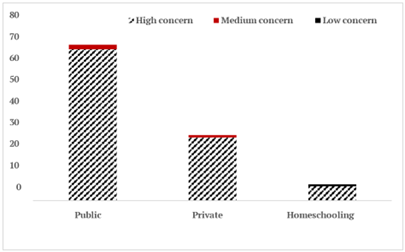
Figure 4 shows the distribution of environmental concern levels (high, medium, and low) according to the type of educational institution: public, private, and homeschooling. The majority of participants in the public sector (more than 65%) expressed high concern, while the private and homeschooling sectors reflect a lower relative proportion in this category. The Chi-square test of independence was used for this. The value obtained was χ2 (4) = 13.90, p = 0.008. These results support the finding of a significant difference between educational sectors regarding the level of concern about climate change (Plutzer et al., 2024).
Exploratory factor analysis
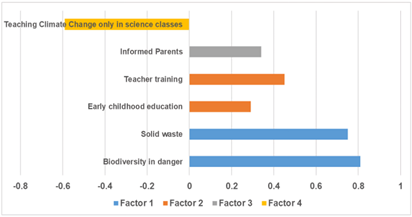
Table 3 presents descriptions of the four factors identified through exploratory factor analysis. Each dimension represents a grouping of assumptions that reflect different areas of perception about climate change. Factor 1 groups perceptions about physical and ecological impacts. Factor 2 includes attitudes toward teacher training and environmental curricula. Factor 3 relates to social and community awareness. Factor 4 addresses curricular assignment and academic preparation. These factors conceptually validate the structure of the instrument used.
Table 3. Factors identified through exploratory factor analysis
|
Figure 5 presents a selection of items that showed significant loadings in the exploratory factor analysis, organized by the four identified factors: factor 1 (blue–ecological impacts), factor 2 (orange–institutional environmental education), factor 3 (gray–community awareness), and factor 4 (yellow–curricular approach). The bars reflect the strength of association between each item and its corresponding factor. Loadings above ± 0.40 are considered significant. This graph supports the conceptual grouping of the dimensions measured in the instrument.
CONCLUSION
Climate change is a critical issue in our communities; however, in Puerto Rico, we lack sufficient information about how this phenomenon affects individuals and the perception of the Puerto Rican population regarding the issue. This study highlights the need to establish educational modules across the archipelago for public, private, homeschooling, and university schools to effectively raise awareness about how climate change can be mitigated locally. The results show a strong environmental perception among participants, particularly regarding the urgency of climate change and its impact on Puerto Rico. The instrument used demonstrated high internal consistency, allowing us to identify factors shaping teachers’ perceptions of environmental issues, from technical knowledge to curricular and social practices. No significant differences were found in the overall perception of educational sectors. However, significant differences emerged in levels of environmental concern, which should be addressed through public policies and tailored curricula relevant to students. The low concern observed in sectors like homeschooling highlights the urgent need to develop accessible resources, ongoing training, and educational campaigns targeting all parts of the education system. These findings support prioritizing climate education within teacher training and the broader education system in Puerto Rico, especially given the country’s vulnerability to the effects of climate change in the Caribbean.
Author contributions: KTSH: methodology, data collection, formal analysis, writing – original draft; CSPB: writing – review & editing, supervision; KTSH & CSPB: conceptualization, instrument design. Both authors have read and agreed to the published version of the manuscript.
Funding: No funding source is reported for this study.
Acknowledgments: The authors would like to thank the Committee of Experts and Advisors on Climate Change in Puerto Rico.
Ethical statement: The authors stated that the study involved an anonymous, voluntary survey of adult participants and posed minimal risk. Informed consent was obtained digitally before participation. According to institutional guidelines, ethics committee approval was not required for this type of study. No personally identifiable or sensitive data were collected, and all responses were stored securely and analyzed in aggregate form.
AI statement: The authors stated that they did not use generative AI or AI-based tools in the writing or analysis of this manuscript.
Declaration of interest: No conflict of interest is declared by the authors.
Data sharing statement: Data supporting the findings and conclusions are available upon request from the corresponding author.
References
- Abdul Rahman, H., Noraidi, A. A., Hj Khalid, A. N., Mohamad-Adam, A. Z., Zahari, N. H., & Tuming, N. E. (2025). Practical guide to calculate sample size for Chi-square test in biomedical research. BMC Medical Research Methodology, 25, Article 144. https://doi.org/10.1186/s12874-025-02584-4
- Bruin, J. (2006). Newtest: Command to compute new test. Statistical Consulting Group. https://stats.idre.ucla.edu/stata/ado/analysis
- Cavallo, E., Hoffmann, B., & Noy, I. (2023). Disasters and climate change in Latin America and the Caribbean: An introduction to the special issue. Economics of Disasters and Climate Change, 7, 135-145. https://doi.org/10.1007/s41885-023-00132-2
- Clayton, S. (2019). Psicología y cambio climático [Psychology and climate change]. Papeles del Psicólogo, 40(3), Article 167. https://doi.org/10.23923/pap.psicol2019.2902
- Climate Rights International. (2023). Right to life. Climate Rights International. https://cri.org/
- Cosh, S. M., Ryan, R., Fallander, K., Robinson, K., Tognela, J., Tully, P. J., & Lykins, A. D. (2024). The relationship between climate change and mental health: A systematic review of the association between eco-anxiety, psychological distress, and symptoms of major affective disorders. BMC Psychiatry, 24, Article 833. https://doi.org/10.1186/s12888-024-06274-1
- Crespo, W. I. (2022). Informe sobre el estado del clima de Puerto Rico: 2014-2021 resumen. Florida Tech. https://research.fit.edu/media/site-specific/researchfitedu/coast-climate-adaptation-library/latin-america-and-caribbean/puerto-rico-usvi-bvi/PRCCC.--2022.--Puerto-Rico-State-of-the-Climate-2014-2021-Executive-Summary.pdf
- Dayton, L., Balaban, A., Scherkoske, M., & Latkin, C. (2022). Family communication about climate change in the United States. Journal of Prevention, 44(4), 373-387. https://doi.org/10.1007/s10935-022-00712-0
- Eckstein, D., Künzel, V. & Schäfer, L. (2021). Global climate risk index 2021. Germanwatch e.V. https://www.germanwatch.org/en/node/19777
- Fontaine, J. R. J. (2005). Equivalence. In K. Kempf-Leonard (Ed.), Encyclopedia of social measurement (pp. 803-813). Elsevier. https://doi.org/10.1016/b0-12-369398-5/00116-x
- George, D., & Mallery, P. (2003). SPSS for Windows step by step: A simple guide and reference, 11.0 update (4th ed.). Allyn & Bacon.
- Gianfredi, V., Mazziotta, F., Clerici, G., Astorri, E., Oliani, F., Cappellina, M., Catalini, A., Dell’Osso, B. M., Pregliasco, F. E., Castaldi, S., & Benatti, B. (2024). Climate change perception and mental health. results from a systematic review of the literature. European Journal of Investigation in Health, Psychology and Education, 14(1), 215-229. https://doi.org/10.3390/ejihpe14010014
- Hayes, K., Blashki, G., Wiseman, J., Burke, S., & Reifels, L. (2018). Climate change and mental health: Risks, impacts and priority actions. International Journal of Mental Health Systems, 12, Article 28. https://doi.org/10.1186/s13033-018-0210-6
- Looney, S. W., & Hagan, J. L. (2011). Statistical methods for assessing biomarkers and analyzing biomarker data. In C. R. Rao, J. P. Miller, & D. C. Rao (Eds.), Essential statistical methods for medical statistics (pp. 27-65). Elsevier. https://doi.org/10.1016/b978-0-444-53737-9.50005-0
- McClenaghan, E. (2024). The Kruskal-Wallis test. Informatics From Technology Networks. https://www.technologynetworks.com/informatics/articles/the-kruskal-wallis-test-370025
- Ndetei, D. M., Wasserman, D., Mutiso, V., Shanley, J. R., Musyimi, C., Nyamai, P., Munyua, T., Swahn, M. H., Weisz, J. R., Osborn, T. L., Bhui, K., Johnson, N. E., Pihkala, P., Memiah, P., Gilbert, S., Javed, A., & Sourander, A. (2024). The perceived impact of climate change on mental health and suicidality in Kenyan high school students. BMC Psychiatry, 24(1), Article 117. https://doi.org/10.1186/s12888-024-05568-8
- Nistor, L. (2024). The perception of Romanian College students regarding climate change. Journal of Comparative Research in Anthropology and Sociology, 15(1), 81-104. https://doi.org/10.62229/cmp1_24/4
- Plutzer, E., Branch, G., & Townley, A. L. (2024). Climate change education in U.S. middle schools: Changes over five pivotal years. Journal of Microbiology & Biology Education, 25(2), Article e00015-24. https://doi.org/10.1128/jmbe.00015-24
- Rivera, F. I. (2020). Puerto Rico’s population before and after Hurricane Maria. Population and Environment 42(2), 1-3. https://doi.org/10.1007/s11111-020-00356-4
- Rodríguez Pacheco, F. L., Mejía Rodríguez, D. L., & Sánchez Buitrago, J. O. (2022). Conocimientos y percepciones sobre el cambio climático en estudiantes universitarios [Knowledge and perceptions about climate change among university students]. Diversitas: Perspectivas en Psicología, 18(1). https://doi.org/10.15332/22563067.6305
- Rodríguez, V. (2024). Desplazadas por las olas: Comunidades en Arecibo batallan contra la erosión costera [Displaced by the waves: Communities in Arecibo battle coastal erosion]. Centro de Periodismo Investigativo. https://periodismoinvestigativo.com/2024/08/desplazadas-comunidades-arecibo- batalla-erosion-costeras/
- Trost, K., Ertl, V., König, J., Rosner, R., & Comtesse, H. (2024). Climate change-related concerns in psychotherapy: Therapists’ experiences and views on addressing this topic in therapy. BMC Psychology, 12(1), Article 192. https://doi.org/10.1186/s40359-024-01677-x
- Universidad de los Andes. (2023). Importancia de la educación ambiental actualmente: Estrategias y casos de éxito [Importance of environmental education today: Strategies and success stories]. Universidad de los Andes. https://programas.uniandes.edu.co/blog/educacion-ambiental
- Vázquez, G. I. (2025). Investigación lo confirma: Más del 50% de los Puertorriqueños ha sufrido algún trauma por eventos climáticos [Research confirms it: More than 50% of Puerto Ricans have suffered some trauma due to climate events]. El Nuevo Día. https://www.elnuevodia.com/ciencia-ambiente/cambio- climatico/notas/investigacion-revela-que-mas-del-50-de-los-puertorriquenos-ha-sufrido-algun-trauma-por-un-evento-atmosferico/
- World Health Organization. (2023). Climate change. WHO. https://www.who.int/news-room/fact-sheets/detail/climate-change-and-health
- Wuebbles, D. J., Easterling, D. R., Hayhoe, K., Knutson, T., Kopp, R. E., Kossin, J. P., Kunkel, K. E., LeGrande, A. N., Mears, C., Sweet, W. V., Taylor, P. C., Vose, R. S., & Wehner, M. F. (2017). Our globally changing climate. In Climate Science Special Report: Fourth National Climate Assessment, Volume I. In D. J. Wuebbles, D. W. Fahey, K. A. Hibbard, D. J. Dokken, B. C. Stewart, & T. K. Maycock (Eds.), U.S. Global Change Research Program (pp. 35-72). https://doi.org/10.7930/J08S4N35
How to cite this article
APA
Soto Hidalgo, K. T., & Perez Burgos, C. S. (2026). Perception of climate change among science educators in public, private, and homeschooling schools in Puerto Rico. Interdisciplinary Journal of Environmental and Science Education, 22(2), e2612. https://doi.org/10.29333/ijese/18103
Vancouver
Soto Hidalgo KT, Perez Burgos CS. Perception of climate change among science educators in public, private, and homeschooling schools in Puerto Rico. INTERDISCIP J ENV SCI ED. 2026;22(2):e2612. https://doi.org/10.29333/ijese/18103
AMA
Soto Hidalgo KT, Perez Burgos CS. Perception of climate change among science educators in public, private, and homeschooling schools in Puerto Rico. INTERDISCIP J ENV SCI ED. 2026;22(2), e2612. https://doi.org/10.29333/ijese/18103
Chicago
Soto Hidalgo, Keyla T., and Claudia S. Perez Burgos. "Perception of climate change among science educators in public, private, and homeschooling schools in Puerto Rico". Interdisciplinary Journal of Environmental and Science Education 2026 22 no. 2 (2026): e2612. https://doi.org/10.29333/ijese/18103
Harvard
Soto Hidalgo, K. T., and Perez Burgos, C. S. (2026). Perception of climate change among science educators in public, private, and homeschooling schools in Puerto Rico. Interdisciplinary Journal of Environmental and Science Education, 22(2), e2612. https://doi.org/10.29333/ijese/18103
MLA
Soto Hidalgo, Keyla T. et al. "Perception of climate change among science educators in public, private, and homeschooling schools in Puerto Rico". Interdisciplinary Journal of Environmental and Science Education, vol. 22, no. 2, 2026, e2612. https://doi.org/10.29333/ijese/18103